
4 Rules That Decide Who Pays When a Tree Falls on a New York Neighbor’s House

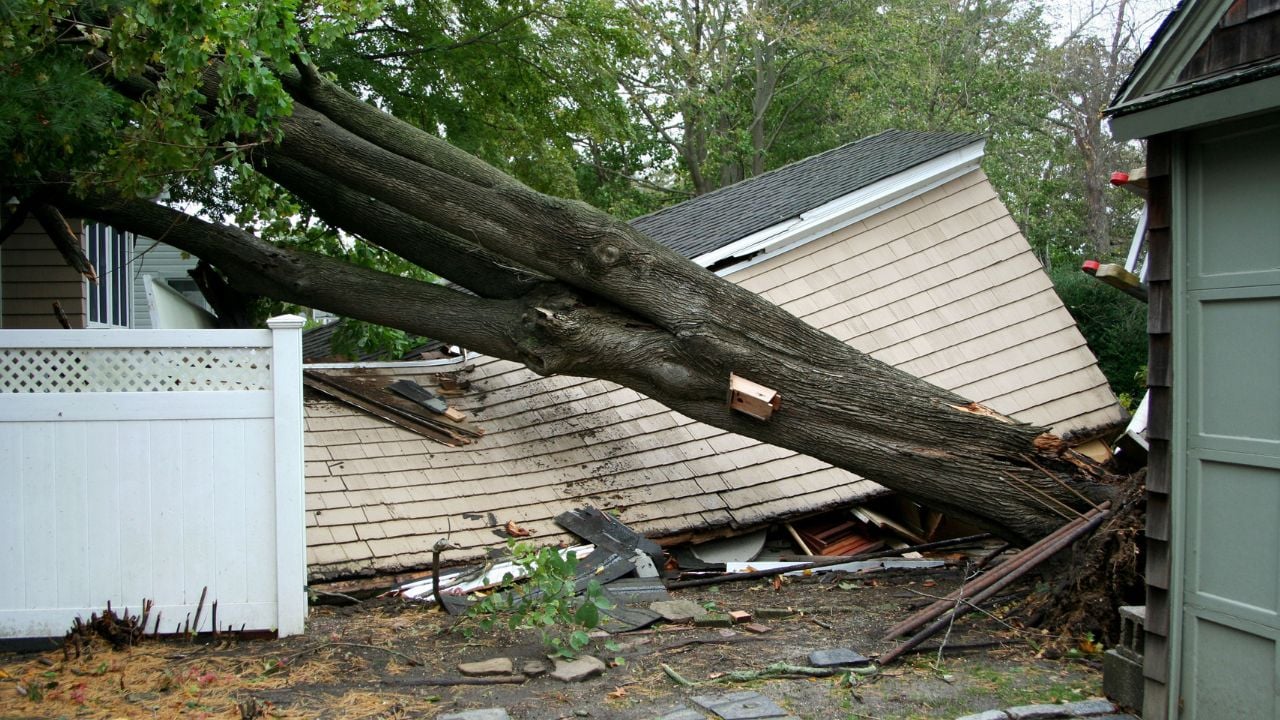
A big storm can leave a neighbor’s tree on your roof, or yours on theirs.
For New Yorkers, who pays doesn’t always come down to whose yard the tree grew in.
Here are the rules that decide who’s responsible.
Note: This is general information, not legal or insurance advice. Court rulings, statutes and policy terms are subject to change, so talk to an attorney or your insurer about your situation.
1. Actual or Constructive Notice
Under New York law, a tree owner generally isn’t liable for a tree that falls off the property unless the owner knew, or should have known, the tree was defective.
In Ivancic v. Olmstead, a limb from a neighbor’s maple came down in a 1980 windstorm in Fultonville and injured a man working on his truck in his parents’ driveway.
In 1985, New York’s highest court, the Court of Appeals, affirmed the Appellate Division’s order.
The court found no competent evidence that the neighbor should have known the tree was defective.
If a neighbor’s tree hits your roof, you carry the burden of proof.
2. Readily Observable Decay
A limb from a homeowners’ tree fell onto a car on New Rochelle Road in Eastchester in 2016.
The case, Sasso v. Village of Bronxville, reached a New York appeals court, the Appellate Division, Second Department.
In a 2022 ruling, the court sided with the homeowners.
It also dismissed the claims against the Town of Eastchester.
At least for adjoining landowners, there’s no duty to keep checking every tree for decay nobody can see.
The decay has to be readily observable before the owner must take reasonable steps to prevent harm.
Under that ruling, if your tree shows decay anyone could spot from the ground, you’re expected to know about it.
The State’s List of Tree Warning Signs
New York’s Department of Financial Services says to consider removing or pruning a tree that shows signs of decay.
Forked, dead or diseased trunks are on the list.
The list also names branches with dead tips, disease or rot, and mounds or divots near the roots.
That list is the state’s advice for tree owners like you, not the court’s test.
3. Danger on Neighboring Land
After a thunderstorm in 2000, an 80-foot tree on Clarkstown town land tilted toward a homeowner’s property.
The homeowner left a town road maintenance supervisor a voicemail about it.
The next morning, he saw the tilt had grown and left a second message.
The tree fell that day.
It landed on a car parked in the homeowner’s driveway and killed the man waiting inside.
He apparently had been waiting to pick up his wife after she finished working.
In Galindo v. Town of Clarkstown, the Court of Appeals ruled in 2004 that the homeowner owed no duty to warn the man waiting in the car.
The town, which owned the land the tree stood on, settled the claim against it.
As a general matter, an owner of land owes no duty to warn or protect others from a dangerous condition on neighboring property.
You’d generally owe a duty only for a danger you created or contributed to.
4. Three Years to Sue
Under New York’s Civil Practice Law and Rules, you generally have three years to sue a neighbor over a fallen tree’s damage to your property.
A claim against a village or town runs on a shorter clock, one year and 90 days under the General Municipal Law.
A wrongful death claim against a village or town gets two years after the death.
Liability Coverage and Deductibles
If your tree damages a neighbor’s house, New York’s Department of Financial Services says your homeowners policy typically covers your personal liability for property damage caused by your negligence.
If wind brings a tree down on your house instead, a windstorm deductible, if your policy has one, applies to any windstorm loss.
That deductible commonly ranges from 1% to 5% of either the dwelling’s value or the amount of insurance on it.
There’s also a separate hurricane deductible for hurricane losses.
A deductible is the amount of loss you have to cover before you’re eligible for an insurance payment.
Say your home is insured for $300,000 and carries a 2% windstorm deductible.
On $9,000 of damage, you’d pay the first $6,000 and the insurer would pay the other $3,000.
Psst! How much do you know about storm damage claims? Take our quiz and see if you can ace it.
Quiz
Storm Damage Claim IQ
Answer these questions on New York homeowners insurance and storm damage. We bet you can’t get them all right. Prove us wrong?
A storm drops a limb on the car in your driveway. What does New York’s insurance regulator say about your homeowners policy?
Village-Owned Trees
A tree that hits your house might belong to a village instead of a neighbor, and the same notice test still applies.
In Harris v. Village of East Hills, a limb from a silver maple on village land fell on a passing car in 1971.
In 1977, the Court of Appeals found constructive notice.
A reasonable inspection would have revealed the dangerous condition.
The court said a village has a clear duty to maintain and inspect trees on village property beside county roads.
That duty is nondelegable, meaning the village can't hand the job off to anyone else.
Before you can sue a village, the General Municipal Law generally requires a notice of claim, and you have ninety days after the claim arises to deliver it.
7 Well and Septic Rules That Catch Upstate New York Buyers Off Guard

Buying a home on a well and septic system comes with checks that many buyers on public water and sewer don't have to make.
Do you know how to check either one before closing on an Upstate home?
7 Well and Septic Rules That Catch Upstate New York Buyers Off Guard
8 Tops Markets Policies New Yorkers Only Learn About at the Register

Halfway through checkout at Tops Markets, a familiar routine can bump into a rule you've never heard of.
These are the Tops Markets rules some New Yorkers meet for the first time at the register.
8 Tops Markets Policies New Yorkers Only Learn About at the Register
