
One Cheap Beef Cut Jumped More Than Steak Since 2020. Hoosiers, Can You Guess It?

Beef night costs a lot more than it used to.
But not all beef prices have risen the same.
National price data shows some cuts have climbed faster than others, and Hoosiers are noticing the difference at the meat case.
Here’s how the cuts compare, from the biggest jump to the smallest.
1. Ground Beef
Ground beef rose 65.7%, the biggest jump among the six cuts here.
The U.S. Bureau of Labor Statistics (BLS) put 100% ground beef at $4.177 a pound across U.S. cities in August 2020.
In August 2026, it was $6.923.
That’s $2.75 more a pound.
Put another way, $100 of ground beef in 2020 now costs about $166.
Ground beef was the cheapest of the six cuts in August 2020. So a smaller dollar rise still gave the biggest percentage.
Two pounds cost $8.35 in August 2020. In August 2026, you’d pay $13.85.
2. Sirloin Steak
If you buy sirloin steak, you’d pay $5.48 more a pound than in August 2020.
No other cut here rose that much in dollars.
Boneless sirloin averaged $8.875 in August 2020 and $14.357 in August 2026. That makes it the priciest of the six.
Its 61.8% rise ranks second, behind ground beef.
Two pounds went from $17.75 to $28.71.
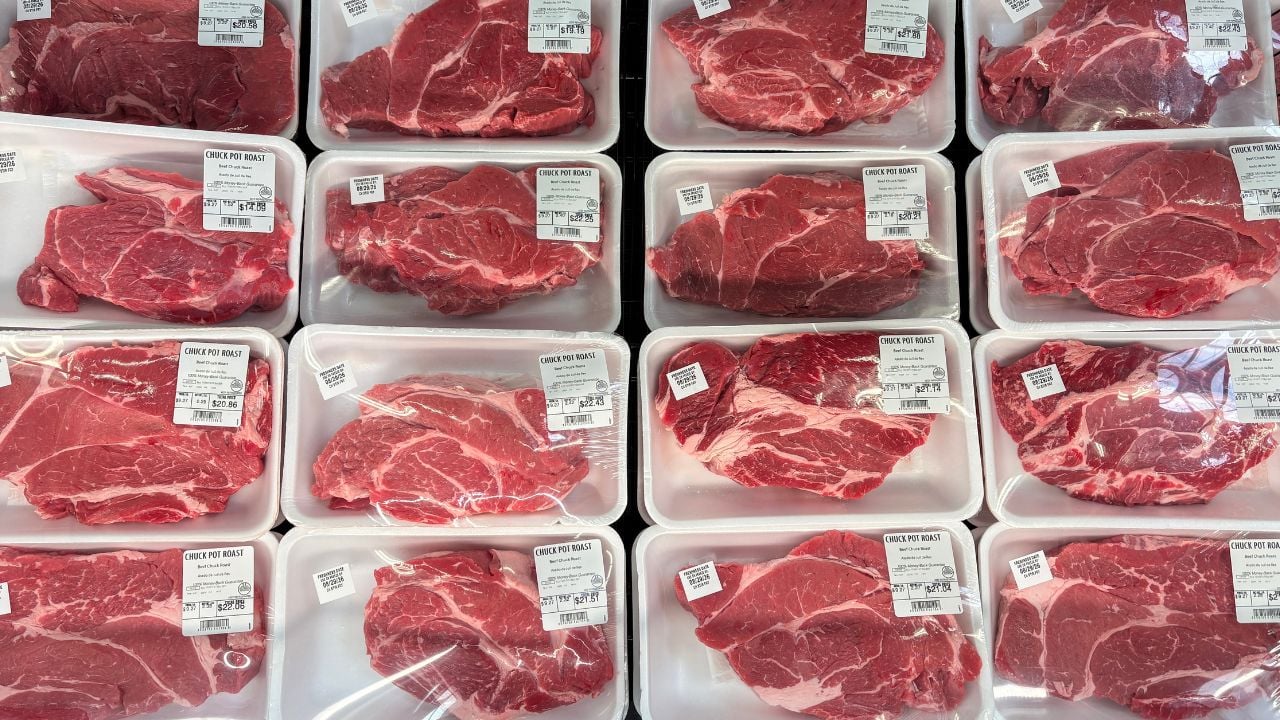
3. Chuck Roast
At average prices, a three-pound chuck roast would have cost you $17.92 in August 2020.
In August 2026, you’d pay $28.34.
That’s $10.42 more.
Per pound, the average went from $5.972 to $9.448, a 58.2% rise. Only sirloin steak rose more in dollars per pound.
4. Round Roast
A pound of beef round roast averaged $8.959 in August 2026. In August 2020, it was $5.668.
The 58.1% rise trails chuck roast by just 0.1 percentage point.
Buy three pounds and you’d pay $26.88 at the 2026 average. At the 2020 average, it was $17.00.
Round roast still costs you $5.40 a pound less than sirloin steak.
Psst! How well do you know the beef aisle? Flip these cards and see how many you get right.
5. Round Steak
Round steak rose 47.3%, the second smallest increase among these beef cuts.
Beef round steak averaged $6.579 a pound in August 2020 and $9.692 in August 2026.
Two pounds would have cost you $13.16 in August 2020 and $19.38 in August 2026.
That’s $6.22 more.
6. Beef for Stew
Two pounds of stew meat cost you $11.99 in August 2020 and $17.17 in August 2026.
Beef for stew rose the least of the six cuts, up 43.2%. The average went from $5.995 a pound to $8.587.
In dollars, you’d pay $2.59 more per pound, also the smallest rise on the list.
Even the smallest rise is big. Stew beef that cost $10 in 2020 now costs about $14.32.
Midwest Ground Beef
Ground beef rose faster in the Midwest than in the country as a whole, 77.4% against 65.7%.
The Midwest average went from $3.818 a pound in August 2020 to $6.773 in August 2026.
The region started lower.
Midwest ground beef is still cheaper than the national average, but the gap shrank from 36 cents to 15 cents a pound.
If you live in Indiana, your state is one of 12 in the bureau’s Midwest region, along with Illinois, Ohio and Michigan.
The August 2026 regional table also lists Midwest chuck roast at $9.359 a pound and Midwest sirloin steak at $13.169.
Midwest round roast comes in at $8.833.
Those are regional averages, so the price at your store could be higher or lower.
A Smaller Cattle Herd
The country had 28.5 million beef cows on July 1, 2026, down 1% from a year earlier, according to the National Agricultural Statistics Service.
That means a few fewer cows.
The 2026 calf crop was estimated at 32.5 million head, down 2% from 2025.
Meanwhile, the Economic Research Service (ERS) says federally inspected beef production was about 2% lower than a year earlier.
It expects production to stay below year-ago levels through the end of 2026.
Fewer cows mean less beef.
If you’re wondering why you pay more for it, a smaller supply is part of the answer.
The 2026 Forecast
ERS forecasts beef and veal prices will rise 9.4% in 2026. On $100 of beef, that’s about $9.40 more.
The forecast range is 7.4% to 11.6%.
Food at home, the grocery category, is forecast to rise 2.4%. So the beef forecast is nearly four times the grocery forecast.
Beef and veal prices were already 5.9% higher in August 2026 than in August 2025.
Where the Prices Come From
Every beef price in this article is a BLS average. It’s built from the price observations behind the Consumer Price Index (CPI).
The U.S. figures are city averages, and the Midwest figure is a regional average.
At the national level, the bureau publishes about 70 average prices for food items.
These beef cuts are six of them.
How the Beef Percentages Work
Each beef percentage here comes from one formula: The August 2026 price minus the August 2020 price, divided by the August 2020 price.
For ground beef, $6.923 minus $4.177 is $2.746. And $2.746 divided by $4.177 is 0.657.
That rounds to 65.7%. Every percentage here rounds to the nearest tenth.
The bureau also cautions that average prices aren’t estimates of price change.
Sample rotation and quality changes can make average prices move differently from the CPI. So these percentages show how the averages changed.
Indiana’s Cattle
Beef starts with cattle.
Indiana had 820,000 cattle and calves on Jan. 1, 2026, according to the National Agricultural Statistics Service.
Hogs outnumber them, with 4.45 million hogs on Indiana farms in December 2025. That’s more than five times as many.
Still, if you live in Indiana, your state had about 1% of the 86.2 million head on U.S. farms that day.
9 Cold Medicine Labels Hoosiers Read Completely Wrong

Indiana caps a single cold medicine buyer at 7.2 grams of pseudoephedrine every 30 days, while federal law allows nine grams.
A single day’s purchase is capped at 3.6 grams, and a year’s total at 61.2 grams.
9 Cold Medicine Labels Hoosiers Read Completely Wrong
5 Things Hoosiers Do Without Realizing It’s Not Normal Anywhere Else
In Indiana, a family that comes up short on rent can ask an elected township trustee for help.
Try describing that to a friend in another state.
5 Things Hoosiers Do Without Realizing It’s Not Normal Anywhere Else
