
4 Things Wisconsin Cranberry Growers Do After the Bogs Are Flooded

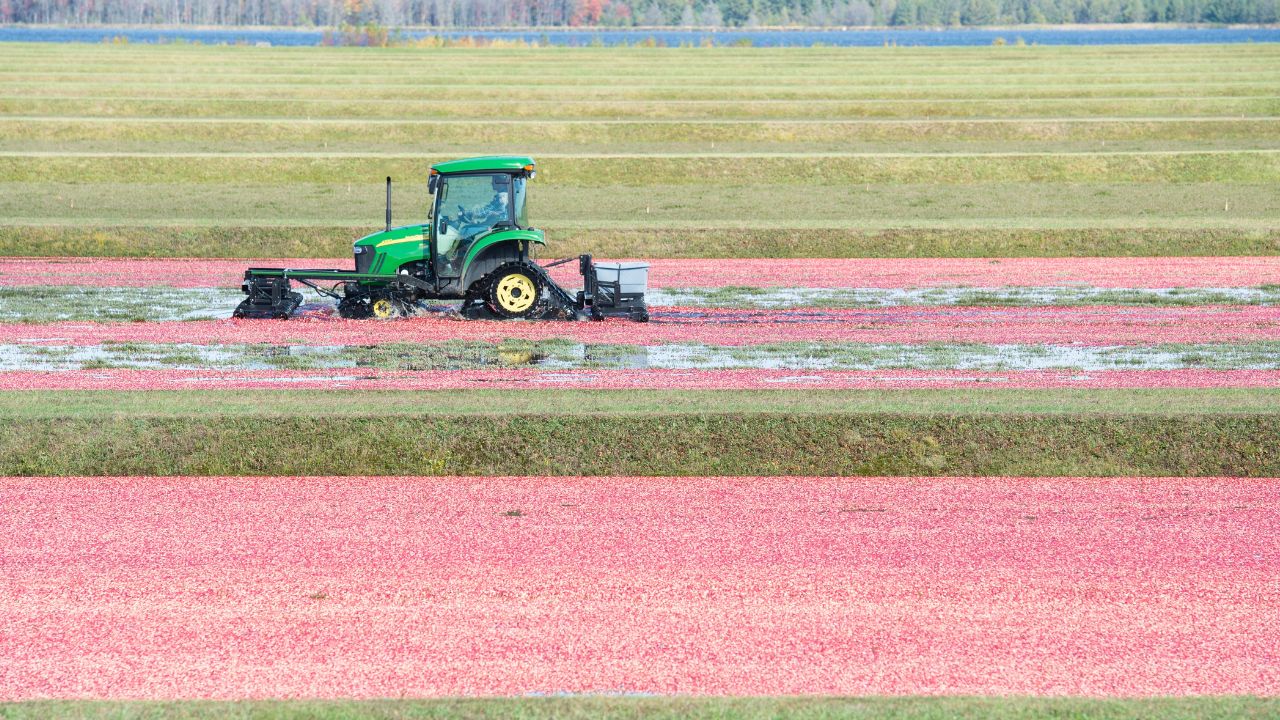
A flooded bog full of red berries is one of fall’s best sights in central Wisconsin.
For growers, that pretty picture is where some of the hardest work begins.
Here’s what Wisconsin cranberry growers do once the water’s in.
1. Harrowing the Berries Loose
Cranberry growers who wet-harvest run a machine with a circular beater through the flooded bed to remove the berries from the vines, according to T.R. Roper, a University of Wisconsin-Madison Extension horticulturist.
At Glacial Lake Cranberries in central Wisconsin, NBC 26 reported in 2019, a harrower raked the berries off the vines.
At Gottschalk Cranberry in Wisconsin Rapids, CBS 58 reported in 2017, a harrow cut the berries off the vines.
Once the berries are loose, you have fruit that floats.
Each berry holds a pocket of air, the Wisconsin State Cranberry Growers Association says, so it floats to the surface of a flooded marsh.
Glacial Lake then pumped in more water so the berries could float freely across the bog.
2. Gathering Berries With a Boom
Cranberry growers who wet-harvest corral the floating berries into a corner of the bed, and the berries then go out of the bed to a waiting truck.
At Glacial Lake Cranberries, NBC 26 reported, workers placed a boom on top of the flooded bog to surround the berries.
From there, you pull the boom slowly toward one corner of the bog, as Glacial Lake’s workers did, pushing the berries along and tightening the boom.
At Gottschalk Cranberry, CBS 58 described tractors and a boom gathering the berries in one place in 2017.
At Glacial Lake, a loader and a truck waited while workers pushed the berries and tightened the boom.
3. Pumping and Separating
Cranberry growers who wet-harvest convey or pump the berries out of the bed, according to Roper.
At Gottschalk Cranberry, CBS 58 reported in 2017, a berry pump lifted berries and water out of the bog.
Fawn Gottschalk, the farm’s co-owner, compared the pump to a giant vacuum cleaner.
At Gottschalk, the berries were sprayed off with water just before they came out of the chute into the truck.
If you’re wondering where the leaves went, they left with the water through another pipe.
The water then went back into the bog.
4. Trucking to Receiving Stations
At Glacial Lake Cranberries, a truck takes the berries from the bog to the receiving station, NBC 26 reported.
By CBS 58’s 2017 account, Gottschalk Cranberry sold its berries on to Ocean Spray for processing.
At Gottschalk, you could spend eight hours from start to finish harvesting a single six-acre bog.
Psst! How much do you know about cranberry growing? Take our quiz and see if you can ace it.
Quiz
Cranberry Country IQ
Answer nine questions on cranberry history, weather, and farming. We bet you can’t get them all right. Prove us wrong?
A frost in which month of 1904 cost Wisconsin more than half of its cranberry crop?
Foot Traffic in the Bogs
Cranberry growers keep walking and travel in their bogs to a minimum, the University of Wisconsin-Madison Division of Extension's cranberry outreach specialist says.
Growers don't drive on the bogs.
Soil compaction worries them, and they want to avoid harming their perennial vines.
A cranberry takes 18 months to grow.
Blossoms come in June, and fruit sets in July and August while the following year's buds are developing.
That means the berries you see in July and August share their vines with the following year's buds.
A chewing insect or a freeze can cost a grower that crop potential.
Winter Ice
Cranberry growers raise a winter flood when a deep cold snap is expected to last a couple of days, according to the Extension specialist.
The goal is 12 to 18 inches of ice, and the water is then drained out from underneath.
The Wisconsin State Climatology Office says a layer of ice forms over flooded bogs and keeps the water temperature consistently around 28 degrees.
The water is drained before the spring growing season so the plants can flower and produce fruit.
If warm winter weather keeps the ice from forming, plants become susceptible to temperatures too cold for them to survive.
If you pass a cranberry marsh in winter and see a sheet of ice, you may be looking at that layer.
Sanding the Ice
Roughly every fifth year, cranberry growers do an operation called sanding, spreading a layer of sand across the ice, the Extension specialist says.
A dump truck can put out a finely screened layer a quarter inch to half inch deep.
Sanding triggers a hormonal signal in the vines, and they send out runners that put down fresh roots.
You can think of it the way the specialist does, as the cranberry grower's equivalent of pruning that keeps fresh tissue on the vines.
2026 Crop Forecast
Wisconsin's cranberry growers account for roughly 61 percent of the national forecast, with 4.8 million of the 7.87 million barrels in the U.S. Department of Agriculture's August 2026 Crop Production report.
The report lists four states, Massachusetts, New Jersey, Oregon and Wisconsin, and Wisconsin's forecast is the largest of them.
You can see how far ahead that is from Massachusetts, the next-largest state at 1.9 million barrels.
The Wisconsin State Climatology Office says approximately 250 growers produce most of the state's cranberry crop, primarily on family farms, covering roughly 20,000 acres.
What a Cranberry Barrel Weighs
The U.S. Department of Agriculture's Crop Production report measures cranberries in barrels.
The report's footnote says a barrel weighs 100 pounds.
Multiply it out, and Wisconsin's forecast of 4.8 million barrels comes to about 480 million pounds of cranberries.
Soil Under the Bogs
Most of the cranberry counties in central Wisconsin have thick sandy soil, according to the Wisconsin State Climatology Office.
That soil covered the lakebed of a large lake that formed at the end of the last Ice Age.
The office says the layers of sand and gravel there are relatively flat and poorly drained, which allowed acidic soil to develop.
Contrary to popular belief, cranberry vines don't grow in water.
They grow only in well-drained dry marshes with sandy soils, so the water you see at harvest time is there for the harvest, not for the vines to grow in.
Harvest Season
Cranberry growers typically harvest from late September through October, according to the Wisconsin State Climatology Office, and the season can sometimes extend into mid-November.
The Wisconsin State Cranberry Growers Association's Cranberry Highway is a self-guided drive that runs 50 miles across central Wisconsin, from Wisconsin Rapids to Warrens.
The association's tour listings for 2026 included Wetherby Cranberry Company's Harvest Days in Warrens, where you could put on waders and walk into the floating cranberries.
9 Vintage Kitchen Items Wisconsinites Should Inspect Before Buying
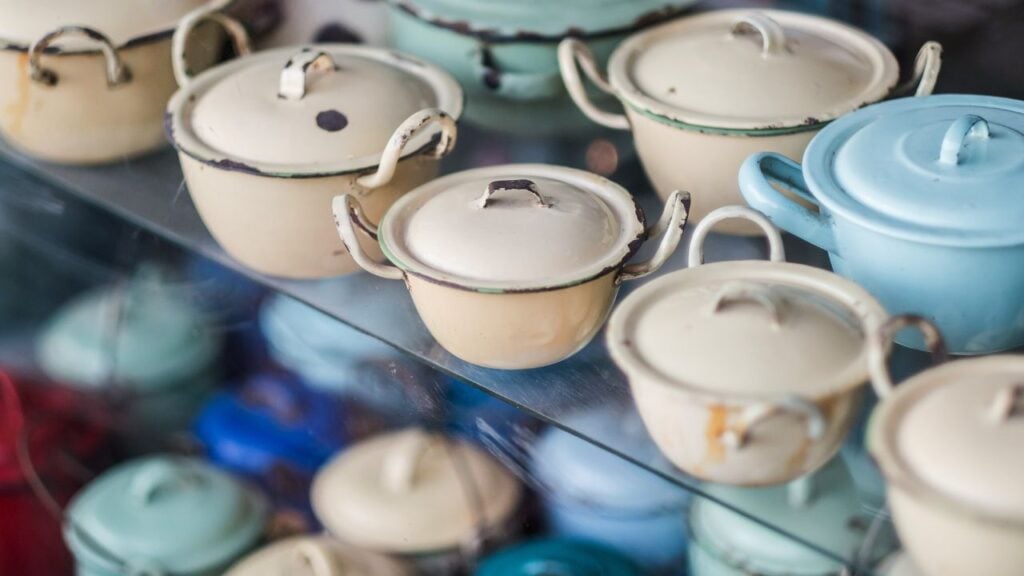
That hand-me-down casserole dish looks tempting, but you'd want to check it first.
Old kitchen finds can be worth the hunt, but a few quick checks first can save you trouble later.
9 Vintage Kitchen Items Wisconsinites Should Inspect Before Buying
9 Account Recovery Settings Wisconsinites Should Fix Before They Need Them

You set up a Gmail account or an Apple ID once, and the recovery settings underneath it rarely get a second look.
Those settings decide whether you get back in when you lose access.
9 Account Recovery Settings Wisconsinites Should Fix Before They Need Them
