
6 Kentucky Amusement Parks Kentuckians Still Talk About

Ask Kentuckians about summers as a kid, and an amusement park might come up fast.
Some of those parks are still open, while others are long gone, remembered in old photos and family stories.
Here’s a look back at the parks people still talk about.
1. Fontaine Ferry Park
Louisville’s Fontaine Ferry Park opened in 1905 and grew to more than fifty rides, including four wooden roller coasters.
A large swimming pool and a skating rink gave you plenty to do between rides.
Not everyone got that choice.
The park stayed segregated until 1964, when it began admitting Black visitors.
A riot broke out on opening day in 1969, and the park closed that year.
Fontaine Ferry Park After 1969
The grounds stayed in use after the park closed.
Louisville TV station WHAS reports that Ghost Town on the River ran there from 1972 to 1975.
River Glen Park followed in 1975 and burned down a year later.
The city took control of the property in 1981.
2. Joyland Park
The Kentucky Historical Society calls Joyland Park Fayette County’s largest amusement park for nearly 40 years.
It opened in 1923 along Paris Pike on Lexington’s north side and shut down fully in August 1963.
Its most popular attraction was the Wildcat roller coaster, built in the late 1920s.
Weekday admission was free, but you paid for the rides, food and games.
If you wanted to cool off, the park had what the society calls the first public swimming pool in Fayette County.
A kiddie railroad, a midway and the Club Joy Dance and Casino filled out the grounds.
That pool had a catch.
White children got free swimming lessons there, while Black children were excluded.
Several times a year, the owners invited the orphans of Lexington to play games and ride for free.
3. Kentucky Kingdom
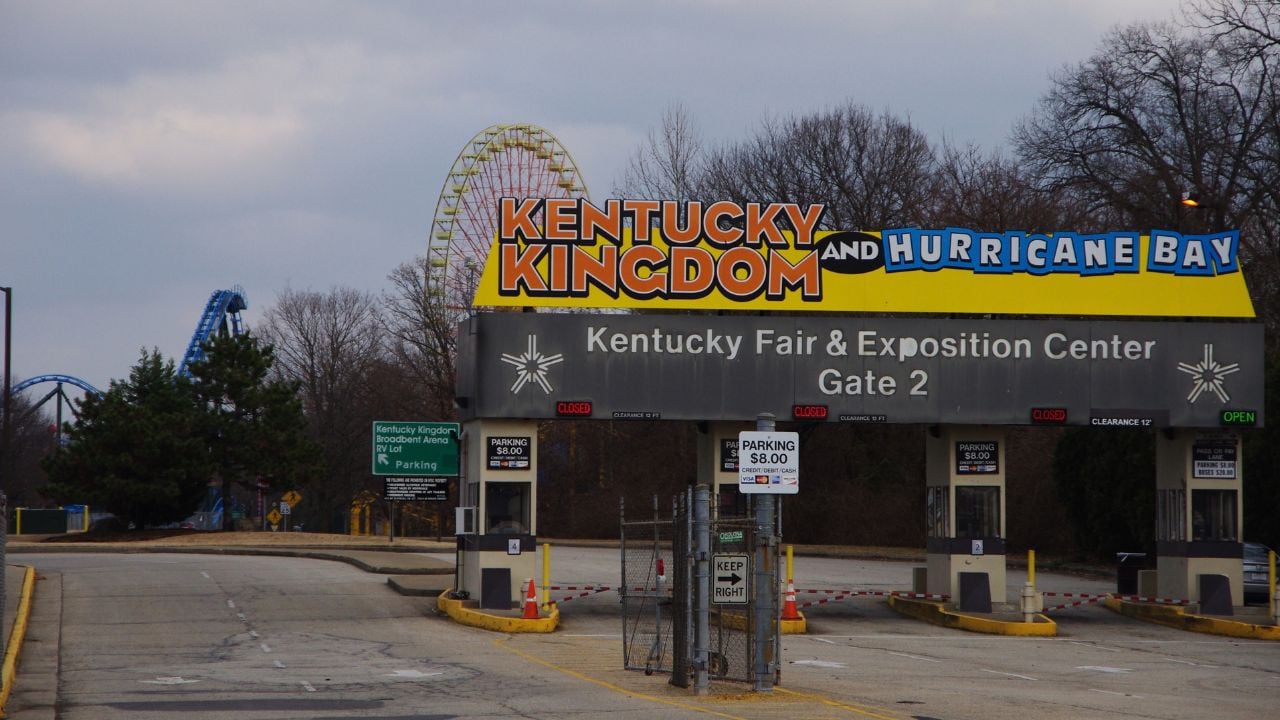
The Kentucky State Fair Board announced a theme park for the Kentucky Fair and Exposition Center grounds, and Kentucky Kingdom opened there in 1987.
The park spent about a decade as Six Flags Kentucky Kingdom before it closed in 2009.
It didn’t stay shut.
In 2014, it reopened after a $44 million redevelopment that doubled the size of the Hurricane Bay water park.
In 2021, the Herschend Family Entertainment company became the majority owner and main operator of Kentucky Kingdom and Hurricane Bay.
If you haven’t been back since the Six Flags days, a 2021 trade report described a 65-acre complex with a theme park and a water park.
If you want a newer thrill, TV station WDRB called Flying Fox the park’s first new coaster since 2019.
Psst! How much do you know about the Kentucky State Fair and the state’s other big attractions? Take our quiz and see if you can ace it.
Quiz
Kentucky Attractions Quiz
Answer these questions on the State Fair, Mammoth Cave, Kentucky Dam and Cumberland Falls. We bet you can’t get them all right. Prove us wrong?
The Kentucky State Fair traces its beginnings to what year?
4. Ludlow Lagoon
Pleasant Run Creek was dammed to build the lake at Ludlow Lagoon, a Northern Kentucky amusement park that opened in 1895.
The lake was so large that five islands dotted its surface, and the park housed a 100-foot Ferris wheel on an island.
A scenic railway roller coaster ran over the water.
If you visited in those years, you'd have found a $10,000 merry-go-round, a 2,500-seat amphitheater and a Japanese Fair with an authentic teahouse.
Then came the setbacks.
A flood in 1913 damaged many of the park's attractions.
That July, a driver lost control of his motorcycle at the park's racetrack and veered into the stands, and nine people were killed.
A tornado in 1915 added more than $20,000 in damage.
The park sold beer, and when the federal government halted beer manufacturing during World War I, the Northern Kentucky Tribune says the loss of those sales proved the final blow.
5. Kaintuck Territory
Local historian Justin Lamb describes Kaintuck Territory in Marshall County Daily as an amusement park built as a re-creation of an 1880s settlement.
It sat on 150 acres along U.S. Highway 641 near Kentucky Dam in Marshall County.
It opened for business on June 12, 1967, with hourly gunfight vignettes of the American Frontier.
A train, a silent movie house and stagecoaches filled the gaps, along with knife throwers, ventriloquists and magicians.
Your day there could also include motocross races and a natural amphitheater with three stages.
Then the economy turned.
By 1979, the stagnant economy and the national gas crisis had forced Walter Sill to file for bankruptcy.
He soon sold the park to an out-of-state company, which eventually closed it.
Before that, if you wanted a concert, the theater the park added in 1976 drew country, rock and pop acts, including Loretta Lynn, Jerry Lee Lewis and the Monkees.
6. Beech Bend
Beech Bend in Bowling Green is an amusement park with carnival rides, a wooden roller coaster and a water park.
It began as a picnic area, and Western Kentucky University's digital exhibit says William Helm Brashear owned it that way from 1880 until 1942.
Then Charles Garvin took over and added rides, a roller skating rink, a dance hall and a swimming pool.
Racing became a popular activity there in the 1950s, and the park boomed in the 1960s with a zoo, more carnival rides and a bigger campground.
Ownership kept changing.
In 1980, a group that included musician Ronnie Milsap bought the park and held it until 1982.
In 1984, Dallas and Alfreda Jones bought the racetracks and began hosting drag-race events, and over the next three years they bought the rest of the park.
A $4.4 million wooden coaster, the Kentucky Rumbler, was set to open there in April, the Bowling Green Daily News reported in October 2005.
If you want to ride it yourself, it's open May through September.
Bowling Green station WNKY reported in 2024 that Splash Lagoon has water slides and a tiki bucket that dumps water.
Parks That Became Neighborhoods
Two parks became neighborhoods.
At Joyland, the Club Joy dance hall caught fire in 1964 and was damaged beyond repair, the society says, and it was torn down.
After the park shut down, developers bought the land and bulldozed the park.
Developers built Mary Todd Elementary School and a bowling alley on the land, and the neighborhood around them was named the Joyland Subdivision.
The Lexington Public Library's 2019 podcast says the land is now the site of several subdivisions.
If you live on Lake, Laurel, Stokesay, Deverill or Ludford streets in Ludlow, you're in the neighborhood built where Ludlow Lagoon once stood.
The Tribune reported in 2016 that the old clubhouse still stood at the corner of Lake and Laurel streets, restored as a home.
The Kenton County Public Library adds that the grounds later housed a city incinerator and a refuse dump.
A Wild West Attraction for Sale
Kentucky's Guntown Mountain first opened to the public in 1969 as a Wild West attraction in Cave City, according to Bowling Green station WBKO.
It has had several owners.
A Century 21 listing says it closed in 2013, then returned as Funtown Mountain with a carnival and circus theme before closing again.
In February 2021, the attraction was up for sale once again.
A realtor said it sits on the corner of Interstate 65, so there's tons of traffic.
New owners reopened it in the spring of 2022, with new shows and new gunfights.
Past attractions included live gunfight shows, a haunted hotel and a chairlift ride up the mountain.
If you're thinking of visiting, the most recent report of it operating that we found is from 2022.
If you've got $1,250,000 to spare, the listing offered the 47.79-acre property as of early October 2026.
8 Kentucky Country Ham Rules Nobody Writes Down

A country ham hanging in a smokehouse looks simple.
Curing one takes patience, and you'll want to know the steps.
8 Kentucky Country Ham Rules Nobody Writes Down
9 Things Kentucky Veterinarians Can Tell About a Pet's Home Life

A veterinarian can learn a lot about your pet from one exam-room visit.
These are the signs a Kentucky vet reads in a pet's home life.
9 Things Kentucky Veterinarians Can Tell About a Pet's Home Life
