
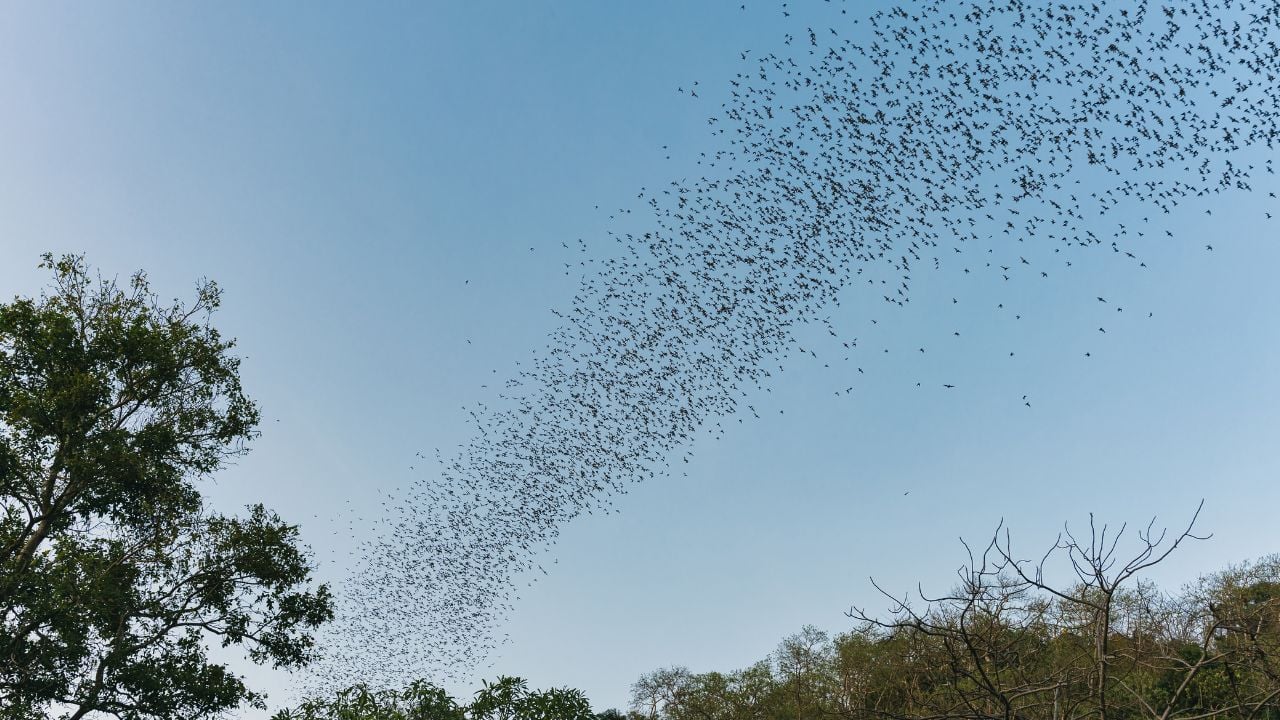
6 Bat Facts That Surprise Arkansans Every Fall

Spot a bat swooping overhead on a fall evening, and you might duck without thinking.
Arkansans share the state with thousands of bats, and some of what these animals do isn’t what people expect.
Here are the facts that tend to surprise people this time of year.
Note: This is general information, not medical advice. Health guidance is subject to change, so confirm the current details with the Arkansas Department of Health.
1. Sixteen Species
Arkansas is home to 16 bat species, according to the National Park Service.
Whichever one you’ve seen, it eats insects, since the Arkansas Game and Fish Commission (AGFC) says all 16 species do, from moths and beetles to flies.
Not all of them live in caves, though.
Several species roost under loose bark, in rock cracks and under concrete bridges, so the bridge on your route may double as a bat roost.
Only one species belongs to the free-tailed family, the Brazilian free-tailed bat.
Members of that family migrate long distances south in late fall and winter, according to the Encyclopedia of Arkansas.
2. Four Endangered Species
The National Park Service lists three bats at Buffalo National River as endangered, the gray bat, the Indiana bat and the Ozark big-eared bat.
The U.S. Fish and Wildlife Service reclassified a fourth, the northern long-eared bat, as endangered in November 2022.
In Arkansas, the Ozark big-eared bat primarily occurs in Crawford, Franklin and Washington counties, plus Marion County.
If you live in one of those four counties, you may share your county with this bat.
3. Blanchard Springs’ Winter Crowd
Gray bats spend the winter at Blanchard Springs Caverns, near Mountain View.
A January 2019 estimate put about 485,000 bats in the cave’s winter roost, the Encyclopedia of Arkansas says.
Visitors can’t walk the Discovery Trail then, since it attracts the endangered gray bat and is closed each winter while bats hibernate.
If you visit in summer, you’ll find the crowd gone, since the bats disperse to other sites in and around the state.
Psst! How much do you know about bats and caves? Take our quiz and see if you can ace it.
Quiz
Bat Trivia
Answer these questions on bats and caves. We bet you can’t get them all right. Prove us wrong?
The U.S. Fish and Wildlife Service estimates that how much of the entire gray bat population hibernates in only 15 caves?
4. Bat Mating at Cave Entrances
If you think bats mate in spring, the Indiana bat, one of Arkansas's endangered species, has news for you.
Indiana bats, whose range includes Arkansas, mate mostly from late August to early October, according to the U.S. Fish and Wildlife Service.
In late August and September, they also gather at cave and mine entrances at dusk and dawn.
That staging is believed to help breeding and to reduce inbreeding in small summer colonies.
5. Caves Closed to Protect Bats
Protecting bats is the reason a cave you find in Arkansas's Ozark-St. Francis National Forests is closed to you.
The regional forester has ordered every cave and mine there closed, except Blanchard Springs Caverns.
The goal is to slow or halt the spread of white-nose syndrome, a bat-killing disease.
Buffalo National River began closing caves in 2009 to slow the disease's spread and added a ban on entry the following year.
The Arkansas Game and Fish Commission tells cavers to observe all cave closures and avoid caves, mines or passages with hibernating bats.
If you walk into a cave with hibernating bats, you can wake them.
Each waking wastes winter fat reserves, the Encyclopedia of Arkansas says.
6. White-Nose Syndrome's Arrival
AGFC says white-nose syndrome has been known in Arkansas since 2012 and has been found in 14 counties across the Ozark and Ouachita Mountains.
The Encyclopedia of Arkansas says the commission confirmed it that year in two northern long-eared bats.
If you live in the Ozarks or the Ouachitas, an affected cave may be closer than you think.
The fungus behind the disease damages bats' tissue and wakes them up more often than normal during hibernation.
Tricolored bats were once common in most Arkansas caves and mines.
The species had fallen about 66 percent between the winters of 2015-16 and 2016-17.
A U.S. Forest Service study in the Ouachita National Forest found northern long-eared bats fell 98 percent.
Why Bats Are Worth Protecting
An Arkansas bat can eat up to its body weight in insects each night, according to AGFC.
Estimates put the gray bats in one cave near Batesville at over 35 tons of insects a year.
If you're wondering whether protections work, look at the gray bat.
AGFC said in 2022 that gray bat populations were rising thanks to protections in the caves where they spend their summers.
Biologists have put up bat gates in cave openings, with a horizontal bar that bats can fly through but you can't squeeze past.
If you want to help bats, you can build and put up a bat house.
A Bat in Your House
Bats and skunks are the high-risk animals for rabies in Arkansas, according to the state Department of Health.
Still, most bats don't carry rabies, and only about 2-3 percent are infected.
You can't spot an infected bat by looking, either, since only a laboratory test shows rabies in wildlife.
Rabies almost always leads to death unless treatment starts soon after exposure.
What to Do If a Bat Gets Inside Your Home
The Arkansas Department of Health says to isolate a bat inside your home to one room, leave the room, and close the doors.
Then call an animal control officer or a nuisance wildlife control company to capture the bat for testing.
The Arkansas State Public Health Laboratory tests wildlife that has bitten or exposed people or domestic animals.
For any animal bite, wash the wound thoroughly with soap and water right away.
Also see a doctor about the wound as soon as possible.
Nationwide, the department says, most human rabies cases come from unrecognized or unreported exposures to bats.
October Bat Surveys
A nine-member team from Arkansas Tech University and federal agencies surveyed bats in the Mulberry River watershed in late October 2024, the public radio station KUAF reported.
Had you joined them, you would have watched harp traps catch 20 gray bats and seven Ozark big-eared bats the first night.
A night-vision count of bats flying out of a crevice nearby added 872, mostly gray bats.
A biologist on the trip said he and a colleague had documented roughly 175 new bat sites in their work.
About 74 of those sites, he estimated, have proposed or listed bat species.
9 Things That Give an Arkansan Away the Moment They Leave the State

Many Arkansans carry a few habits across the state line.
See which habits give them away.
9 Things That Give an Arkansan Away the Moment They Leave the State
2 Arkansas Town Squares That Never Recovered From Their Biggest Closure

Not every Arkansas town gets its factory back.
Read how these town squares fared after a big closure.
2 Arkansas Town Squares That Never Recovered From Their Biggest Closure
