
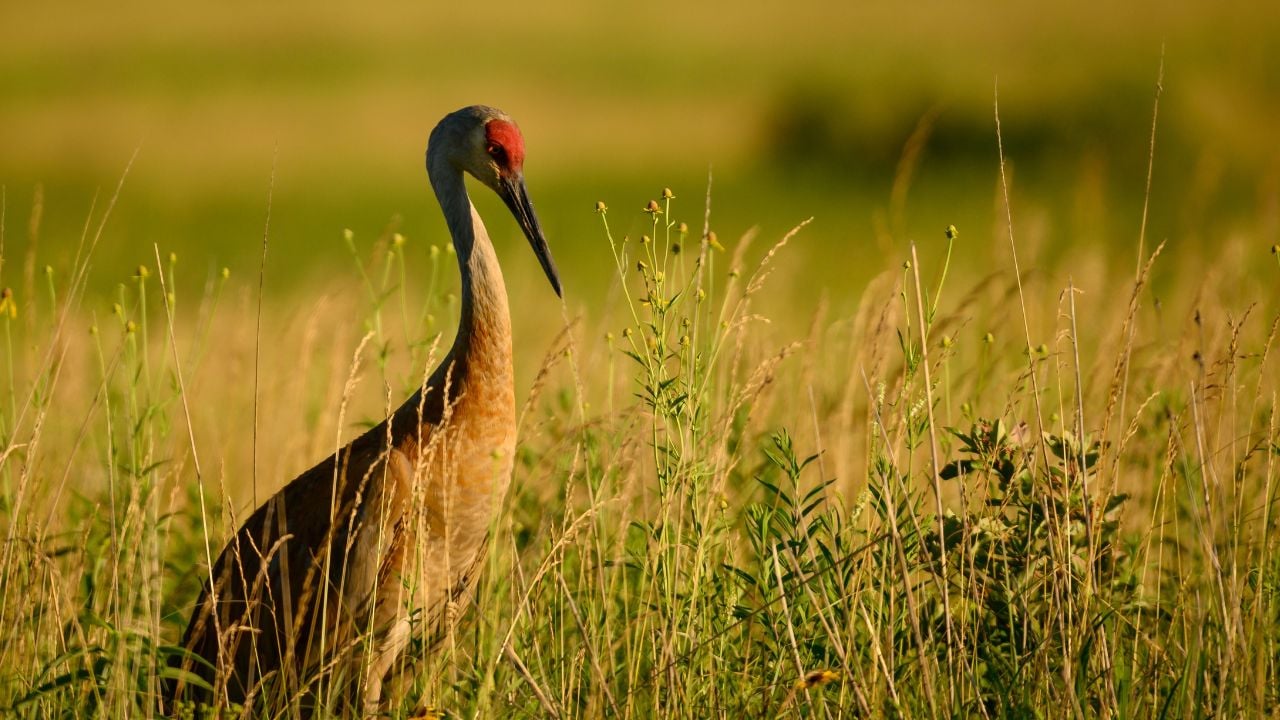
6 Things Indiana’s Sandhill Cranes Do Every Fall That Most Hoosiers Never See

One of Indiana’s best fall shows happens in the sky, and a lot of people miss it.
Hoosiers who make the trip can watch thousands of cranes come and go.
Here’s what the cranes do each fall, and when to catch it.
1. Sunset Gatherings
About an hour before sunset, the DNR says, flocks of sandhill cranes start flying into Jasper-Pulaski near the observation area from all directions.
Before returning to the roosting marshes at dusk, the cranes gab and socialize again.
If you’re standing at the observation area then, you can watch them come in.
Audubon wrote in 2023 that a spot on the viewing platform just before sunset can put you in front of up to 30,000 cranes.
That’s the cranes’ usual routine, but wild animals aren’t always predictable.
2. Dancing in the Fields
Between the sunrise and sunset flights, you can spot sandhill cranes feeding and dancing in harvested farm fields near Jasper-Pulaski.
The Cornell Lab of Ornithology describes courting cranes stretching their wings, pumping their heads, bowing and leaping into the air.
Cranes may gather close to the observation area, but the DNR says they’re usually several hundred yards away.
That’s why a spotting scope or binoculars helps, though a few stationary viewing scopes are available.
3. Sunrise Fly-Outs
The DNR describes gigantic flocks of sandhill cranes rising from their roosting marshes at sunrise and flying to feed on surrounding private farmland.
On the way, some birds stop in the open grassland areas of the refuge.
Audubon says the cranes then feed all day on unharvested grains and invertebrates.
The Cornell Lab describes their diet as heavy in seeds and cultivated grains.
Sunrise and sunset are the best times to see the cranes, so if you’re hoping to catch the fly-out, you’ll want to be in place early.
Psst! How much do you know about Indiana’s wildlife? Take our quiz and see if you can ace it.
Quiz
Wildlife IQ
Answer these questions on Indiana birds, bats and other wildlife. We bet you can’t get them all right. Prove us wrong?
Which southern Indiana landmark gave scientists the first Indiana bat specimen described to science in 1928?
4. Migrating as Families
In fall, you get a chance to watch young sandhill cranes on their first migration, learning the ropes from their parents.
According to the Cornell Lab, mated pairs and their juvenile offspring stay together through the winter, until the 9- to 10-month-old juveniles separate from their parents the following spring.
So if you watch a flock come in at Jasper-Pulaski, some of the cranes are likely young birds on their first trip south.
5. Roosting in Closed Marshes
At night, sandhill cranes roost in Jasper-Pulaski's Waterfowl Resting Area, which the DNR keeps closed to the public.
The closure lets migrating birds rest without human disturbance.
Across their range, the Cornell Lab says, sandhill cranes roost on shallow lakes or rivers at night and spend the day in irrigated croplands, pastures, grasslands or wetlands.
You can't visit the roost, but the cranes return to it at dusk after socializing.
6. Flocks by the Thousands
If you want the biggest crowds, aim for late November or early December, when the DNR says crane numbers at Jasper-Pulaski peak.
In 2025, the weekly count began at 514 on Oct. 7 and reached 3,235 by Oct. 28.
The count then rose to 6,062 on Nov. 25 and 16,400 on Dec. 2.
From 2022 through 2025, the counts taken between Oct. 24 and Oct. 31 ran from 3,235 to 7,953.
If you visit in late October, expect thousands of cranes rather than the peak crowds.
Counting the Cranes
The Indiana DNR counts the cranes at Jasper-Pulaski weekly, typically on Tuesdays.
Four to six property staff members do the counting before sunrise, each stationed in a parked vehicle in a separate area of the property.
Each person counts small groups of cranes as they leave the roost and fly overhead.
Toward the end, a property manager checks the Waterfowl Resting Area for cranes that are still there.
The staff stay far enough apart to avoid counting the same flock twice.
The highest figure in the 2022 through 2025 table is 32,938 cranes, counted on Nov. 28, 2023.
If you want to follow along, the DNR's crane page lists the 2026 count dates, which run from Oct. 6 through Dec. 22 as of early October.
When the Count Drops
If you're planning a December visit, the DNR's counts show that sandhill crane numbers at Jasper-Pulaski fall off at different times from year to year.
In 2017, Indianapolis station WRTV reported that birds at Jasper-Pulaski typically stay for a few weeks, according to a wildlife area manager.
In 2023, the count was still 20,158 on Dec. 12.
On Dec. 26, 2024, the count was still 11,362 cranes.
In 2025, none of the counts after Dec. 2 topped 220.
Saturdays at the Viewing Tower
International Crane Foundation staff will be at the viewing tower on Saturdays from Oct. 17 through Dec. 19, 2026, according to the DNR.
The visits skip Halloween and Thanksgiving weekends.
That leaves Oct. 17 and 24, Nov. 7, 14 and 21, and Dec. 5, 12 and 19.
The staff will be happy to answer your crane questions.
During those Saturday visits, you may even be able to spot an endangered whooping crane.
9 Cold Medicine Labels Hoosiers Read Completely Wrong

A cold medicine box deserves a second look.
Reading all of it is left up to you.
