
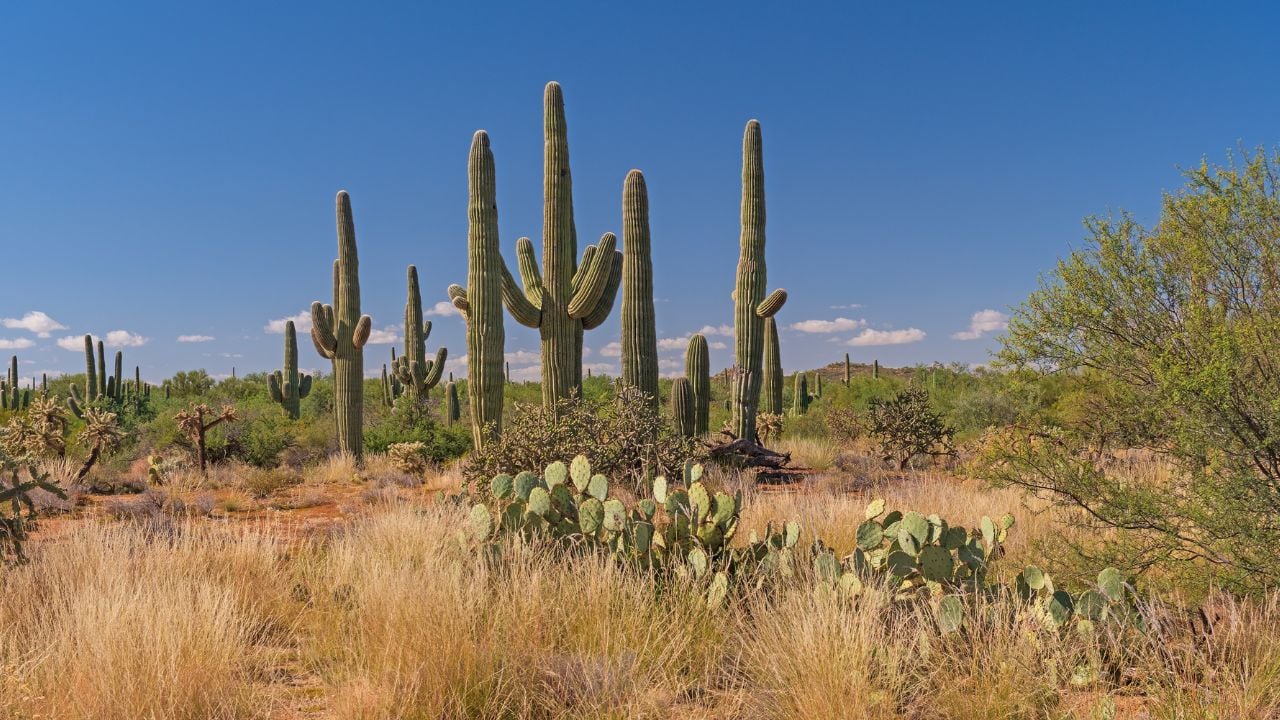
6 Things Arizonans Wish Out-of-Staters Knew About Saguaros

A saguaro can take 70 years to grow six feet tall.
That’s a long wait for a cactus, and it’s one reason Arizonans want visitors to treat saguaros with care.
Here’s what Arizonans wish you knew about saguaros before you visit.
Note: This is general information, not legal advice. Plant protection rules and permit requirements are subject to change, so confirm the current requirements with the Arizona Department of Agriculture.
1. Protected Plant
Saguaros are protected in Arizona, and statewide cactus laws prevent theft or destruction.
Before any protected plant leaves the ground, the law requires a native plant tag and seal on it.
Moving a wild saguaro taller than four feet from its original location to a new site takes a separate movement permit on top of the saguaro tag.
Plants can’t be removed from any land without the owner’s permission and a permit from the Department of Agriculture.
To collect, transport, or sell protected native plants, you have to be 18 or older and hold an appropriate permit.
Stealing protected native plants worth $1,500 or more is a class 4 felony.
Below $500, the theft is a class 1 misdemeanor, and values in between fall under lower felony classes.
Other violations of the chapter are class 3 misdemeanors, and knowingly misusing permits, tags, or seals, or moving protected plants without the required paperwork, is a class 1 misdemeanor.
No permit, no shovel.
2. Slow Growth
A saguaro grows between 1 and 1.5 inches in the first eight years of its life.
It may take 70 years to reach six feet in height.
Arms normally begin to appear at 50 to 70 years of age.
In drier areas, it may take up to 100 years.
The period of greatest growth comes as a saguaro goes from an unbranched cactus to a branched adult.
Over time, a saguaro can sometimes reach 50 feet.
So when you see a saguaro with arms, you’re looking at a plant that has been growing for decades.
3. Sonoran Desert Cactus
The National Park Service says saguaros grow only in the Sonoran Desert, and not in all parts of it.
Their range covers southern Arizona, the Whipple Mountains and Imperial County in California, and western Sonora in Mexico.
The Sonoran Desert is the greenest desert in North America.
Cold limits how far the range stretches.
If the elevation is too high, cold weather and frost can kill a saguaro.
If you picture a saguaro in Texas or Utah, you’ve moved it somewhere it doesn’t grow naturally.
To see one growing in the wild in the United States, you’ll need southern Arizona or a pocket of California.
4. Pronouncing the Name
Saguaro is pronounced sah-wah-roh.
The stress falls on the middle syllable.
Many longtime residents wince when you stress a different syllable.
An alternate spelling, sahuaro, swaps the g for an h.
5. Night Blooms
Saguaros bloom at night, and each flower closes the following day.
The large white flowers have yellow centers.
The white blossom is the state flower.
It grows on the largest cactus in the United States.
Flowering begins around late April, and the peak runs from the last week of May through the first week of June.
Flowering is triggered when the days grow longer and temperatures rise.
Birds, insects, and bats pollinate the flowers.
If you visit in the last week of May, you’ll catch the start of the peak.
6. Fruit Harvest
Saguaros ripen their fruit to a deep red in late June and early July.
If you want to see the fruit on the cactus, plan your trip for those weeks.
The O’odham, Native people of the Sonoran Desert, hold a traditional saguaro harvest each year through June and July, with social and religious festivities.
That harvest marks the beginning of the O’odham new year.
Traditionally, women prepared drinks like saguaro wine.
The Arizona-Sonora Desert Museum says the Tohono O’odham regard saguaros as sacred and treat them with great respect as members of their community.
Members of the Tohono O’odham Nation have harvested saguaro fruit on ancestral lands that Saguaro National Park now manages.
Nurse Trees
Saguaros start life under the protection of a nurse tree, most often a palo verde, ironwood, or mesquite.
That tree shields a young saguaro from summer sun and winter frosts.
It’s a head start.
Tiny, young saguaros can be hard to see, so if you want to spot one, check the ground under a palo verde on your next hike.
As the saguaro keeps growing, its much older nurse tree may die.
Some scientists believe competition from the saguaro for water and nutrients in the soil may be the cause.
Freezes and Fires
A park science article says that since 1978 the park had experienced only one major freeze, in 2011.
In monitoring plots compared between 2010 and 2014, nearly 17% of large adults, those taller than 24 feet, had died after that freeze.
Younger saguaros under 18 feet fared far better, with mortality below 3%.
Protection from nurse plants probably made the difference.
A 2021 article reports that wildfires have burned at lower elevations than they historically did, reaching into saguaro habitat.
An increase in invasive grasses is the probable cause.
Psst! How much do you know about saguaros? Take our quiz and see if you can ace it.
Quiz
Saguaro Smarts
Answer eight questions on saguaros. We bet you can’t get them all right. Prove us wrong?
A large saguaro may weigh about how much for each foot of its main trunk?
Saguaro National Park
Saguaro National Park is home to over 2 million saguaros.
The park has two districts, the Tucson Mountain District on the west and the Rincon Mountain District on the east.
7 Records an Arizona HOA Has to Share With Any Homeowner Who Asks

Asking your homeowners association for its records can feel like a long process.
Some of the records on that list may surprise you.
7 Records an Arizona HOA Has to Share With Any Homeowner Who Asks
5 Fry's Perks Arizonans Over 60 Leave on the Table

Some Fry's perks are built for shoppers over 60.
A few are easy to miss until somebody points them out.
