
7 Things That Happen at a Michigan Cherry Orchard After Harvest

The leaves under a Michigan cherry tree this fall can carry a fungus all the way into spring.
The cherries were picked months ago, but growers still have work to do.
Here’s what goes on in a cherry orchard after harvest, and what you’re seeing when you drive by.
1. Leaf Spot Spray
A tart cherry orchard gets a fungicide spray within a week of harvest.
The target is cherry leaf spot, which Michigan State University (MSU) Extension has called the most important fungal disease of tart cherry in Michigan.
Leaves that pick up the spots turn yellow and fall.
A tree that loses its leaves before early September has less carbohydrate stored in its roots.
That makes the tree more vulnerable to winter injury.
Fewer flower buds and less fruit follow the next season.
With USDA’s forecast of 83.1 million pounds, down 26.9 million from the year before, you might think an orchard can skip the spray.
It can’t.
Even in orchards with a reduced crop, the main damage from leaf spot lands on tree health, including winter injury and tree death.
2. Mite Scouting
If you see someone turning over leaves in a late-summer cherry block, a mite count is the likely reason.
Growers still scout a cherry orchard for two-spotted spider mites after harvest.
The treatment threshold is eight to 10 mites per leaf, from July all the way through post-harvest.
Mite scouts sample 25 leaves at each of three to five sites in a block.
The waiting period before harvest runs 14 days or longer for many miticides, so a miticide often goes on after harvest.
Heavy mite feeding can reduce photosynthesis and fruit bud formation.
In hot, dry years with high mite numbers, firing can follow, and a portion of the tree collapses.
3. Pruning Crews
MSU Extension has described pruning crews working bearing cherry trees between cherry and apple harvest.
Growers are advised against pruning after mid-September.
Too many orchards have grown too tall for the spacing they were planted at.
Taller trees also drop their cherries farther onto the harvester.
A limited, preliminary study in tart cherries found a strong trend toward more damage as the drop height increased.
For sweet cherries, Cornell research in New York found that pruning after harvest in dry weather gave the best results.
Dry-weather pruning significantly reduced the likelihood of bacterial canker infection.
In sweet cherries, pruning should never happen during or right before wet weather.
If you prune a sweet cherry tree, that rule holds for you too.
How Tall MSU Suggests Cherry Trees Should Be
MSU specialists suggest tying the height of a bearing cherry tree to the width of the clear alleyway between rows, to help light reach the canopy.
For triangular trees, the bearing area should be no taller than three times the alleyway width.
With a six-foot alleyway, that means 18 feet of bearing area, plus about four feet from the ground to the fruiting area, for a total height near 22 feet.
For rectangular trees, the bearing surface should be about twice the alleyway distance.
In a six-foot alleyway, that works out to 12 feet of bearing surface and about 16 feet in total.
4. Brown Rot Mummies
After harvest, a sweet cherry orchard can still have mummies, rotted fruit left by brown rot that dries down in the summer heat and sticks tight to the limbs.
Left in the canopy, mummies become a source of infection for the next season.
Mummies that fall to the ground do the same the following year.
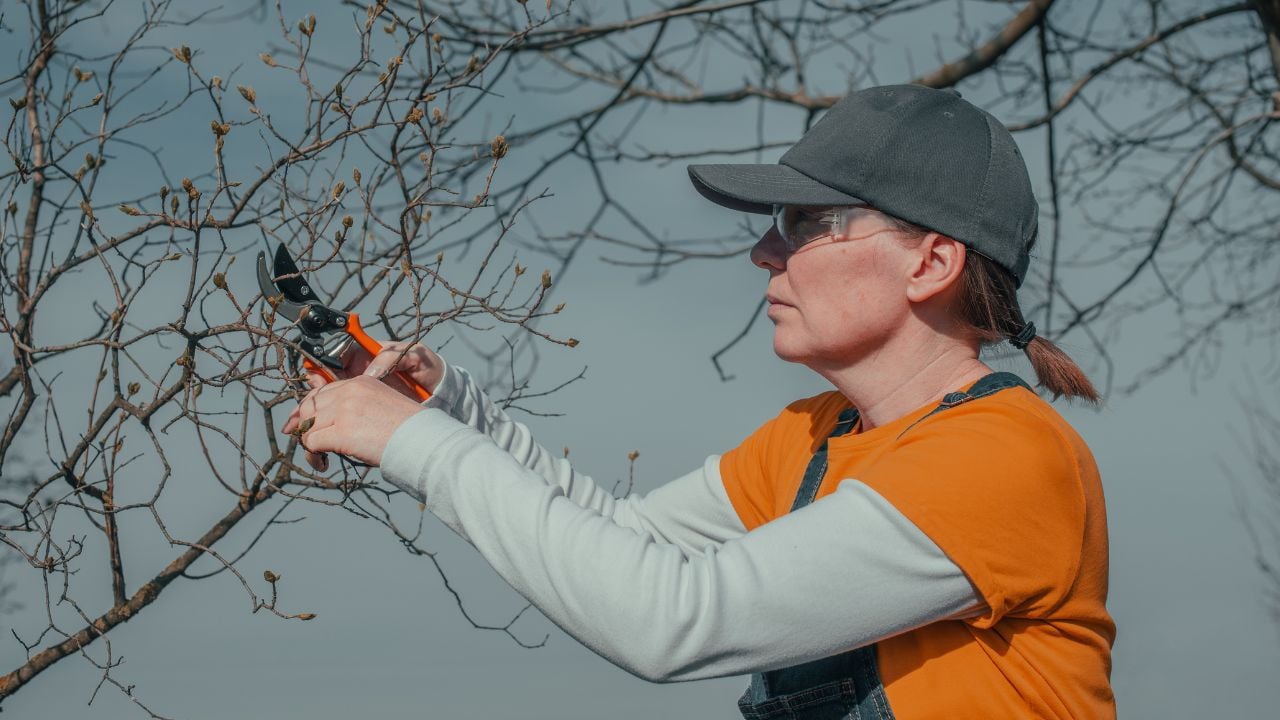
Pruning crews watch for mummies in the canopy and cut them out.
Flail chopping the mummies on the ground, right in the row, is another option.
If you ever spot dried-up cherries clinging to a branch, that’s a mummy.
5. September Urea Sprays
MSU research supports spraying cherry trees with urea, a nitrogen fertilizer, in September.
By fall, the nitrogen in a cherry leaf typically drops to half its growing-season level.
Fall nitrogen sprays on the leaves improve the winter hardiness of tart cherries as well as sweet cherries.
The urea goes on late enough that it doesn’t stimulate new growth.
The recipe calls for two applications of a 3 percent urea solution, seven to 10 days apart.
Both applications go on in September, starting as early as Sept. 1.
In 2012, it was recommended for stressed cherry trees, as long as most of their leaves were still on.
6. Copper at Leaf Drop
MSU Extension says sweet cherry growers can apply copper in the fall, timed to about 25 to 35 percent leaf drop.
The spray runs 1.2 to 2 pounds of metallic copper per acre.
Each leaf that drops leaves a scar, and that scar is open to infection for only about one to two days.
If you watch a cherry tree shed its leaves, each one leaves behind one of those scars.
The bacteria that cause bacterial canker then move into dormant buds.
The overall value of that fall application is unclear.
Psst! How much do you know about Michigan cherries? Take our quiz and see if you can ace it.
Quiz
Michigan Cherry IQ
Answer eight questions on Michigan cherries, from old orchards to record-setting pies. We bet you can’t get them all right. Prove us wrong?
How far has a cherry stone been spit in competition, according to Guinness World Records?
7. Fallen Leaves
After harvest, infected leaves that fall in a cherry orchard carry cherry leaf spot through winter in their lesions.
If you see fallen leaves under a cherry tree, they can carry the fungus into spring.
By spring, the fungus forms fruiting bodies that release spores when conditions turn wet and warm.
Infection can begin before bloom, as soon as bract leaves emerge.
8 Things Michigan Law Lets an Employer Take From a Final Paycheck

Many Michiganders have questions about what a last paycheck holds.
Some of the answers come as a surprise.
8 Things Michigan Law Lets an Employer Take From a Final Paycheck
8 Wedding Habits Michiganders Say Have Gotten Out of Hand

Many Michiganders say a few wedding habits have gotten out of hand.
Some of those habits land on the bridal party and guests, not just the couple.
