
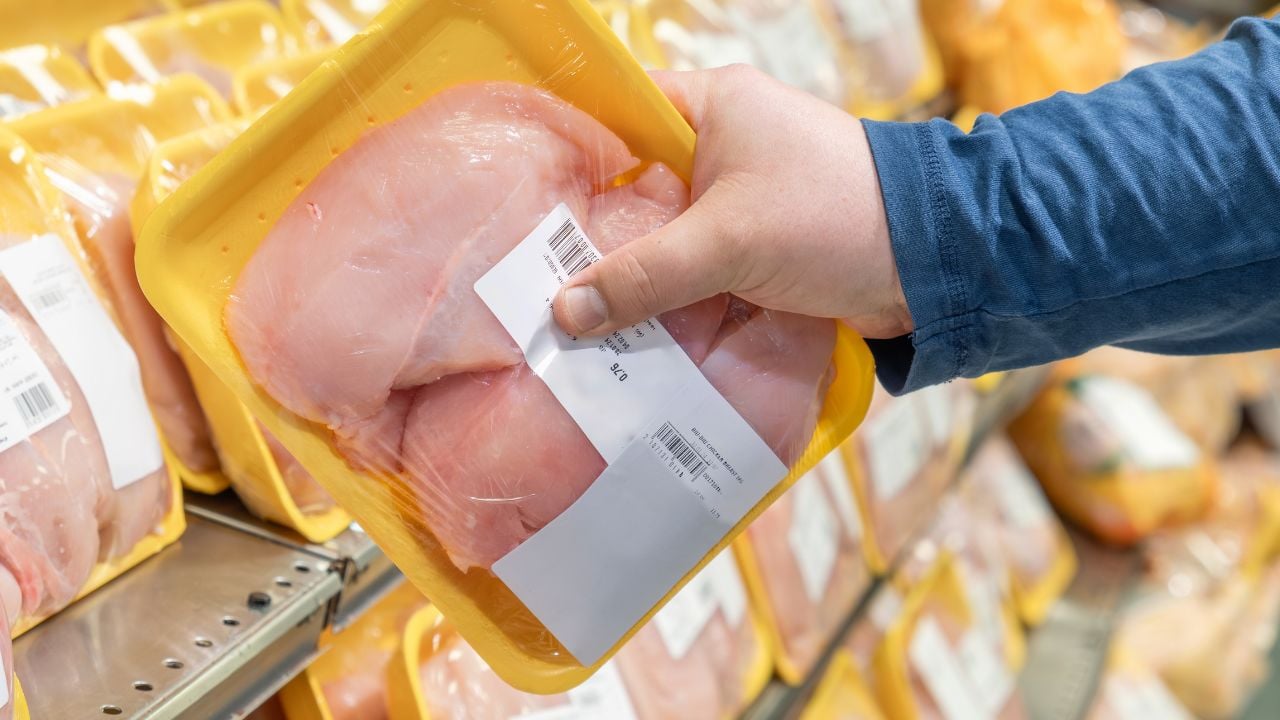
Arkansas Is Chicken Country, So Why Are Boneless Breasts Up 12% Across the South?

Boneless chicken breasts averaged $4.14 a pound across the South in August 2026, up from $3.70 a year earlier, according to Bureau of Labor Statistics data.
Arkansas raises a lot of chickens, so that’s alarming to locals.
Here’s what you need to know about the price hike.
Where the $4.14 Comes From
Boneless chicken breasts averaged $4.139 a pound across the South in August 2026, according to Bureau of Labor Statistics (BLS) data republished by the Federal Reserve Bank of St. Louis.
That rounds to $4.14.
The series covers whole and half boneless, skinless chicken breasts, fresh or frozen, organic or not.
So the figure is a Southern average, not an Arkansas price.
Your store’s price may differ, so divide the price on your package by its weight in pounds to see how far off the average it lands.
What the South Average Covers
The South region’s boneless chicken breast average covers 16 states and the District of Columbia.
Those are Alabama, Arkansas, Delaware, Florida, Georgia, Kentucky, Louisiana, Maryland, Mississippi, North Carolina, Oklahoma, South Carolina, Tennessee, Texas, Virginia and West Virginia, plus the District.
Arkansas is one of those states, so the region this number describes includes where you live.
BLS collects these prices every month in 75 urban areas nationwide, and it publishes a South average only when the sample there’s large enough.
Because the average spans that whole region, the price at your store could land above or below it.
Up From August 2025
Boneless chicken breasts cost about 44 cents more across the South in August 2026 than in August 2025, when they averaged $3.695 a pound, a rise of about 12%.
A 2-pound purchase at August 2026’s average would cost you $8.28, compared with $7.39 a year earlier, a difference of 89 cents.
Through August 2026, you’d have seen a higher South average than a year earlier in every month of 2026, starting in January.
Of those eight months, the gap was widest in August, at 44 cents.
May’s was the smallest, at 27 cents.
The average rose 16 cents from May to June, from $3.970 to $4.128, the biggest one-month increase of 2026 through August.
It then fell to $4.105 in July before rising to $4.139 in August.
How the South Compares With the Nation
The U.S. city average for boneless chicken breasts was $4.173 a pound in August 2026, so the South’s $4.139 landed about 3 cents below it.
In August 2025, the South’s $3.695 sat about 52 cents below the national average of $4.212.
Over the next 12 months the national figure slipped about 4 cents.
The gap nearly vanished.
Among the four regions, the South had the lowest average in August 2025 ($3.695), followed by the Northeast ($4.004), the Midwest ($4.343) and the West ($5.324).
A year later, the Northeast ($3.829) and the Midwest ($3.915) were both below the South’s $4.139, and the West ($4.718) was highest.
Those three regions each fell over the 12 months, while the South rose.
BLS notes that comparisons between regions can reflect differences in brand, quality and size because items are selected separately at each location.
Even so, if you expected Southern chicken to be the cheapest in the country, August says otherwise.
The South placed third-lowest of the four regions.
Arkansas in Chicken Country
Boneless breasts come from broilers.
Broilers are chickens raised for meat, and Arkansas farms raised 7.79 billion pounds of them in 2025, according to USDA’s annual poultry report.
That was about 3% more than the 7.56 billion pounds Arkansas raised in 2024.
Only North Carolina (8.27 billion pounds) and Georgia (8.17 billion) topped it, with Alabama fourth (6.63 billion).
If you count birds instead of pounds, Arkansas ranked third, with 1.05 billion broilers behind Georgia and Alabama.
By weight, Arkansas’s 7.79 billion pounds is about one of every eight pounds in the national total of 62.2 billion.
Psst! How much do you know about chicken, eggs and turkeys? Take our quiz and see if you can ace it.
Quiz
Poultry and Prices IQ
Answer these questions on chicken, eggs, turkeys, and grocery prices. We bet you can’t get them all right. Prove us wrong?
Among the states USDA listed individually for 2025, which raised the most turkeys?
Meat and Grocery Indexes
Chicken breasts are one item inside the grocery groups tracked by the Consumer Price Index (CPI).
In the South, the CPI group for meats, poultry, fish and eggs rose 1.1% over the 12 months ending in August 2026, while the food-at-home index, which covers grocery store purchases, rose 1.9%.
Those groups include far more than chicken breasts, so they don't predict the average price of any one item on your list.
BLS says its indexes are the better tool for tracking price change, while average prices show the level in a given month.
So read the 12% as the gap between two monthly averages, not as a measure of inflation at your checkout.
Past Augusts
Through August 2026, the South's $4.139 is the highest monthly average in the BLS series, which begins in January 2006.
Before this year, the record was $4.071 in September 2022, and June 2026's $4.128 was the first month to pass it.
Even 2022 fell short.
Compared with August 2019, when the South average was $2.919 a pound, you'd pay about $1.22 more at August 2026's $4.139, or roughly 42% more.
The August average rose every year from 2019 through 2022, from $2.919 to $4.060, with that last jump about 70 cents above August 2021's $3.365.
It then came in at $3.694 in August 2023, $3.472 in 2024 and $3.695 in 2025, so you can see why $4.139 stands out.
8 Things Arkansas Families Assume Are Written Down and Aren't

An Arkansas family empties a late relative's filing cabinet, expecting the paperwork to answer every question.
What often turns up instead is a mix of things everyone agreed to out loud years ago and never put on paper.
8 Things Arkansas Families Assume Are Written Down and Aren't
