
4 Things Bald Eagles Do on the Mississippi Every Winter That Iowans Rarely See

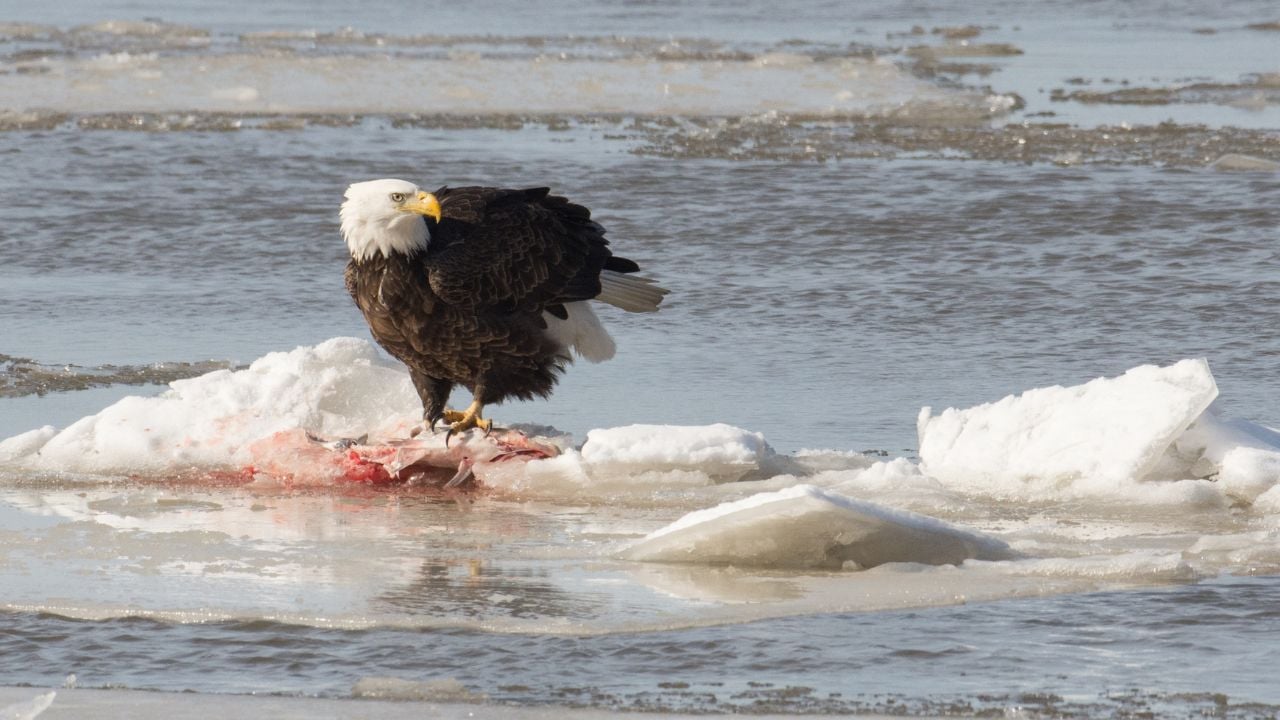
On mild winter days, bald eagles stand right on the Mississippi’s ice at Bellevue, pecking at fish.
Iowans who drive past the river rarely stop to watch what else they’re doing.
Here are the things bald eagles do on the Mississippi every winter.
1. Crowding Below the Dams
When ice begins to form on the river, the public television show Nature says, eagles lose access to food and move to where the water is still open.
Wintering eagles gather especially at locks and dams and power plants that keep the river from freezing.
Lock and Dam 14 at Pleasant Valley is a great viewing spot.
A 2015 DNR tips page puts the winter population at 4,000 to 7,000 eagles along the Mississippi, from Minneapolis to about 50 miles south of St. Louis.
Adults from colder nesting areas start south by mid-November, so a cold snap up north may send more birds toward your stretch of river.
2. Taking Easy Meals
In winter, an eagle must eat 6 to 11 percent of its body weight every day, according to Nature.
Fish stunned or killed in the turbulent water below a dam provide an easy meal.
The DNR says gizzard shad are often stunned as they pass through the dam gates.
At Lock and Dam 12 in Bellevue, eagles take off from nearby trees to swoop down for fish.
If you stop at a dam, watch the trees as well as the water.
The U.S. Fish and Wildlife Service says an eagle will also steal prey from other eagles, mammals and birds of prey.
3. Standing on the Ice
On mild days, the DNR says, eagles may be seen standing on the ice.
At Bellevue, they stand around on the ice, pecking at chubs.
Standing, a bald eagle can be up to 3 feet tall, so a dark bird on white ice may be easy for you to pick out.
Scan the ice first.
Psst! How much do you know about bald eagles and the Mississippi River? Take our quiz and see if you can ace it.
Quiz
River Eagle IQ
Answer these questions on bald eagles and the Mississippi River. We bet you can’t get them all right. Prove us wrong?
About how heavy can the biggest Iowa eagle nests get?
4. Roosting Together
Nature says wintering eagles spend upwards of 90 percent of daylight hours roosting to conserve energy.
Bald eagles generally roost together in large, mature trees with a buffer of smaller trees around them.
According to the DNR, large cottonwoods tend to be used most frequently, and daytime perches are usually within 60 yards of the water's edge.
Start with the biggest trees you can see.
The Iowa Ornithologists' Union lists a boat ramp in Keokuk, listed under Lock and Dam 19, as a place where you can watch eagles come in to roost.
Adding Sticks to the Nest
Bald eagle nesting details from the DNR cover the whole state, not just the river.
Iowa eagles often start building their nest, or adding sticks to an old one, in October or November.
They frequently return to the same nest site year after year.
Those stick nests can reach over 7 feet across and 12 feet deep, and they can weigh over two tons.
Nest building runs from November to January, according to a 2015 DNR release, and a pair can begin incubating eggs as early as February.
A big stick nest in a tree you pass this winter is often already under repair.
Watching From a Distance
The DNR's winter tips say more than 70 percent of an eagle's feeding happens in the early morning.
Visitors should avoid areas eagles rely on for food before 9 a.m.
Quad City Bald Eagle Days ran January 9 to 11 in 2026 at an expo center in Davenport, with free bus tours to watch eagles.
Check a current listing before you plan a trip.
How Far Back Bald Eagles Need You
Stay at least 400 yards from a perched eagle.
That's roughly four football fields.
A winter eagle has to eat enough while spending as little energy as possible to stay warm.
If you come closer, a perched eagle burns energy it can't spare, and it may abandon the spot.
Counting Eagles in January
Each winter, surveyors count bald eagles on Iowa's waterways in the DNR's Bald Eagle Midwinter Survey.
In 2014, they counted a then-record 4,957 eagles in Iowa.
In January 2023, they counted over 2,900 along 1,663.5 miles of waterway, and the Mississippi and Des Moines Rivers had the most.
Immature birds made up 32 percent of that count, or about one in three.
Young birds are mottled brown, so a bird without a white head is worth a second look on your stretch of river.
9 Things Iowans Miss Most After They Move Away

Iowa's average worker spends about 19.8 minutes getting to a job, according to Census Bureau data.
That's about six and a half minutes shorter than the 26.4-minute national average, but it's only one stop on this list.
9 Things Iowans Miss Most After They Move Away
8 Roadside Stops Iowans Send Every Out-of-State Visitor To

The Twins and the Phillies played at the Field of Dreams in Dyersville in August, in a new permanent ballpark with temporary bleachers that brought capacity to about 8,000.
The movie-site field is, its website says, open from sunrise to sunset year round, weather permitting.
