
5 Grocery Store Buys That Still Get Hit With New Hampshire’s Meals Tax

Buy five muffins at a New Hampshire grocery store bakery, and you could pay Meals Tax.
Buy six, and you might not.
The state has no general sales tax, so that charge on your receipt can catch you off guard.
Here are the grocery store buys that still get hit with New Hampshire’s Meals Tax.
Note: This is general information, not tax advice. Tax rules and rates are subject to change, so confirm the current details with the New Hampshire Department of Revenue Administration (DRA).
1. Prepackaged Sandwiches
You pay the 8.5% Meals Tax on a sandwich from your grocery store, even though the state has no general sales tax.
Sandwiches of all kinds count as a meal, even when they were wrapped somewhere else and arrive sealed.
So a wrapped sandwich and a sandwich made to order at the deli counter get the same tax.
The wrapper doesn’t help.
On a $10 sandwich, you pay 85 cents.
DRA’s 2007 guidance exempts frozen sandwiches that need more cooking.
2. Salad Bar and Buffet Food
Anything you build at a grocery store salad bar, toppings included, is taxed as a meal.
Rules cover salad bars and buffets, and DRA’s 2007 guidance adds self-serve food carts, with stand-alone olive bars as the exception.
On $12 of salad bar food, you owe $1.02 in tax.
Salad bars sell meals.
Psst! How much do you know about the Meals Tax? Take our quiz and see if you can ace it.
Quiz
Meals Tax Pop Quiz
Answer these questions on what the Meals Tax covers and what it skips. We bet you can’t get them all right. Prove us wrong?
You buy a bag of fresh-popped popcorn from a grocery store counter. How does the Meals Tax treat it?
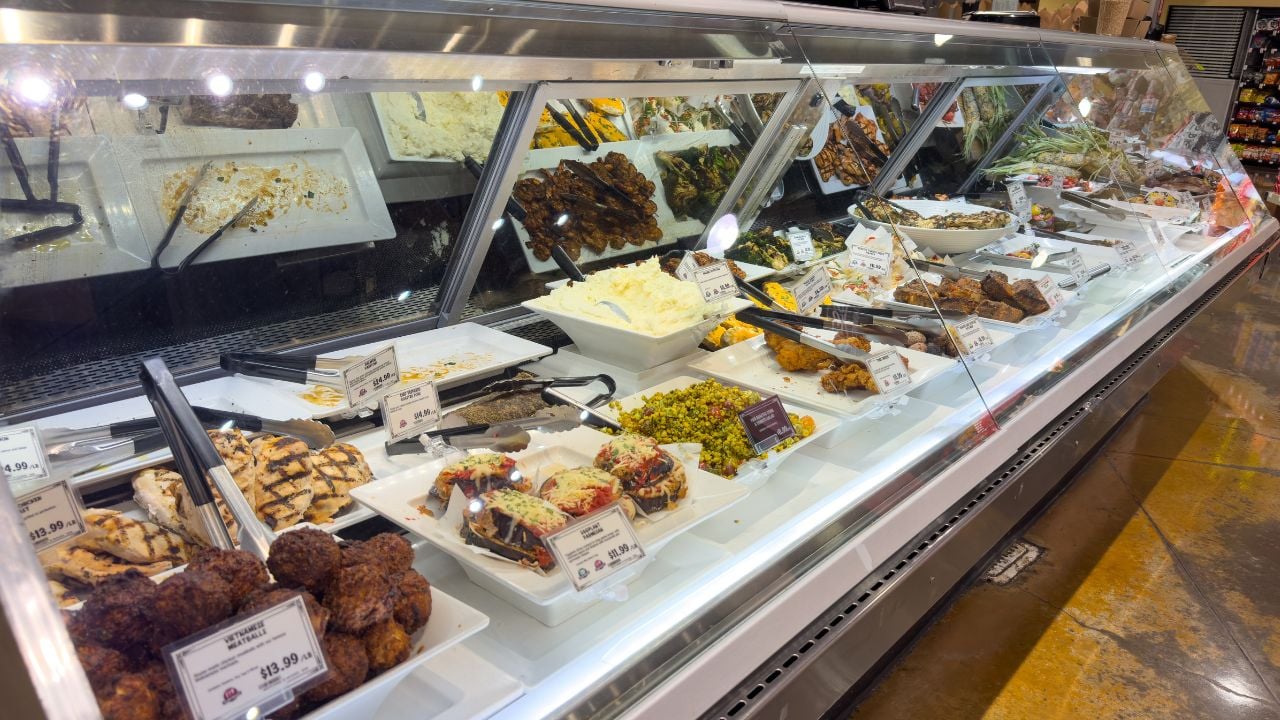
3. Hot and Cold Prepared Foods
Soup, stews and side dishes that your grocery store sells hot are taxed as meals.
DRA's guidance for grocery stores lists hot seafood, meats, vegetables, side dishes, soups, stews and chowders.
Rules go further and cover prepared, ready-to-eat food whether or not the store heats or cools it.
Food packaged as a meal, such as on a plate, is taxed as well.
Cold counts too.
If you buy a dinner the store prepared, hot or cold, you pay 8.5% either way.
Taking it home doesn't remove the tax, since state law counts take-out food as a meal, wrapped or not.
4. Party Platters
Party platters from your grocery store are taxable whether delivered, picked up or never served.
Serving isn't required.
The rules name vegetable, meat, dessert, bakery, fruit and hors d'oeuvres platters.
If you set out three $40 vegetable platters for a holiday table, you pay $10.20 in tax.
How the Meals Tax Rounds
The statute behind the Meals Tax rounds any fraction of a cent up to the next whole cent.
That makes the tax on a $15 charge $1.28, not $1.27.
The same statute starts the tax at a 36-cent charge.
DRA's FAQ says the Meals Tax applies to the amount after a coupon or discount, so a $2 coupon on a $12 charge leaves tax on $10.
5. Bakery Items Under a Half Dozen
Baked goods sold in units of fewer than six are taxed at a grocery store, unless they were packaged somewhere else and arrive sealed.
One cookie or four muffins from your store's bakery falls under that line.
Six is the cutoff.
Baked goods sold in units of six or more for off-premises consumption aren't taxed, and the rule's example treats two bagels, three muffins and one danish as six.
You pay the tax on five cookies to go, but not on six.
A stand-alone bakery that sells only baked goods to take home isn't taxed in any quantity, but one that also sells taxable beverages or sandwiches counts as a restaurant.
When Groceries Become a Meal
Whether the Meals Tax applies to grocery store food depends on how your store sells it.
Food sold by weight, by count or in an unopened container stays untaxed, unless the store sells it on a plate, on a platter or packaged as a meal.
That's why a pound of sliced turkey is untaxed, while the same turkey on a platter is taxed.
State law taxes three things even when they're packaged off the premises. Those are sandwiches, beverages in unsealed containers and catered or delivered meals.
The restaurant test decides it.
State law defines a meal as food provided by a restaurant, including the restaurant section of a store, in a form ready for immediate consumption.
Sealed packaged foods other than sandwiches, and store-sold food products, stay untaxed, even when you can eat them right away.
DRA's 2007 guidance says stores should have a list of the items they tax available.
Where the Rate Stands
The Meals Tax rate has been 8.5% since October 1, 2021.
That's the rate on your grocery receipt today.
A 2026 bill to raise it back to 9% died in the House in February.
That bill would have changed the small-charge bracket table too.
The rate stayed put.
What Stays Untaxed
Ordinary groceries stay outside the Meals Tax, and state law lists fruits, vegetables, candy, flour, nuts, dairy products, meat, poultry, fish and eggs among them.
Sealed packaging matters.
DRA's rules add sealed chips, crackers, pastries, candy and granola bars, along with factory-packaged ice cream in cups, cones and sticks.
The same rules tax an ice cream novelty that isn't wholly packaged off the premises.
Frozen foods you cook before eating, such as a frozen pizza, stay untaxed too.
Canned and bottled drinks in their original containers aren't taxed, but a drink poured for you, from a fountain or in an unsealed cup, is.
5 Current Use Rules That Cost New Hampshire Landowners When Land Use Changes

Owning acres in New Hampshire comes with choices about what to do with the land.
Some of those choices come with bills that show up later.
5 Current Use Rules That Cost New Hampshire Landowners When Land Use Changes
5 Questions New Hampshire Town Clerks Get Asked Every October
Once the leaves turn, town clerks across New Hampshire field the same handful of questions.
You may have asked some of those questions too.
5 Questions New Hampshire Town Clerks Get Asked Every October
