
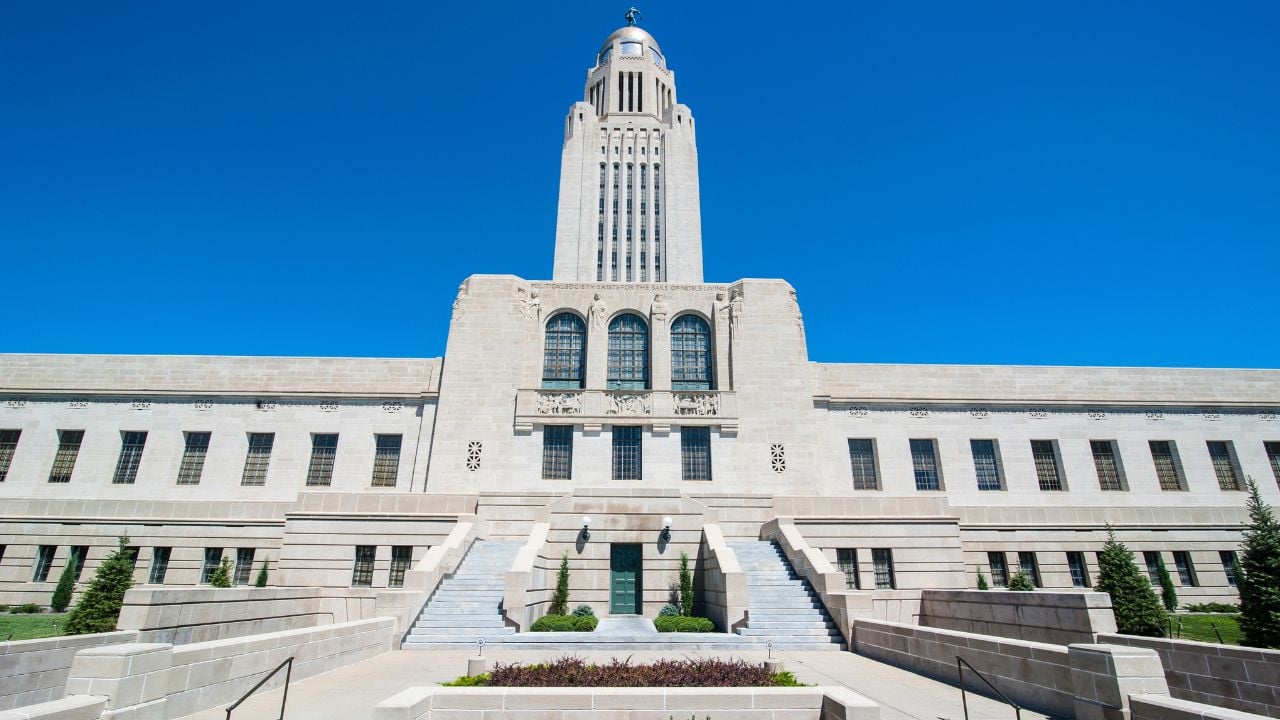
Why Nebraska Runs With Just One Legislative Chamber, and What It Means for Nebraskans

Nebraska has no state House, so your district sends just one lawmaker to Lincoln.
Nebraskans have run their Legislature that way since voters approved it in 1934.
Here’s why Nebraska runs with just one legislative chamber, and what it means for Nebraskans.
Norris’s Case Against Two Houses
George Norris, who settled in McCook, campaigned for what became Nebraska’s Unicameral, a Legislature with a single chamber.
If you’re wondering what bothered him, it was duplication, since a second house repeated work the first had already done.
The Legislature’s history traces the two-house model to the British Parliament.
Then came conference committees, which settle differences when each house passes a different version of a bill.
In Nebraska’s old setup, an appointed six-member committee met in secret, and its members’ votes weren’t public record.
Norris argued that such committees held too much power and were easy for lobbyists to influence.
Checks and Balances
What stops a single chamber from running unchecked?
Norris pointed to the governor, who could veto improper measures, and to the Supreme Court, which could rule on them.
Voters like you would be a check too, through the right to vote and to petition.
The 1934 Ballot Measure
In 1934, voters approved the one-house amendment 286,086 to 193,152.
It reached the ballot as an initiative, a tool the state constitution gives you and other voters to propose amendments without going through the Legislature.
Earlier pro-unicameral movements had come up several times before one finally succeeded.
The Legislature’s history credits Norris’s influence, the Depression and other ballot issues for drawing enough supporters.
Fewer Lawmakers and Lower Session Costs
The switch to one chamber cut the Legislature’s membership from 133 to 43.
The last two-house session, in 1935, ran 110 days, passed 192 bills and cost $202,593.
The first one-house session, in 1937, ran 98 days, passed 214 bills and cost $103,445.
Lawmakers introduced 581 bills in 1937, about half the previous session’s total, and committees fell from 61 to 18.
The 1937 change cut government costs.
Psst! How much do you know about Nebraska’s government and history? Take our quiz and see if you can ace it.
Quiz
Nebraska Civics IQ
Answer nine questions on Nebraska’s government, Capitol and history. We bet you can’t get them all right. Prove us wrong?
Nebraska is the only state to have joined the Union in what way?
A Bill's Path
Because the constitution vests lawmaking power in one chamber, every bill is debated, amended and passed in that chamber alone.
No second house means no second version to reconcile, the job conference committees do in two-house legislatures.
A nine-member Reference Committee sends each bill to one of 14 standing committees, and the full Legislature then takes it up at least twice.
General File is the first time all senators can debate and vote on the bill, and it takes 25 votes to adopt an amendment there.
Select File is the second debating and voting stage.
Final Reading allows no amendments or debate, although a bill can return to Select File for an amendment.
Most bills are introduced during the first 10 days of a session, and none can win final passage until at least five legislative days after introduction.
Each bill covers a single subject, and the governor has five days, Sundays excepted, to act.
Lawmakers need 30 votes to override a veto.
Most bills that win the governor's approval become law three calendar months after the Legislature adjourns, unless they carry an emergency clause.
Public Hearings
Before a bill reaches Nebraska's single chamber for debate, it gets a public hearing in committee, except for a few technical bills.
If you want to weigh in, you can testify at one, and committee chairs often allow neutral testimony.
At the witness table, you sign in, spell your last name for the record and say whom, if anyone, you represent.
You'll get your message across better with written testimony, and 15 copies usually do the job, while long testimony can be summarized out loud.
Hearings usually start at 1:30 p.m., and Nebraska Public Media provides streaming video.
Nonpartisan Elections
The constitution requires senators to be elected in a nonpartisan manner, so you won't see a party label next to a legislative candidate.
The same 1934 amendment that created one chamber made its elections nonpartisan.
The two candidates with the most primary votes face each other in the general election.
All Nebraska voters, including those who belong to no party, can vote in those races.
Many other races on your ballot are nonpartisan, such as those for the State Board of Education and the Board of Regents.
Norris believed nonpartisanship would let senators focus on local interests instead of national party lines.
The Legislature says that, unlike other states, its leadership doesn't depend on party affiliation.
Your Senator
Nebraska has no state House, so your district sends one lawmaker to the Legislature, a state senator.
That senator is one of 49, and the number has grown since the 43 who first met in 1937.
Nebraska remains the only state with a single chamber, and each senator serves a four-year term for a district of about 40,000 citizens.
Each session opens on the first Wednesday after the first Monday in January.
Your senator then has 60 legislative days in even-numbered years and 90 in odd-numbered years to take up bills.
7 Things Nebraskans Always Grab at a Gas Station on a Road Trip

Crossing Nebraska by interstate is a long drive.
Nebraskans who've done it know exactly what belongs in the console and the cooler before the on-ramp.
7 Things Nebraskans Always Grab at a Gas Station on a Road Trip
5 Casserole Traditions That Divide Nebraska Church Potlucks

Walk into a Nebraska church potluck, and the casserole table is where the opinions are.
The dish may look the same from pan to pan, but cooks disagree on how it should be made.
