
6 Things Snowy Owls Do When They Show Up in Wisconsin Every Winter

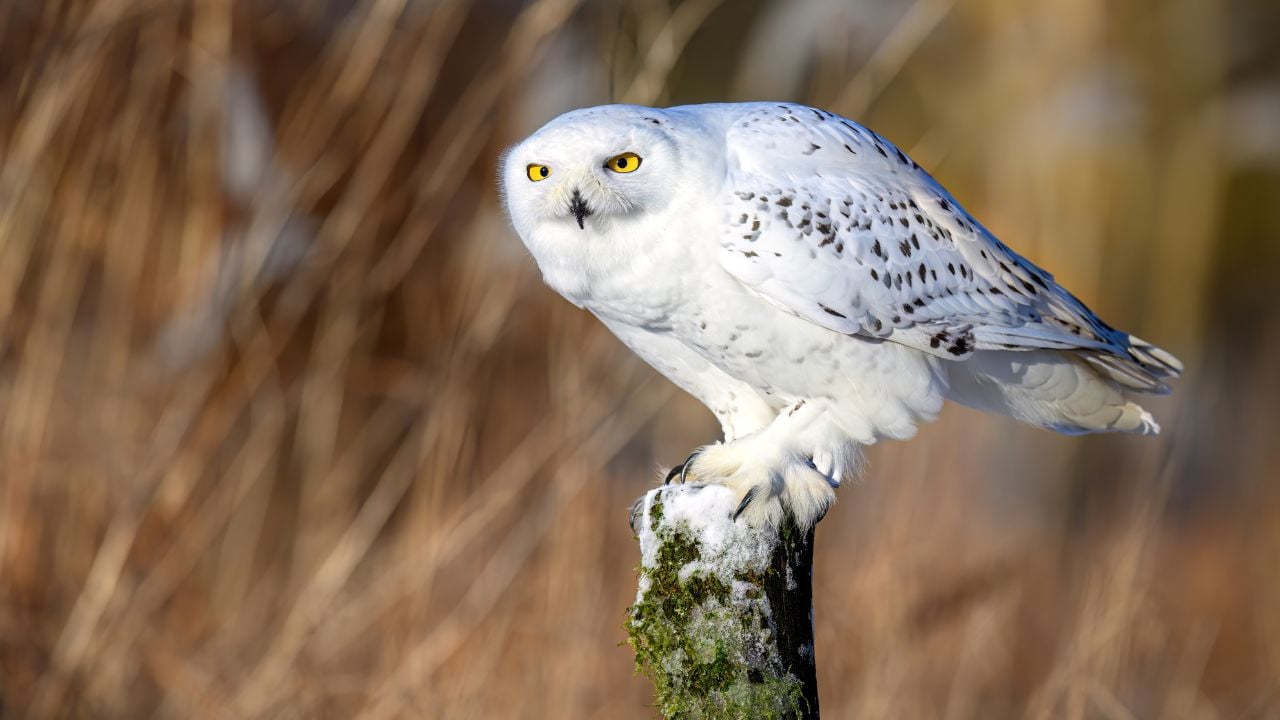
That white lump on a hay bale in a Wisconsin field might be a snowy owl.
They arrive from the Arctic around mid-November, so now’s the time to start looking for them.
Here’s what snowy owls do when they show up in Wisconsin every winter.
1. Landing on Open Ground
Snowy owls turn up at airports.
A Wisconsin Department of Natural Resources (DNR) research scientist said in 2023 that airports mimic the tundra in a way because they’re treeless and wide open.
That tundra, above the Arctic Circle, is where the owls nest.
Open grasslands, farm fields, wetlands, and ice-covered water are typical habitat too.
A state bird-monitoring coordinator also named harbors and breakwalls in Oconto, Manitowoc, Sheboygan, and Milwaukee as suitable habitat in 2013.
Snowy owls are also often found in suburban or urban settings, so your neighborhood could be worth a look.
When you go looking, scan the widest, flattest ground nearby before you check the trees.
2. Perching on Hay Bales and Poles
You may find a snowy owl roosting on the ground, a hay bale, a fence post, a telephone pole, a rocky break wall, a muskrat house, or a silo.
When the wind picks up, you can check the downwind side of buildings, hay bales, hedgerows, and rocks, where owls often seek shelter.
3. Staying Active by Day
Unlike many other owls, snowy owls are often active during the day.
Some hunt through the night, while others are quite active in broad daylight.
In winter, they tend to be most active around dawn and dusk.
If you drive past open fields at dawn or dusk, you’re out during the hours when they tend to be most active.
Watchers in New Glarus reported an owl active and catching prey for much of its stay in the winter of 2024-25.
4. Hunting Nearly Anything
From their perches, snowy owls seek nearly anything that moves, though many target voles, mice, and shrews.
Ducks and other waterbirds are surprisingly common prey, and rabbits, weasels, muskrats, and pigeons are also regularly taken.
If you watch one on a fence post, it may be scanning for a duck, a rabbit, or a mouse.
5. Settling Into Small Territories
Early-season snowy owls are often on the move, so you can’t count on finding one in the same spot day after day.
By late December and January, most have settled into smaller winter territories.
Badger, a juvenile female, stayed within about 0.7 square miles near Freedom in the days after researchers tagged her on Dec. 30, 2017.
In its 2025-26 update, the DNR said the owls already in the state should stay mostly put through February.
So an owl you find in January may still be around weeks later.
6. Arriving and Leaving
In most years, snowy owls arrive around mid-November and leave by the end of March.
Some years, you may spot them as early as mid-October, and they can linger well into April or even May.
Owls that stay through February tend to start wandering and head north later in March and early April.
A state bird-monitoring coordinator wrote in 2013 that December is often the month of peak snowy owl movements, so you may see more owls on the move then.
Where Snowy Owls Turned Up in 2023
By mid-February 2023, a DNR research scientist told Wisconsin Public Radio that only about 30 snowy owl sightings had been reported in the state.
A few owls were around the airport in Superior, in the northwest corner, and a few more were at Crex Meadow State Wildlife Area.
Others ran in a swath from Green Bay down through the Freedom area and Green Lake County into northern Dane County.
How Many Owls Show Up
At least small numbers of snowy owls reach Wisconsin each year.
Large numbers move in every few years, in what’s known as an irruption.
As of Jan. 5, 2026, about 59 snowy owls had been recorded statewide, compared with 84 at the same point a year earlier.
That still beat the 18 at the same point in 2023 and the 34 in 2022.
The DNR’s update called the 2025-26 total on par with a year without an irruption.
A February 2025 report said sightings had risen after two winters with low numbers.
So if you strike out one winter, the next can look different.
The Big 2013-14 Winter
Snowy owls got off to a slow start in Wisconsin in the 2013-14 winter, with only five reported before Thanksgiving.
Then relatively large numbers began funneling down the Lake Michigan shoreline.
By Feb. 9, the state’s total had reached 271 owls.
Hotspots ran from the Freedom area of eastern Outagamie County and Kewaunee County to Buena Vista Marsh in Portage County and the Highway 29 corridor between Menomonie and Wausau.
If you live near any of those spots, you’re in country where owls have turned up before.
Tracking Owls With Transmitters
Project SNOWstorm has tagged snowy owls in Wisconsin with solar-powered transmitters.
The transmitters log latitude, longitude, and altitude, at intervals that can be set as short as every 30 seconds.
Each unit weighs roughly 40 grams, or about 1.5 to 3 percent of an owl’s body weight.
A harness that goes over the wings holds each transmitter in place.
The data can show movement patterns, home range size, migration timing, and habitat use.
Tagged owls get names.
Buena Vista and Kewaunee are two Wisconsin owls that wore transmitters.
Psst! How much do you know about snowy owls? Take our quiz and see if you can ace it.
Quiz
Snowy Owl Pop Quiz
Answer nine questions on snowy owls and the people who track them. We bet you can’t get them all right. Prove us wrong?
Some snowy owls that spend winter in Wisconsin may end up in Russia. What body of water do they cross to get there?
Watching From a Distance
The DNR says you're too close if a snowy owl frequently looks at you, sits erect with open eyes in your direction, or flushes from its perch.
An owl near New Glarus often allowed a close approach, which may have been a way to conserve limited energy.
White plastic bags can fool you, since they're far more common than actual owls.
Slow down if you see an owl close to the road.
Don't flush an owl repeatedly, don't play audio recordings from your phone, and don't feed owls mice or other prey.
When you're viewing from a vehicle, turn off the engine so you don't interfere with the way an owl hunts by ear.
Keep flash photography to a minimum, since flash can disrupt an owl's activity patterns, especially after dark.
Ask a landowner for permission before you step onto private property, and keep public roads and access points clear.
5 Signs Wisconsin Lake Season Is Officially Over for the Year
Many boaters hold out as long as they can when lake season winds down in Wisconsin.
But the signs show up, if you know where to look.
5 Signs Wisconsin Lake Season Is Officially Over for the Year
8 Wisconsin Deer Season Rules Landowners Get Wrong Near a Property Line
Archery season is already open in Wisconsin, so hunters may be closer to your fence line than you think.
What you can do near that line, and what they can, isn't always obvious.
8 Wisconsin Deer Season Rules Landowners Get Wrong Near a Property Line
