
The Reason Hoosiers Are Called Hoosiers, and Why Nobody Can Agree on It

The earliest newspaper uses of “Hoosier,” from 1831, spelled it “Hoosher.”
Ask Hoosiers where the word came from, and you’ll hear more than one answer.
Here’s the reason Hoosiers are called Hoosiers, and why nobody can agree on it.
Cabin-Door Greeting
One popular Hoosier story starts at a settler’s cabin door.
In that legend, if you knocked, the settler called back asking who’s there.
If you slur the greeting together, the legend goes, you end up with Hoosier.
The Indiana Historical Bureau lists it among the popular theories, but its blog calls stories like it almost certainly apocryphal.
The Bureau notes no one ever explained why the greeting would be more typical of Indiana than of Illinois or Ohio.
The poet James Whitcomb Riley offered a rougher version.
He was joking.
In his telling, tavern brawls left stray ears on the floor, and a bartender’s careless question about whose ear it was supposedly turned into Hoosier.
Samuel Hoosier and the Canal
One Hoosier theory turns the word into a surname.
A contractor named Samuel Hoosier supposedly preferred to hire Indiana laborers over laborers from neighboring Kentucky for the Louisville and Portland Canal.
His crews became known as Hoosier’s men, the story goes, and the label shrank to Hoosier over time.
There’s a catch.
History.com reports that no record of a Hoosier or a similar name turns up in canal records.
The Indiana Historical Bureau’s page still lists a contractor’s workers among the popular theories, but it names the contractor only as Hoosier.
If you hear the canal version at a family cookout, you can politely ask to see the payroll.
Hussars, Huzzas and Hushers
A few Hoosier theories lean on words that sound close to it.
In one telling, rivermen who hushed their opponents in brawls became known as hushers, and the word drifted into Hoosier.
In another, a wrestler working as a boatman in New Orleans fought four men at once and shouted that he was a Hussher.
Other tellings trace the word to a mispronounced hussar, a European soldier, or to boatmen shouting huzza.
William D. Piersen wrote in a 2016 article that early explanations of the word reflected poorly on Indiana.
So some residents offered flattering origins, and the hussar and huzza versions are two you may have heard.
Piersen isn’t convinced.
If you’re weighing those two, he argues, neither one explains why people used the word as an insult in the early Southeast.
Psst! How much do you know about Indiana’s symbols and statehood? Take our quiz and see how many you can get right.
Quiz
Hoosier State IQ
Answer these questions on Indiana’s symbols and statehood. We bet you can’t get them all right. Prove us wrong?
Which of these Indiana state emblems did the state adopt first?
Dunn's Dialect Theory
Jacob Piatt Dunn Jr.'s 1907 study of the word Hoosier is one of the most thorough and accurate on the topic, the Indiana Historical Bureau's blog says.
Dunn traced the word to hoozer, a dialect word from Cumberland, now part of Cumbria, England.
He linked hoozer to hoo, an Old English term for high ground.
In his view, the word migrated up from the South as a slang term for uncouth countrymen.
Dunn offered several leads, including that English root and a word from India, huzur, that reached America by way of England.
He called huzur a stretch.
If you follow Dunn's trail, you get possibilities, not answers.
Historians still debate the question, and it's unlikely we'll ever know with any certainty where the word began.
Harry Hoosier
Harry Hoosier was a Black Methodist lay preacher whose speeches left a lasting impression on listeners.
By 1780, he was traveling with Methodist Episcopal Bishop Francis Asbury, and he drew large crowds of Black and white listeners.
He never preached in Indiana.
Scholar William D. Piersen has argued that the word Hoosier began in the South as a jab at Methodists who followed him.
Piersen admits the evidence is circumstantial, like the evidence for many of the other theories.
The Indiana Historical Bureau disagrees, saying no primary sources support the idea.
If you've seen the Harry Hoosier story online, you've seen a theory, not a settled fact.
Earliest Spellings
The earliest known newspaper uses of Hoosier, from mid-1831, spell it Hoosher, a 2008 Indiana Historical Society article reports.
One ran in a June issue of the Lawrenceburg Indiana Palladium.
A writer using Hoosher as a pen name was describing steamboat racing on the Ohio River.
If you search old newspapers for Hoosier, you may need to look for Hoosher as well.
The Indiana Democrat followed in January 1832 with a carrier's poem that used the word.
The spelling varied.
John Finley's Poem
Hoosier reached a national audience after former state representative John Finley's poem "The Hoosier's Nest" appeared in 1833.
The poem ran with the New Year's Day issue of the Indianapolis Journal, and other papers copied it.
Finley spelled the word Hoosher, too.
Finley portrayed a Hoosier as an industrious farmer, not an uncouth backwoodsman.
If you read the poem today, you'll find that picture of a Hoosier but no answer about where the word came from.
That image caught on.
First Written Use
The first written use of Hoosier depends on which source you check.
The Indiana Historical Bureau dates the earliest known written use to a February 11, 1831, letter that mentions a steamboat called the Indiana Hoosier.
The Indiana Historical Society's fact page lists an 1827 letter as one of the earliest known uses.
A 2008 article from the same society ties that 1827 date to a practical joke retold in an 1860 book.
If you see 1826 listed as the first use, that article calls the date an error.
From Insult to Pride
Indiana lawmakers took up the word Hoosier in 2023.
Rep. J.D. Prescott sponsored House Bill 1143, which sought to make "The Hoosier State" Indiana's official nickname.
It also sought to name Harry Hoosier the state's namesake.
The bill died in a House government committee on February 21, 2023, after historians questioned that origin story.
If you're a Hoosier, you carry a word that Piersen's article describes as an insult in the early Southeast.
An 1833 newspaper noted that people had called Indiana's residents Hoosiers for some time, sometimes as praise and sometimes not.
Pride took a while.
Dunn argued that locals took the nickname on with a sense of humor.
By the 1840s, it had general acceptance, a 2008 Indiana Historical Society article says.
Bartlett's Dictionary of Americanisms defined Hoosier in 1848 as a nickname for natives of Indiana.
The Indiana Historical Bureau's list of emblems and symbols now includes "The Hoosier State" as the state nickname.
7 Things Indiana and Illinois Drivers Do Differently at the State Line
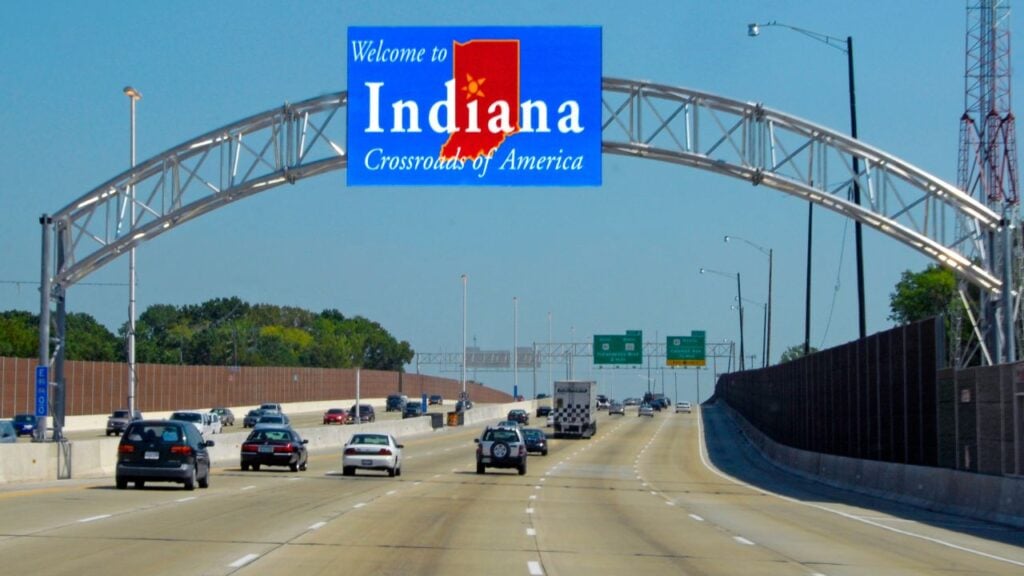
You're cruising down the highway, and the only sign you've left one state is a welcome sign on the shoulder.
Hoosiers and Illinoisans share that road but not the same rulebook.
7 Things Indiana and Illinois Drivers Do Differently at the State Line
7 Things Grandparents in Indiana Do at Bedtime That Their Own Parents Never Did

A grandparent's nightstand can look nothing like it did a generation earlier.
Here's what has changed after dark.
7 Things Grandparents in Indiana Do at Bedtime That Their Own Parents Never Did
