
7 Things That Happen on a North Carolina Christmas Tree Farm Before the First Tree Ships

You may not know it, but your Christmas tree gets a lot of attention before it ever reaches your living room.
Here’s what happens on a North Carolina Christmas tree farm before the first tree ships.
1. Spring Planting
Planting on a Christmas tree farm mostly happens in early spring, once the soil dries enough to work.
Most growers set about 1,600 trees to an acre.
Most growers now buy greenhouse-grown seedlings, which has shortened seedling production to one or two years.
On the steeper mountain sides, crews do all of the work by hand.
Fraser Fir Growing Time
A Fraser fir Christmas tree can take 12 to 15 years to go from seed to harvest.
In an outdoor nursery bed, a seedling can spend five years reaching a one-foot transplant.
Once it’s in the field, a 6-to-7-foot Fraser fir can take 7 to 10 years to grow.
Part of the reason is that a Fraser fir only puts on one flush of new growth each year.
2. Replacing Dead Trees
Young Christmas trees can die from drought, deer browsing, beetle grub damage to their roots or root disease.
Growers manage ground cover and weeds to give young trees a chance to grow.
Phytophthora root rot kills about 15% of North Carolina’s Christmas trees in a typical year, according to Ashe County Extension agent Blake Williams.
In 2025, he put losses closer to 18% to 20%, an uptick he called not overly concerning yet.
Walk a choose-and-cut farm and you may spot a bare patch where a tree died, and growers reset those gaps with new transplants.
3. Summer Shearing
Growers visit each Christmas tree at least 100 times for shaping, fertilizing and other care, according to North Carolina State University’s Extension service.
Shaping happens in early summer, and young trees may need only their tops pruned.
As a tree gets older, growers shear the sides with a long knife.
Growers shear for a full, dense look or a thinner, open look based on what customers want, and for a wide or narrow taper.
Growers fertilize and lime according to soil analysis reports, usually by hand.
A grower can spend seven to eight years shaping a Fraser fir before you ever see it on a lot.
4. Colored Ribbons
The Macon County Extension office says colored ribbons go up on a Christmas tree farm in the summer or sometime before harvest.
Some growers color-code the ribbons by height, so everyone on the farm can pick out the trees earmarked for harvest.
Psst! How much do you know about Christmas trees? Take our quiz and see if you can ace it.
Quiz
Christmas Tree Trivia
Test yourself on tree history and the Fraser fir. We bet you can’t get them all right. Prove us wrong?
In 1882, an associate of Thomas Edison wired electric bulbs onto his Christmas tree in a New York City parlor. How many did he use?
5. Pest and Algae Checks
Christmas tree growers regularly scout their fields for pests to see what problems may be developing.
In November 2025, the university's Extension service wrote about Cinara aphid eggs it had recently noticed on trees.
The aphids don't normally harm trees, but growers do better to remove colonies before they sell a tree.
Many farmers also find algae, which shows up as gray-green dust that rubs off when you scrape it with a fingernail.
It's most likely on older trees that grow close together.
Many farmers found it in 2025, and once algae grows on a tree, it's very difficult to remove.
6. Harvest Prep
Harvest on a Christmas tree farm begins around the start of November, so growers prepare storage areas and check their harvest equipment beforehand.
Growers may add extra fertilizer before harvest to improve tree color.
The harvest itself takes just 3 to 6 weeks, after as many as 12 to 15 years of growing.
Growers keep cut trees in storage areas that stay cool and humidified until a truck picks them up.
7. Cutting, Baling and Sorting
If you pass a Christmas tree farm during harvest, you'll hear chainsaws buzzing, according to the Macon County Extension office.
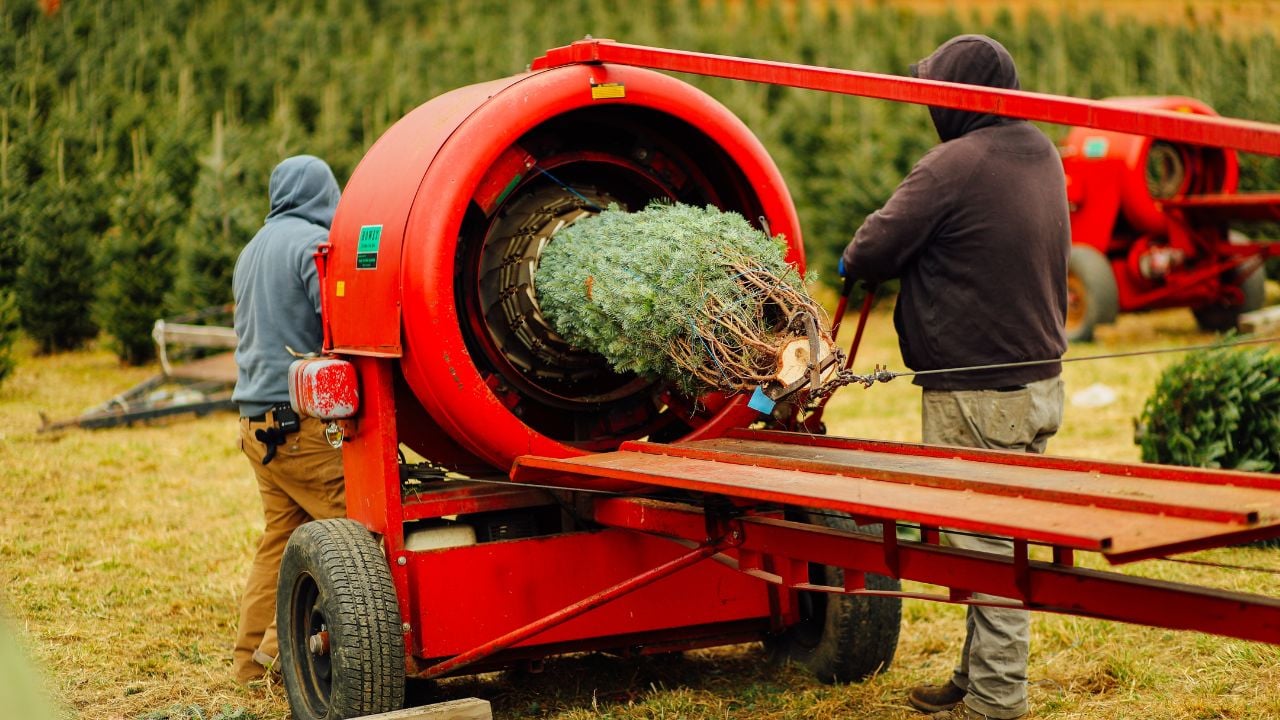
Field crews carry the freshly cut trees to a baler, where twine wraps around each tree and compresses it.
Handlers then sling a baled tree over a shoulder and hustle it to a nearby shady area for storage.
Sorting by size happens in the storage area, and most trees pass through workers' hands 6 or 7 times between the cut and a tractor trailer.
A loader with a conveyor belt can then feed the trees into a huge semi-truck.
White House Tree Pick
In 2024, a North Carolina farm supplied the White House Christmas tree for the 16th time.
White House staff visited Cartner's Christmas Tree Farm in Avery County in late October, looked at about six or eight trees and picked one.
The visit came weeks after Hurricane Helene devastated much of western North Carolina.
The tree stood 20 feet tall, and the Cartner family planned to present it to the First Lady on Nov. 25.
Top-Producing Counties
North Carolina ranked second in the nation for number of Christmas trees harvested, the state Department of Agriculture said in 2024.
North Carolina farms grow about 22% of the live Christmas trees grown in the U.S., harvesting over 3 million trees a year from more than 33,000 acres.
If your tree came from the mountains, it may have grown in one of the state's top six counties as of 2024.
Those are Ashe, Avery, Alleghany, Watauga, Jackson and Mitchell.
14 Things Only a North Carolina Childhood Teaches You

From barbecue loyalties to basketball rivalries, North Carolina kids pick up lessons early.
Some come with a plate of pork, and others come with a team color.
14 Things Only a North Carolina Childhood Teaches You
4 Regional BBQ Styles That Divide North Carolina Neighbors

Ask two North Carolinians how barbecue should be made, and you might get two different answers.
Whole hog, pork shoulder, vinegar sauce, and ketchup all have their defenders.
