
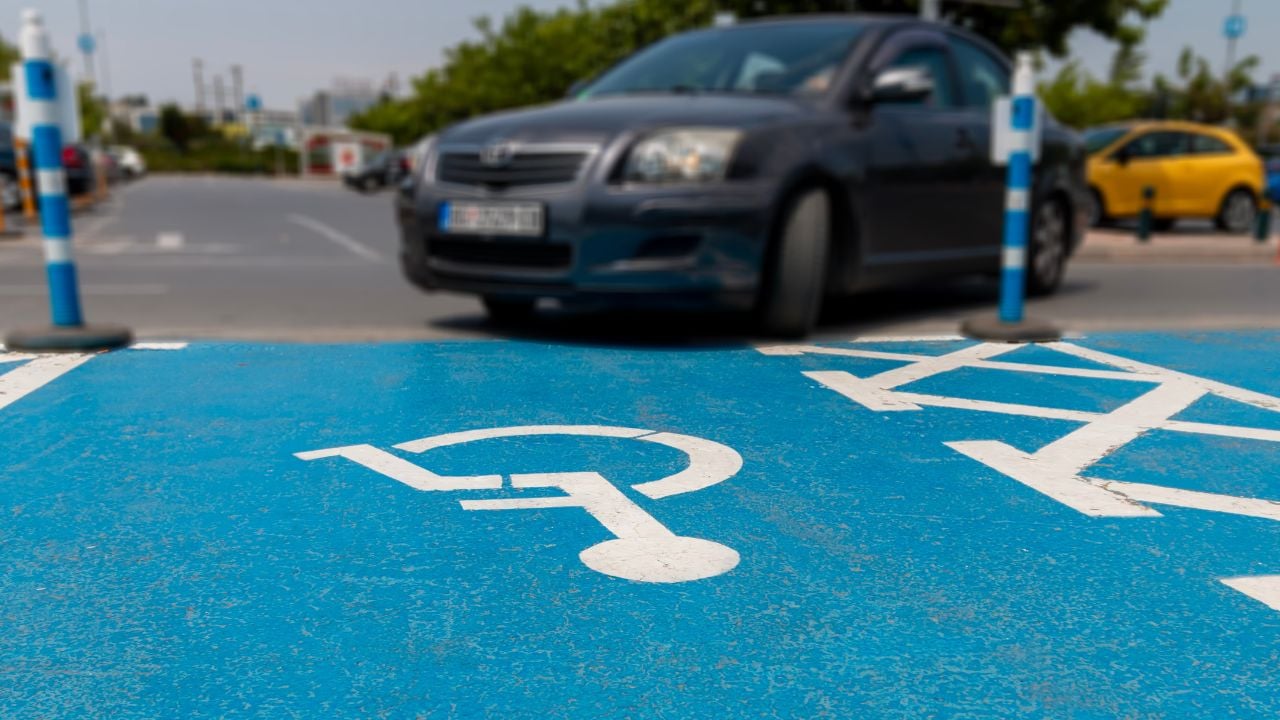
4 Things Marylanders Need to Get a Disability Parking Placard From the MVA

You’re ready to apply for a Maryland disability parking placard, and you want to get it right the first time.
There’s one signature the MVA won’t process the application without, and it isn’t yours.
Here’s what Marylanders need to get a disability parking placard from the MVA.
Note: This is general information, not legal or medical advice. MVA forms and procedures are subject to change, so confirm the current requirements with the MVA.
1. Maryland Disability Parking Placard Application (VR-210)
The VR-210 is the MVA’s one form for a placard application, and it covers disability plates too.
On one application, you can ask for one or two placards, one set of disability plates, or one placard and one set of plates.
2. Your Health Professional’s Certification
A licensed health professional has to certify your disability, either on the paper form or through the MVA’s online portal.
For a temporary placard, the MVA accepts a licensed physician, physician assistant, nurse practitioner, optometrist, podiatrist or chiropractor.
For a permanent placard, the VR-210 and Maryland’s plate law sort providers by condition.
A physician, physician assistant or certified nurse practitioner can certify any qualifying condition.
Chiropractors, podiatrists and physical therapists cover a narrower list that leaves out lung disease, heart disease and vision loss.
An optometrist can certify only the vision condition.
Who Can Skip the Provider’s Signature
The disability placard application has one exception to the provider’s signature.
If you’ve lost a foot, leg, hand or arm, state law lets you certify that condition yourself.
You do it in person at a full-service MVA office, with proper identification.
Loss of use of a limb isn’t covered by this exception.
3. Your Qualifying Disability
Your application has to show a qualifying disability, and the MVA splits placards into permanent and temporary.
Maryland’s list of qualifying conditions comes from state law, and the VR-210 prints it for your provider.
Maryland’s placard law requires you to be a state resident.
A parent or legal guardian can apply for a qualified minor.
If you’re a 100% disabled veteran, check the veteran box on the VR-210.
Send a Veterans Administration letter stating your disability percentage, as the form directs.
A temporary disability counts when it’s expected to last at least three weeks.
The temporary placard that follows may be valid for up to six months.
Psst! How much do you know about driving in Maryland? Take our quiz and see if you can ace it.
Quiz
Maryland Road Rules IQ
Answer these questions on Maryland’s traffic laws and driving rules. We bet you can’t get them all right. Prove us wrong?
A Maryland driver who passes a stopped school bus with its red lights flashing can face a fine of up to how much?
4. Your Completed Application
The fourth thing is the finished placard application in the MVA's hands, and you have three ways to get it there.
The MVA calls the online portal the fastest.
First, your provider can start the certification online after your appointment, and you then submit it through myMVA, the MVA's online services portal.
Second, you can complete your section of the VR-210, take it to your provider, and upload the finished form through myMVA.
Third, you can mail it to the MVA's Disability Unit, Room 202, at 6601 Ritchie Highway N.E. in Glen Burnie, Maryland 21062.
Which Conditions Qualify for a Disability Parking Placard?
The list has nine qualifying conditions for a disability parking placard.
Lung disease severe enough to meet the law's breathing-test limits qualifies.
So does cardiovascular disease classified as Class III or Class IV.
You also qualify if you can't walk 200 feet without stopping to rest.
The same goes if you can't walk without a brace, cane, crutch, another person or a prosthetic device.
Requiring a wheelchair for mobility counts.
Having lost a foot, leg, hand or arm counts.
Having lost the use of a foot, leg, hand or arm is a separate listed condition.
Permanent vision loss in both eyes counts when it meets the law's acuity or field limits.
A permanent disability that significantly affects your ability to walk also counts when going without the placard would cause hardship or risk injury.
Placard or Plates?
The placard application can also ask for plates, and the two work differently.
Disability plates are the permanent option.
A set can go only on a vehicle titled or leased to you.
The MVA issues them only at full-service office locations.
Placards are the portable choice.
They move from one vehicle to another.
You can also request up to two motorcycle disability plates with any placard or plate application.
Plates stay put.
Using Your Placard
Hang your placard from the inside rearview mirror, and take it down before you drive.
If your car has no usable mirror, display the placard on top of the dashboard on the driver's side.
Conceal your placard when you're not using it, to discourage theft.
Keep your copy of the certification with you whenever you use your placard.
You must present that certification to law enforcement on request.
What the Application Costs
The VR-210 says there's no fee for a placard.
Plates are different.
The form lists a $40 fee for plates, plus the registration fee if your vehicle's registration is due for renewal.
If you mail a plate application, include that payment, and never send cash.
Renewal and Expiration
Under Maryland law, a permanent disability placard stays valid until the holder's death.
The MVA still says to display the side of the placard that shows its expiration date.
If you need a temporary placard for longer than six months, the VR-210 says your provider can certify another period of up to six months.
Lost, Stolen or Damaged Placards
A lost placard doesn't mean starting over, since Maryland law lets the holder apply for a replacement.
For a lost or damaged placard, complete only Section A of the VR-210.
For a stolen placard, include the police report number and the jurisdiction that took the report.
For replacement plates, complete Sections A and B, since B covers the vehicle owner.
A replacement placard skips the provider's certification section, so you don't need a new certification.
FAQ
These answers cover the placard application, not plates.
Where do you send a Maryland disability placard application?
You can submit it through the MVA's myMVA online portal or mail it to the MVA Disability Unit, Room 202, 6601 Ritchie Highway N.E., Glen Burnie, Maryland 21062.
Who can sign the health professional section?
For a temporary placard, the MVA accepts a licensed physician, physician assistant, nurse practitioner, optometrist, podiatrist or chiropractor. For a permanent placard, it depends on the condition.
How long does a temporary placard last?
A temporary placard may be valid for up to six months, and it covers a disability expected to last at least three weeks.
Does a Maryland disability placard cost anything?
The VR-210 states there's no fee for a placard, while plates carry a fee.
Can you replace a lost placard?
Yes.
Maryland law lets the holder apply for a replacement when a placard is lost, stolen or damaged.
9 Maryland Habits That Place Someone Within an Hour of Home

How far from home do you live?
Your habits may answer that for you.
9 Maryland Habits That Place Someone Within an Hour of Home
9 Heirlooms Maryland Families Fight Over More Than Money
Dividing up the bank account is rarely what splits a Maryland family.
Some of the objects on the shelf start bigger fights.
