
Most of America’s Cranberries Come From Wisconsin. 6 Things Wisconsinites Know That Out-of-Staters Don’t

Thanksgiving is Nov. 26, and somebody at your table is going to reach for the cranberry sauce.
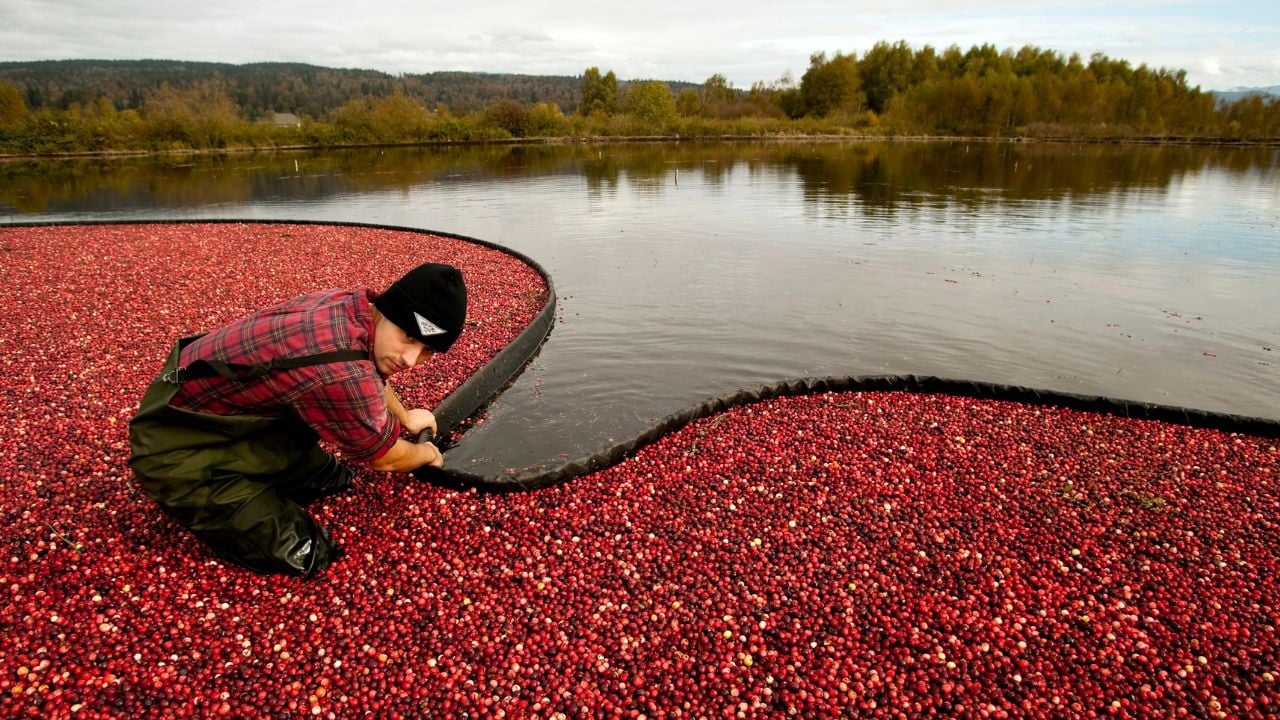
The berries in that bowl have a history in Wisconsin that goes back to the 1850s.
Here’s what Wisconsinites know about America’s cranberries that out-of-staters don’t.
1. Official State Fruit
The cranberry has been Wisconsin’s official state fruit since April 2004.
If you want the paper trail, the law names the cranberry the state fruit.
The University of Wisconsin-Madison’s State Climatology Office calls cranberries the state’s largest fruit crop by both quantity and economic value.
2. Passing Massachusetts
Wisconsin’s cranberry growers took over as the country’s leading producers in 1994.
By 1956, Wisconsin had become the second-largest source of cranberries, behind Massachusetts.
Wisconsin growers produced 4,605,000 barrels of the 7,508,000 that the U.S. Department of Agriculture (USDA) counted for the nation in 2025.
That’s about 61 percent.
Massachusetts, the old leader, grew 1,925,000 barrels in 2025, less than half of Wisconsin’s.
How USDA Counts Cranberries
USDA’s cranberry report lists total production by state, in barrels.
A barrel weighs 100 pounds.
Multiply by 100, and Wisconsin’s 4,605,000 barrels in 2025 come to about 460.5 million pounds, against 750.8 million nationwide.
The table doesn’t split production by product, so you can’t tell from it how many of those pounds were sold fresh.
3. Festival Season
Cranberry festivals fill the Wisconsin calendar from June to October on the Wisconsin State Cranberry Growers Association’s 2026 list.
The Cranberry Blossom Festival in Wisconsin Rapids opened the season June 18 to 21.
The schedule there had live music, a carnival and cranberry-based food.
Warrens held its Cranberry Festival September 25 to 27, which the list bills as the world’s largest cranberry festival.
The schedule included marsh tours, a large parade and a pancake breakfast.
If you wanted a look at a working marsh during harvest, Lake Nokomis offered free guided tours October 1 to 4.
Free samples of cranberry products were on offer too.
You could also have caught Eagle River’s festival October 2 to 4 at the Vilas County Fairgrounds, with cranberry beer and wine among the offerings.
Stone Lake followed on October 3 with a cranberry bake-off, marsh tours and a pie social.
The day also included a parade, crafts and a Krate Derby.
Psst! How much do you know about cranberries? Take our quiz and see if you can ace it.
Quiz
Cranberry Know-How
Answer nine questions on cranberry marshes, growers and harvests. We bet you can’t get them all right. Prove us wrong?
Contrary to popular belief, cranberry vines grow best in which setting?
4. Fresh Berries
Fresh cranberries reach buyers in the fall, and Habelman Bros. lists them from mid-September to mid-December.
The Agricultural Marketing Resource Center says only about 5 percent of U.S. cranberries are sold fresh.
Processors take the rest, mostly for juice and juice blends, so a bag of fresh berries in your cart is the exception.
About 20 percent of U.S. cranberry consumption comes during Thanksgiving week.
5. Dried Cranberries
Ocean Spray celebrated the completion of a $75 million expansion for dried cranberries at its Wisconsin Rapids plant in September 2008.
The new lines were built to make sweetened dried cranberries for ingredient customers and under the Craisins brand.
The expansion doubled the plant's size to 440,000 square feet.
Once both lines were running, the company expected capacity of more than 30 million pounds a year.
Your options for sweetened dried cranberries include three companies in the growers association's product listings.
One of them also lists cranberry concentrate.
6. First Marshes
In the early 1850s, commercial cranberry growing in Wisconsin began near Berlin, in Green Lake County, the Wisconsin Historical Society says.
Ho-Chunk people were already carrying on a large trade in cranberries with early settlers of Juneau County in 1849.
The center of the industry later moved to marshes around Tomah, Warrens and Wisconsin Rapids.
How Growers Got Organized
Wisconsin's legislature passed the Cranberry Law in 1867, giving growers the legal right to build dams to develop their marshes.
Growers formed the Wisconsin State Cranberry Growers Association in 1887 to address shared challenges.
The state's production peaked in 2016, when growers harvested 6.1 million barrels.
USDA's 2025 count of 4,605,000 barrels sits about 1.5 million barrels below that peak.
The industry's economic impact on the state is valued at nearly one billion dollars.
Beyond the Sauce
Wisconsin cranberries end up in more than sauce, according to the growers association's product listings.
One listing offers cranberry wine.
Another lists cold-pressed juice made from 100 percent Wisconsin cranberries, available seasonally starting in September.
A third lists unsweetened dried cranberries with no added sugars, juices or oils.
The 1904 Frost
The State Climatology Office says Wisconsin's cranberry crop lost more than half its fruit to frost in August 1904.
Weather observers in Jackson County reported subfreezing temperatures on August 18 of that year.
The Weather Bureau's Milwaukee office then began issuing cranberry frost advisories.
A National Weather Service office in Milwaukee has since created a Frost and Freeze Decision Support Tool that shows growers frost probabilities.
The state's main cranberry harvest typically runs from late September through October.
It can stretch into mid-November.
Historically, Wisconsin cranberries often lacked a vibrant red color because of the short growing season.
A University of Wisconsin-Madison breeding program developed an early-maturing hybrid named HyRed, which lets growers harvest before autumn frosts.
This Year's Forecast
USDA's August forecast has Wisconsin's cranberry growers harvesting 195,000 more barrels in 2026 than in 2025.
Massachusetts is forecast to dip by 25,000 barrels over the same stretch.
Nationwide, the forecast is 7,870,000 barrels, up from 7,508,000 in 2025.
New Jersey's forecast is up 161,000 barrels, to 610,000.
Wisconsin's forecast of 4,800,000 would again be about 61 percent of that total.
USDA labels the 2026 numbers a forecast, so the final tally can differ.
That extra 195,000 barrels would add up to 19.5 million pounds of berries.
7 Assumptions About Wisconsin Winters That Locals Correct
You've lived through enough Wisconsin winters to think you've got this one figured out.
A few things you take for granted may only be half true, and the records say which.
7 Assumptions About Wisconsin Winters That Locals Correct
7 Things Wisconsinites Order at Culver's That Out-of-Staters Never Think to Try
By the time you reach the Culver's counter, you've probably decided what you're getting.
Many Wisconsinites go off script.
7 Things Wisconsinites Order at Culver's That Out-of-Staters Never Think to Try
