

7 Things Hoosiers Over 40 Remember About Marsh Supermarkets

You unloaded your cart at a Marsh checkout more times than you could count, and you never gave the scanner in front of you a second thought.
That machine has a bigger place in grocery history than you’d guess.
Here’s what Hoosiers over 40 remember about Marsh Supermarkets.
1. Village Pantry Stores
Marsh Supermarkets once owned the Village Pantry convenience stores.
The company’s April 2005 annual report listed 161 Village Pantry stores in central Indiana and western Ohio.
Of those, 107 sold fuel, about 80% of them under the Marathon brand.
Fifty-nine had seating.
Of the 161, 146 had ATMs.
Many people probably still remember a Village Pantry stop.
Village Pantry began separating from Marsh in 2007, a decade before the supermarkets closed.
2. First Barcode Scan
The Smithsonian says the first installation of supermarket scanners entered service on June 26, 1974, in a Marsh supermarket in Troy, Ohio.
A package of Wrigley’s chewing gum was the first purchase made with those scanners.
The Smithsonian’s record for the scanner says the pack that was scanned stayed with Marsh’s Clyde Dawson.
Marsh’s April 2005 annual report said all of its supermarkets had electronic scanning checkout systems.
It also said Village Pantry used scanning at 100% of its front end.
3. Fresh I.D.E.A. Card
Marsh Supermarkets’ shopper card was the Fresh I.D.E.A. Card.
Marsh’s April 2005 annual report said over 800,000 active cards were in circulation.
The card gave shoppers electronic coupons and chances to win trips and other prizes.
Shoppers could also pick a VISA co-branded version and earn rebates on credit card purchases.
In 2002, Marsh introduced MyMarsh, a program that tracked individual customer spending to tailor incentives and rewards.
4. Symphony on the Prairie
Symphony on the Prairie’s title sponsor from the series’ start in 1982 was Marsh Supermarkets.
The Indianapolis Symphony Orchestra staged the outdoor summer concerts on the grounds of Conner Prairie Interactive History Park.
If you caught a concert there in the 1990s, Marsh was the title sponsor.
Marsh also sponsored the White River Park State Games and Computers for Education, according to the Encyclopedia of Indianapolis.
The company’s 35-year run as title sponsor ended in 2017, the year it filed for bankruptcy.
5. O’Malia Food Markets
In 2001, Marsh bought O’Malia Food Markets.
It bought Carter’s Supermarkets that year and Mr. D’s Fresh Food Markets in 2003.
Those two chains were rebranded as Marsh Supermarkets, while O’Malia’s kept its name.
Marsh’s April 2005 annual report listed eight O’Malia Food Markets and called them upscale neighborhood stores.
It also listed 38 LoBill Foods stores, a smaller, low-price format.
6. Speedway Catering
Crystal Food Services was Marsh’s food-service division.
It offered banquet hall catering, special events catering and concession services, among other work.
Marsh’s April 2005 annual report claimed the company was the largest caterer of special events at the Indianapolis Motor Speedway.
It also said the company was the exclusive foodservice provider of the RCA Tennis Championships and ran concessions at the Indianapolis Zoo.
If you ate at a special event at the Speedway around 2005, the catering may have come from Marsh.
7. 2017 Closing
In 2006, Sun Capital Partners bought the family-owned Marsh Supermarkets for $88 million in cash and the assumption of $237 million in debt.
Eleven years later, Marsh said in May 2017 that it was prepared to close its remaining stores within two months.
It closed 19 stores that month and filed for bankruptcy protection.
Kroger and Fresh Encounter agreed to buy 26 of the 44 stores left for a total of $24 million.
Eighteen stores had no buyer.
Bakery Counters
Marsh’s April 2005 annual report listed bakeries in 116 of its 117 supermarkets.
Its department list also included delicatessens in 116 stores, floral shops in 77 and Ticketmaster outlets in 35.
The “Chef Fresh” program offered take-home items in 116 stores, made in the company’s central kitchen.
Marsh also stocked regional favorites such as Roselyn Bakery recipe pastries, cakes and cookies, according to the Encyclopedia of Indianapolis.
Psst! How much do you know about Indiana? Take our quiz and see how many you can get right.
Quiz
Hoosier State Trivia
Answer these questions on Indiana’s state symbols and landmarks. We bet you can’t get them all right. Prove us wrong?
Which famous New York landmark is built with Indiana limestone, the state stone?
Why the Chain Struggled
By the mid-1990s, Marsh was the nation's 38th-largest food retailer, with about $1.3 billion in annual sales and more than 4,000 employees in the Indianapolis area, according to the Encyclopedia of Indianapolis.
Financial problems followed as competition from Kroger and Meijer grew.
Meijer began opening stores in Indiana in 1994.
Marsh's 2005 push beyond its Indiana-Ohio markets, including into the Chicago area, failed within a year.
After the Sun Capital purchase, Marsh replaced its store-branded products with less-known Food Club brands.
The change brought bigger profit, but stores lost customers who had been loyal to the store brand.
By early 2017, reports said some stores were struggling to pay rent.
Sun Capital sold controlling interest in Marsh to JT Grocery Consulting on March 24, 2017.
Where the Buildings Went
Some former Marsh stores have found new uses since the 2017 closings, according to the Encyclopedia of Indianapolis.
One in Broad Ripple became a church.
Another, in Carmel, served as a temporary library location.
If you needed a used rotisserie in summer 2017, Marsh's Anderson, Indiana, warehouse had some for sale.
Forklifts, frozen food cases and grocery carts were up for sale as well, through July 30, according to a June 21, 2017, AndNowUKnow report.
5 Indiana Small-Town Traditions That Still Run Every Fall Like It's 1975
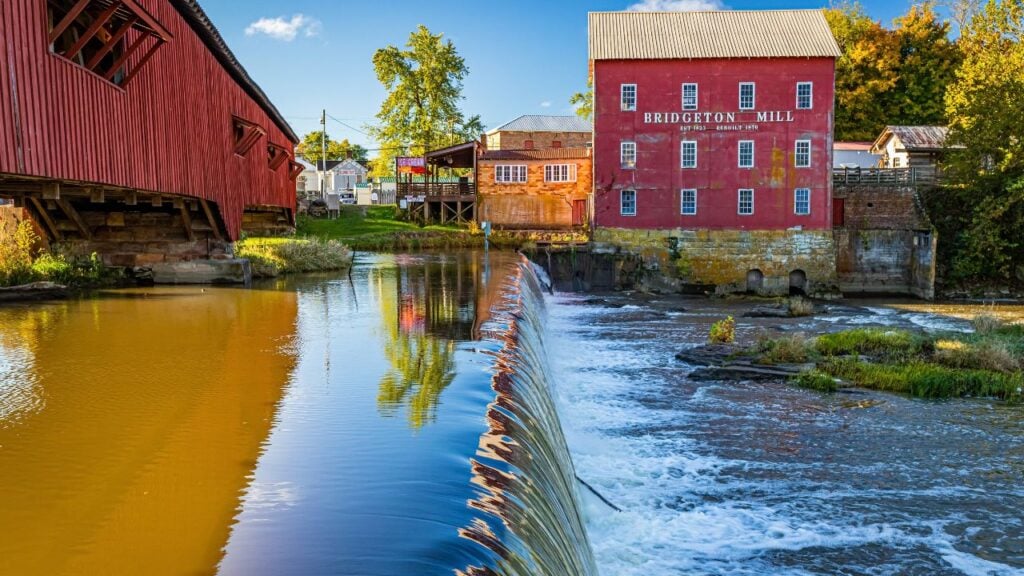
When the leaves turn, several small Indiana towns fill their streets with festivals.
Some have been going for generations, and many Hoosiers plan their autumn weekends around them.
5 Indiana Small-Town Traditions That Still Run Every Fall Like It's 1975
10 Things Hoosiers Do That Confuse Everyone Who Moves to Indiana

Show up to an Indiana pitch-in carrying nothing but a bottle of wine, and nobody will say a word.
Many Hoosiers would sooner let you work it out on your own.
10 Things Hoosiers Do That Confuse Everyone Who Moves to Indiana
