
7 Montana Driving Laws Most Drivers Have Never Heard Of

Heading down a long Montana grade, you might be tempted to shift into neutral to save gas. Don’t.
It’s the kind of rule you never hear about until you break it.
Here are the Montana driving laws most drivers have never heard of.
Note: This is general information, not legal advice. Traffic laws and equipment rules are subject to change, so confirm the current requirements with the Montana Department of Justice.
1. Funeral Procession Right-of-Way
The right-of-way rule for funeral processions lets the cars behind the lead vehicle follow it through an intersection despite a traffic signal, as long as each driver uses reasonable care.
The lead vehicle gets no such break, since it has to follow the signal when it reaches the intersection. The cars in line still have to yield to an approaching emergency vehicle with a siren or lights.
Drivers outside the procession can’t cut in. They can’t drive between its moving vehicles unless a police officer authorizes it or they’re driving an emergency vehicle with a siren or lights on, and they can’t join the line just to get the right-of-way.
A green light doesn’t change that. If a procession is running a red, you can’t enter the intersection unless you can do it without crossing its path.
The cars in line have a few requirements too. They can’t go faster than 55 mph on a highway posted 55 or higher.
On other roads, they go no faster than 5 mph under the limit, and their headlights and taillights have to stay on.
The law defines a procession as two or more vehicles driving in the daylight hours, with the remains of the deceased in one of the vehicles.
2. Slowing for Farm Equipment
Drivers who come up behind an agricultural vehicle have to slow to its speed, according to the farm equipment law.
Drivers may pass the vehicle where passing is allowed.
During harvest, a combine on a two-lane road through wheat country can set the pace for a long line of traffic.
When an agricultural vehicle is coming toward you, the law says to drop to half the posted speed limit, so 35 mph on a road posted 70.
On a multi-lane road, you move out of the lane closest to the center line when it’s safe.
Hay trucks count.
The definition covers a vehicle hauling hay or straw, along with farm tractors, farm implements and self-propelled farm equipment.
Farm drivers have a duty too, since the law tells them to turn off at the nearest safe turnout once a line of vehicles forms behind them.
3. Move-Over Speeds
A stopped law enforcement vehicle, emergency vehicle or highway worker vehicle with its emergency lights on triggers a speed drop for drivers under the move-over law.
If a temporary speed limit is posted, that’s the speed to slow to.
Without a posted number, the amount depends on the road. With room to change lanes, you drop 20 mph below the limit on an interstate and 30 mph below on a state highway or county road.
If you can’t change lanes, or you’re on any other road, the speed is half the posted limit.
You have to move away from the vehicle, too. Until flaggers or signs are posted, that means a lane that isn’t next to it on a multi-lane highway, and as far over as you safely can otherwise.
Montana Move-Over Speeds by Road Type
The move-over law works out to 60 mph on an interstate posted 80 when you can change lanes, and 40 mph when you can’t.
On a state highway posted 70, it’s 40 mph with a lane change and 35 mph without.
On a county road posted 50, it’s 20 mph with a lane change and 25 mph without.
4. Passing Speed Allowance
Drivers can go 10 mph over the limit to pass another vehicle.
The extra speed applies on a two-lane road and in a designated passing zone, and you have to return safely to the right-hand lane.
Outside a designated passing zone, the usual limit stays the maximum.
5. Studded Tire Dates
On a high pass like Lookout or MacDonald, ice can show up before drivers are ready for it.
Ordinary studded tires are one answer, but you can run them only from October 1 to May 31.
Studs can’t stick out more than one-sixteenth of an inch past the tread.
School buses get a longer window, from August 15 through June 15.
You can use tire chains when snow, ice or other conditions tend to make a vehicle skid.
The Montana Department of Transportation (MDT) can go further and require chains or other traction devices on a stretch of highway when conditions turn dangerous.
When MDT decides chains are the only fix, the requirement covers the tires on the driver wheels of one axle, studded tires included.
Psst! How much do you know about Montana’s roads and the rules that govern them? Take our quiz and see if you can ace it.
Quiz
Montana Roads IQ
Answer these questions on Montana’s roads, rules and records. We bet you can’t get them all right. Prove us wrong?
The lower 48 states’ record cold, minus 70 degrees in January 1954, was recorded at a mining camp near which Montana pass?
6. Driving Through a Stream
Under the streambed law, you can't drive a motor vehicle or off-highway vehicle in the water of many streams and rivers on state or federal land.
It reaches some waters that flow through private land, too.
A shallow creek can look like an easy shortcut when you're in a truck on a dry day.
Roads are the exception.
A vehicle may cross where an established road or trail enters or crosses a stream.
The crossing has to take the shortest practical or designated route to the road or trail on the opposite bank.
A land agency can authorize driving below the high-water mark in writing, or designate a route for it.
A person who can't walk can use an off-highway vehicle in the streambed for recreation, as long as the driving is prudent and minimizes destruction.
7. Coasting Downhill
Drivers on a long downgrade might be tempted to slip into neutral to save fuel, but the coasting rule says you can't.
The wording names two ways to coast, leaving the transmission in neutral or manually disengaging the clutch.
It applies to anyone driving a motor vehicle, not just a truck, and it doesn't say how steep the grade has to be.
Between the mountain passes and river canyons, Montana has no shortage of downhill road.
Staying in gear with the clutch engaged keeps you within the rule on the way down.
7 Rules Montana Ranch Roads Follow That Aren’t Posted Anywhere
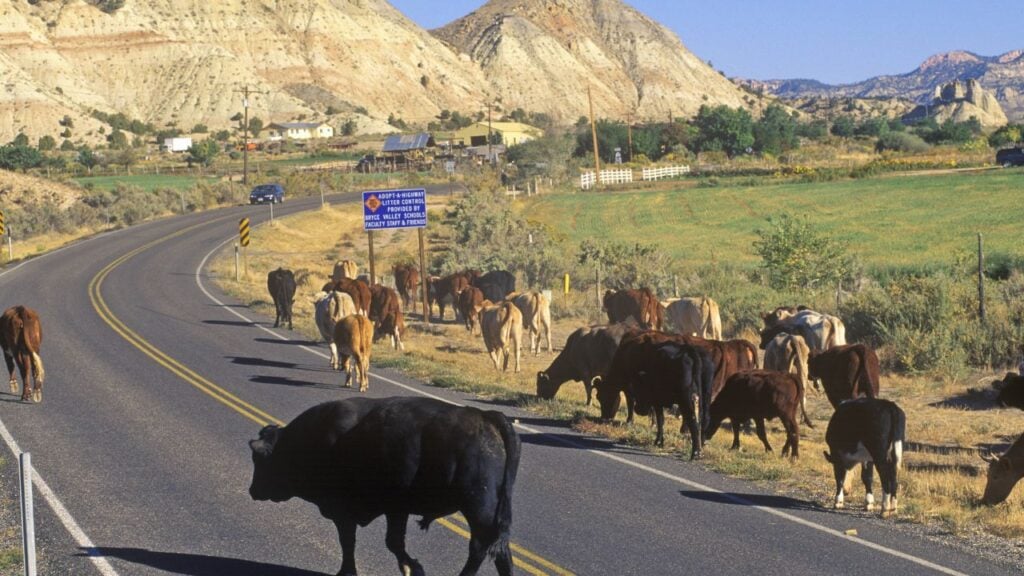
A Montana gravel road can run for miles without a single sign.
The law still applies out there, and a newcomer can easily miss how.
7 Rules Montana Ranch Roads Follow That Aren’t Posted Anywhere
9 Things Out-of-Staters Get Wrong About Montana

A trip to Montana can come with a few surprises for visitors.
This list covers the things out-of-staters often get wrong about the state.
