
7 Things Michiganders Can’t Legally Do to a Trespasser

Michigan’s firearm deer season opens Sunday, Nov. 15, and more people will be out in the woods.
If someone ends up on your land, pointing a gun at them can turn you into the one facing charges.
Here’s what Michiganders can’t legally do to a trespasser.
Note: This is general information, not legal advice. Michigan laws and court rulings are subject to change.
1. Deadly Force Over Property
Michigan law doesn’t let you use deadly force on a trespasser simply for being on your land.
The Self-Defense Act allows deadly force when you honestly and reasonably believe it’s necessary to prevent imminent death, imminent great bodily harm or an imminent sexual assault.
Protecting property isn’t on that list.
The law also drops any duty to retreat anywhere you have the legal right to be, but only if you aren’t committing a crime at the time.
The Break-In Presumption
Michigan law adds a presumption that you reasonably feared death or serious harm when you use force on someone breaking into a dwelling or business premises.
A dwelling is a structure or shelter used permanently or temporarily as a place to live, and a business premises is a building or other structure used for business.
Either term also covers a structure attached to it.
A court can rebut that presumption, and it doesn’t apply in several cases, including when the other person has a legal right to be there.
Because the presumption is tied to breaking in, someone crossing your lawn doesn’t trigger it.
2. Spring Guns and Traps
A spring gun or trap set for a trespasser can land you in jail.
Michigan makes it a crime to set a spring gun, or a trap or device that fires or explodes, and leave it unattended.
The penalty is up to a year in county jail or a fine of up to $500.
If the device kills someone, the law calls it manslaughter.
That includes a trespasser.
Other traps can bring civil liability too.
Under Michigan’s Trespass Liability Act, you can be liable if you injure a trespasser through willful and wanton misconduct.
The Michigan Supreme Court read that phrase in 1994 as covering an intent to harm, or reckless conduct from which intent can be inferred.
3. Pointing a Gun
Pointing a gun at a trespasser can turn you from the property owner into the defendant.
Pointing or aiming a firearm at another person intentionally but without malice is a misdemeanor in Michigan.
It carries up to 93 days in jail, a fine of up to $500, or both.
Felonious assault covers assaulting another person with a gun.
It’s a felony with a base penalty of up to four years in prison, a fine of up to $2,000, or both.
Michigan’s Supreme Court defines assault to include an unlawful act that places another person in reasonable fear of an immediate battery.
You don’t have to fire a shot for it to count.
Self-defense is the exception.
Whether it applies depends on the facts.
4. Holding Them Until Police Arrive
Holding a trespasser until police arrive can expose you to criminal or civil liability.
Trespassing after being forbidden to enter or told to leave is a misdemeanor in Michigan.
It carries up to 30 days in county jail, a fine of up to $250, or both.
Michigan generally lets you make an arrest for a felony, or when a peace officer summons you to help.
Misdemeanor trespass isn’t on that list.
Confining someone on purpose can also bring a civil false imprisonment claim.
If you hold a trespasser at gunpoint, Michigan’s unlawful imprisonment law can apply.
Restraining someone by means of a weapon is a felony punishable by up to 15 years in prison, a fine of up to $20,000, or both.
5. Damaging Their Property
A trespasser’s car, tools and phone still belong to that person.
Slashing a trespasser’s tires is a crime under Michigan’s malicious destruction law.
The law covers anyone who willfully and maliciously destroys or injures another person’s personal property.
At $1,000 or more in damage, it’s a felony.
If a car is parked on your land without your consent, Michigan lets you have it towed as an abandoned vehicle by contacting a local towing agency.
The towing agency then has to notify police before it removes the vehicle.
That’s the lawful route.
6. Using Force Beyond Self-Defense
Force against a trespasser has to stay inside what the Self-Defense Act allows, or you can face an assault charge.
The Act allows force short of deadly force when you honestly and reasonably believe it’s necessary to defend yourself or someone else from imminent unlawful force.
Defending your land isn’t in that wording.
Assault and battery is a misdemeanor in Michigan, with a base penalty of up to 93 days in jail, a fine of up to $500, or both.
7. Taking Their Belongings
If you take a trespasser’s phone, keys or tools, it can be larceny.
Michigan’s larceny law covers stealing the property of another person.
For property worth under $200, the base penalty is up to 93 days in jail.
Property worth $200 to under $1,000 carries up to a year in jail.
At $1,000 or more, it’s a felony, and the maximum starts at five years in prison.
Treating a trespasser’s property as yours can also bring a claim under Michigan’s statutory conversion law.
It allows three times the actual damages plus costs and attorney fees.
When Trespass Becomes a Crime
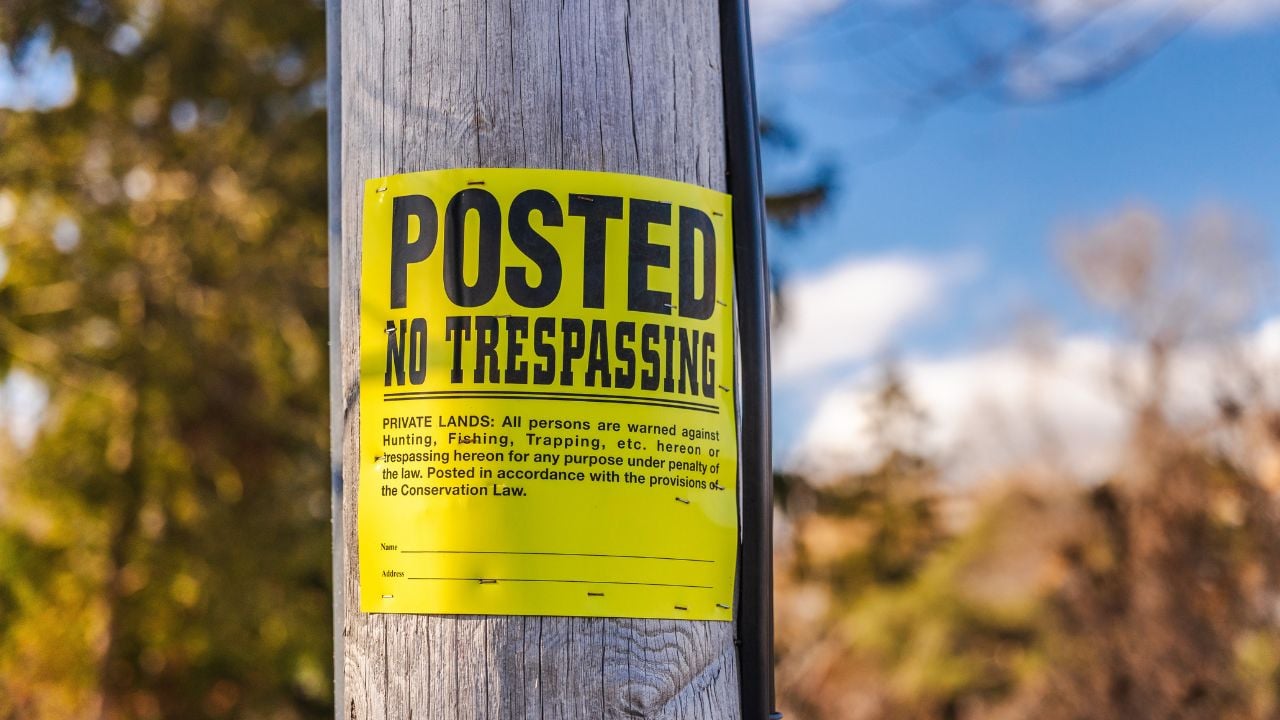
Michigan treats trespass on fenced or posted farm property as a separate offense.
Entering or staying there without the owner’s consent is a crime, and no warning is required.
Michigan’s Recreational Trespass Act sets separate sign rules for recreation and trapping on fenced or posted land.
If you post your land, each sign needs letters at least 1 inch tall and a size of at least 50 square inches.
The signs also have to be spaced so a person can see at least one at any point of entry.
Farm property and connected woods need consent for recreation or trapping whether or not you’ve fenced or posted them.
The DNR says hunters need permission from the landowner before they hunt farmlands, connected woodlots, private land or fenced property.
This year’s regular firearm deer season is set for Nov. 15 through Nov. 30.
Owner Liability Limits
Michigan’s Trespass Liability Act sets liability limits, not bans.
It says you owe a trespasser no duty of care.
If you know, or should know, a trespasser is there, you can be liable for active negligence.
A second rule covers a limited area of land where trespassers constantly intrude.
If you know or should know about that spot, you have to use reasonable care for their safety during any activity there that risks death or serious bodily harm.
A child who trespasses on your land isn’t treated like an adult trespasser under the Act.
If a man-made hazard on your land injures a child, you can be liable when all of the Act’s conditions apply.
They include that you knew or had reason to know children would likely trespass, and that the child was too young to realize the risk.
Another condition asks whether removing the danger would have cost you little compared with the risk.
The hazard also has to involve an unreasonable risk of death or serious bodily harm to a child.
Squatters and Lockouts
A trespasser who moves into your empty property loses some protections under Michigan law, but you can’t treat that person any way you like.
Michigan’s anti-lockout law protects tenants from changed locks and cut utilities.
That protection excludes an occupant who took possession by forcible entry or holds it by force.
It also excludes an occupant who came in by trespass with no claim to ownership or other right to possess the property.
A separate section lets an owner enter premises held that way without having to enter peacefully.
But that section says a forcible entry can’t include conduct covered by Michigan’s assault laws.
Some squatter and former tenant disputes turn on the facts, so a court may have the final say.
Psst! How much do you know about Michigan’s land and hunting laws? Take our quiz and see if you can ace it.
Quiz
Michigan Land Law IQ
Answer these questions on Michigan hunting seasons, land rules and property law. We bet you can’t get them all right. Prove us wrong?
A hunter’s wounded deer runs onto a neighbor’s private land. What does the Michigan DNR say about going after it?
Limited Rights to Enter
Some people have a limited legal right to enter your land.
An angler wading or floating a navigable public stream can enter within the clearly defined banks without written or oral consent, even on fenced, posted or farm property.
A person can also enter on foot to retrieve a hunting dog, as long as they carry no firearm and enter only to get the dog.
They have to leave within a reasonable time, and the right is lost if you've already prohibited entry in writing or orally.
In 2005, the Michigan Supreme Court ruled that the public may walk the Great Lakes shore below the point where the water's action leaves a distinct mark.
The same ruling says the state's role as trustee of the public's rights in the lakes can't justify trespassing on private property.
4 Documents a Michigan Boat Title Transfer Falls Apart Without

You shake hands on a used boat, pay the seller and start planning your first trip.
Michigan may not see the deal as done until a few key documents are in order.
4 Documents a Michigan Boat Title Transfer Falls Apart Without
5 No-Fault Insurance Choices That Leave Michiganders Exposed After a Crash

Many drivers want a lower car insurance bill, and Michigan lets you trim your coverage to save money.
But each cut can carry a catch that leaves you paying out of pocket.
5 No-Fault Insurance Choices That Leave Michiganders Exposed After a Crash
