
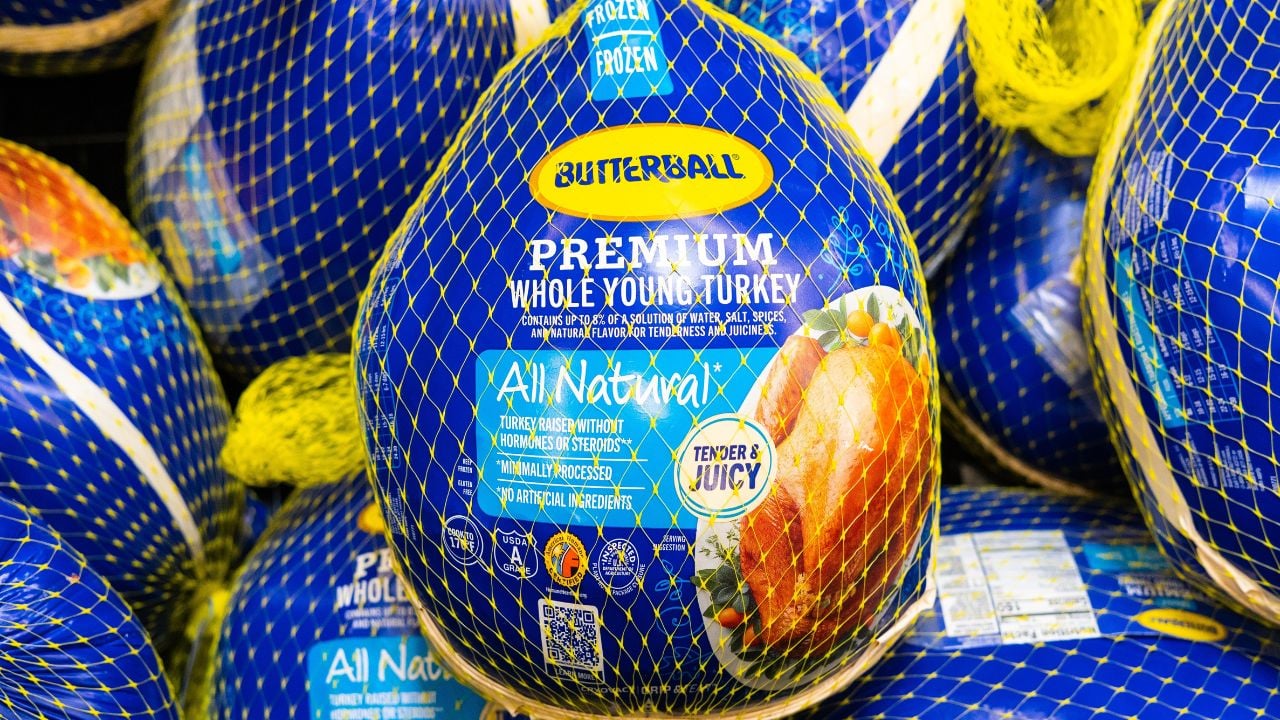
SOS! Butterball Answers Thousands of Turkey Emergencies. 6 That Can Ruin a North Carolina Thanksgiving

Thanksgiving is Nov. 26, and the turkey you pull out of your oven looks perfect.
But but looking perfect and being perfect are two totally separate things.
Here are the turkey emergencies Butterball hears about that ruin Thanksgiving in North Carolina the most.
1. Still-Frozen Turkey
Thawing was the top question callers brought to the Butterball Turkey Talk-Line in 2019, Popular Science reported.
Butterball says a refrigerator thaw takes at least a day for every 4 pounds.
That means a 16-pound turkey has to be in your refrigerator by Sunday, Nov. 22, four days before Thanksgiving on Nov. 26.
If the middle is still icy when you slide the turkey into the oven, plan on cooking it at least 50% longer, according to North Carolina Cooperative Extension.
Butterball’s Cold-Water Thaw Math
Butterball’s cold-water thaw takes 30 minutes for every pound of turkey, so a 20-pound turkey needs about 10 hours.
You change the water every 30 minutes the whole time.
The turkey stays fully submerged.
That same 20-pound turkey needs at least five days in the refrigerator, so cold water saves you more than four days.
2. Counter Thaw
Counter thawing is a food safety emergency, and North Carolina Cooperative Extension agents advise against it.
Bacteria such as salmonella and campylobacter can grow on the turkey and spread to your counter and anything else it touches.
A veteran Talk-Line employee told Ad Age about a caller whose husband put the turkey in a bath with the kids, Popular Science reported in 2019.
Popular Science added that other people have apparently tried dishwashers and electric blankets.
Neither is thawing.
The bottom shelf of your refrigerator and a sink of cold water both thaw a turkey safely.
Microwave thawing works too, as long as you follow the manufacturer’s instructions and cook the turkey right after.
3. Underdone Turkey
Golden skin and clear juices aren’t reliable signs of doneness, according to North Carolina Cooperative Extension.
That means a turkey can look finished long before it is.
Use a thermometer.
Butterball says you should push an oven-safe thermometer deep into the lower part of the thigh, without touching the bone.
Butterball’s roasting instructions call a whole turkey done at 170°F in the thigh and the breast.
University of Illinois Extension puts the minimum for turkey at 165°F, so Butterball’s number gives you a five-degree cushion.
Butterball says to let the turkey stand 15 minutes after it comes out of the oven, before carving.
4. Undercooked Stuffing
The stuffing inside a turkey can still be unsafe to eat after the meat is done.
Stuffing has to reach 165°F, whether it’s cooked inside the turkey or in a separate dish, according to a Haywood County extension agent.
Butterball tells you to move the thermometer to the center of the stuffing once the thigh is up to temperature.
That’s two readings.
Stuff the turkey loosely, with about three-quarters of a cup of stuffing per pound.
Do it right before the turkey goes in the oven.
Baking your stuffing in a separate dish avoids the problem.
The U.S. Department of Agriculture (USDA) recommends cooking stuffing separately, according to University of Illinois Extension.
5. Turkey Fryer Fire
A turkey fryer can turn Thanksgiving dinner into a house fire.
The North Carolina Office of State Fire Marshal says Thanksgiving is the leading day for home cooking fires in the United States.
A partly frozen turkey can make hot oil splatter and ignite.
Butterball says you should fry only a fresh turkey or a turkey that’s completely thawed, then pat it dry first.
It also says to leave at least 3 to 5 inches between the oil fill line and the top of the pot.
An overfilled pot can spill over and start a fire.
Set the fryer on a flat, non-flammable surface outdoors, away from your home, deck and overhangs.
Never leave the fryer unattended.
6. Dry Turkey Breast
Rushing your oven can dry out a turkey’s breast meat.
Butterball Turkey Talk-Line specialist Karen Wilcher said in a 2021 interview that raising the oven temperature to speed up cooking could dry out the breast meat.
Butterball’s roasting instructions say to loosely cover the breast with foil when the turkey is about two-thirds done, to prevent overcooking.
North Carolina’s Turkey Farms
If you’re carving a turkey on Nov. 26, your bird could have come from Butterball’s home state of North Carolina, which raised about 27 million turkeys in 2024.
North Carolina ranked second in the nation by headcount and first by weight, according to North Carolina State University’s College of Agriculture and Life Sciences.
The 2025 National Thanksgiving Turkey, Gobble, and its alternate, Waddle, were both North Carolina natives raised in Wayne County.
Psst! How much do you know about the Thanksgiving turkey? Take our quiz and see if you can ace it.
Quiz
Turkey Trivia
Answer these questions on the history, farming and science of the Thanksgiving turkey. We bet you can’t get them all right. Prove us wrong?
Many people say President Truman gave the first presidential turkey pardon in 1947. What does the Truman Library say it found?
Reaching Butterball's Talk-Line
The Butterball Turkey Talk-Line opened Monday, Nov. 2, and runs through Dec. 24, Butterball said in a Sept. 28 release.
That release says more than 50 experts answer your questions by phone, text, email, chat and social channels.
You can call 1-800-BUTTERBALL or text 844-877-3456.
In 2021, Butterball said the line helped more than 4 million cooks each November and December.
The line's first season, in 1981, brought in 11,000 calls, Butterball said.
12 North Carolina Weather Records That Still Stand Today
Some weather records fall every few years.
Others in North Carolina have lasted for generations.
12 North Carolina Weather Records That Still Stand Today
9 Things a North Carolina Landlord Can't Legally Do to Renters in 2026

Rent is hard enough to cover without worrying about what your landlord is allowed to do.
Here's what North Carolina renters can count on their landlords not to do.
9 Things a North Carolina Landlord Can't Legally Do to Renters in 2026
