
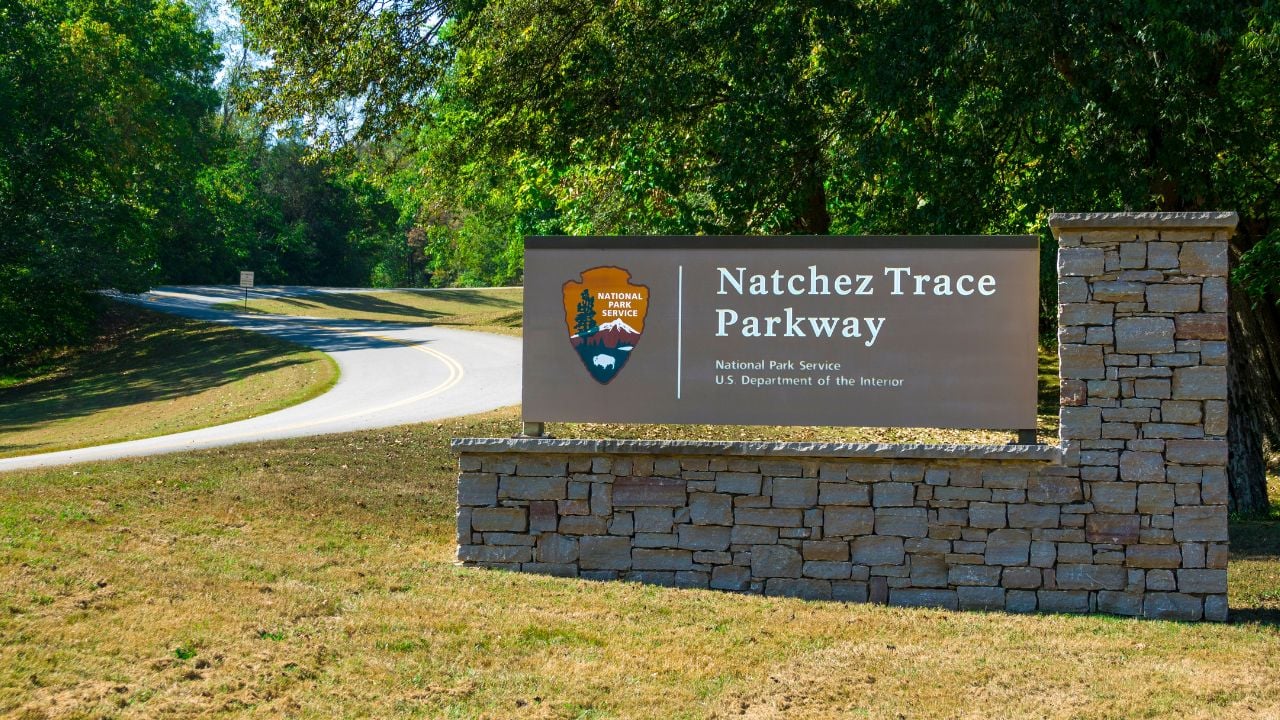
The Natchez Trace Has No Gas Stations for 444 Miles. 6 Rules Mississippians Follow That Out-of-Staters Don’t

If you’re taking the Natchez Trace to Thanksgiving dinner, you probably figure it’s just a prettier way to get there.
It pays to be prepared, though.
Here’s why the Natchez Trace rules Mississippians follow that out-of-staters don’t.
1. No Commercial Vehicles
You won’t share a lane with a delivery truck because the Natchez Trace Parkway bans commercial vehicles.
Commercial tour buses need advance permission, though school buses may travel without it.
RVs are allowed.
The National Park Service says some areas are closed to them, so check before you go.
The lanes are also narrower than normal roadways.
2. Fueling First
Fill up before you turn onto the Natchez Trace Parkway, which has no gas stations, food or lodging on its 444 miles by design.
Those services sit in the towns along the route, so top off whenever you pass through one.
Watch the gauge.
Rest stops usually come within 50 miles of each other, so they’re less of a worry than fuel.
3. Speed Limit
The speed limit on the Natchez Trace Parkway is 50 mph, unless a sign says otherwise.
It’s a recreational road and scenic drive, not a shortcut.
Wildlife can turn up on the road, especially in the morning and evening.
If you need your phone, pull over in a safe spot first.
Give it a full day.
How Long the Natchez Trace Takes
The Natchez Trace Parkway runs from Milepost 0 near Natchez to Milepost 444 near Nashville.
At 50 mph, that works out to just under nine hours of steady driving.
In practice, the full drive from Natchez to Nashville takes at least 10 hours.
The drive from Tupelo to Natchez takes 5.5 to 6 hours.
Count on 3.5 to 4 hours between Tupelo and Jackson.
4. Sharing the Lane With Cyclists
The Natchez Trace Parkway is a designated bicycle route, so you’ll share your lane with riders.
They have the same rights and responsibilities as drivers.
Give them at least 3 feet when you pass.
With lanes only 11 feet wide, you’ll pass a rider by moving into the other lane, and only when no one is coming.
Take your time.
Riding groups of eight or more need a permit, and so do commercial bicycle tours.
5. Camping Only in Campgrounds
The Natchez Trace Parkway allows camping only in its designated campgrounds, and it doesn’t allow dispersed camping.
The route has three campgrounds, all of them free and primitive, on a first come, first serve basis.
None of them offers electricity, showers or dump stations, so you’ll need to plan for that.
Rocky Springs Campground, at milepost 54.8, is the closest to Jackson and Natchez.
It has 22 sites.
If you stay there, you can follow self-guiding walking trails through the old Rocky Springs town site and the spring.
Psst! How much do you know about the Natchez Trace? Take our quiz and see if you can ace it.
Quiz
Natchez Trace Trivia
Answer nine questions on the Old Trace and the parkway that follows it. We bet you can’t get them all right. Prove us wrong?
After floating goods down the Mississippi to Natchez, what did Kaintuck flatboatmen do with their boats?
6. Leaving Artifacts Alone
Federal law protects archeological sites and artifacts on the Natchez Trace Parkway.
You can't dig, collect artifacts or use a metal detector.
Violations can bring jail time, fines or confiscated equipment.
Found an artifact?
Leave it where you found it.
Photograph it with a landmark, then show a park ranger your pictures and the location.
Please don't post the photos on social media.
Emerald Mound
Emerald Mound sits near milepost 10.3 on the Natchez Trace Parkway, so you'll reach it within the first 11 miles if you're heading north from Natchez.
It's the second-largest Mississippian Period ceremonial mound in the United States.
The mound covers eight acres and measures 770 feet by 435 feet at its base.
It stands 35 feet high.
Two secondary mounds on top bring the total height to about 60 feet.
People of the Mississippian culture built and used it between 1200 and 1600 C.E.
Mount Locust
Mount Locust, a historic inn and plantation, sits at milepost 15.5 on the Natchez Trace Parkway.
You'll find it about five miles past Emerald Mound, so you can see both in one stretch.
The Fergusons bought the property in 1784, and the park service calls the house one of the oldest structures still standing in the area.
Inns like it gave travelers shelter along the Trace from the 1790s to the 1840s.
They were called stands.
A cemetery at the site holds the remains of 43 enslaved people.
The Sunken Trace
At the Sunken Trace, milepost 41.5 on the Natchez Trace Parkway near Port Gibson, thousands of walkers, riders and wagons wore the Old Trace down in places where the ground was loess soil.
Today you can walk the deeply eroded trail yourself.
Plan on five minutes.
Tupelo Visitor Center
The Natchez Trace Parkway Visitor Center near Tupelo is open daily, from 9 a.m. to 4:30 p.m.
It closes on Thanksgiving, December 25 and January 1.
Paper maps are available there.
You can pick one up before you start driving.
Pharr Mounds
You'll pass the Pharr Mounds at milepost 286.7 on the Natchez Trace Parkway, a complex of eight dome-shaped mounds.
Native people of the Middle Woodland era built them around 2,000 to 1,800 years ago.
That's older than Emerald Mound.
The site spreads over 90 acres.
The park service asks you to respect the mounds.
6 Things Mississippians Know About Catfish That Out-of-Staters Never Learn
Catfish is dinner on a plate.
But there's a lot more to it in Mississippi than that.
6 Things Mississippians Know About Catfish That Out-of-Staters Never Learn
7 Porch-Sitting Habits That Give Away a Mississippi Upbringing
A Mississippi porch isn't decoration.
Its habits go unexplained to anybody who didn't grow up on one.
7 Porch-Sitting Habits That Give Away a Mississippi Upbringing
