
The Lost Colony Wasn’t Lost the Way North Carolina’s Legend Tells It. 5 Things the Roanoke Story Leaves Out

If you grew up in North Carolina, you probably heard the Lost Colony story told as a mystery with no answers.
Historians have more to go on than that, though.
Here’s how the Lost Colony wasn’t lost the way North Carolina’s legend tells it, and what the Roanoke story leaves out.
1. A Settlement Taken Apart
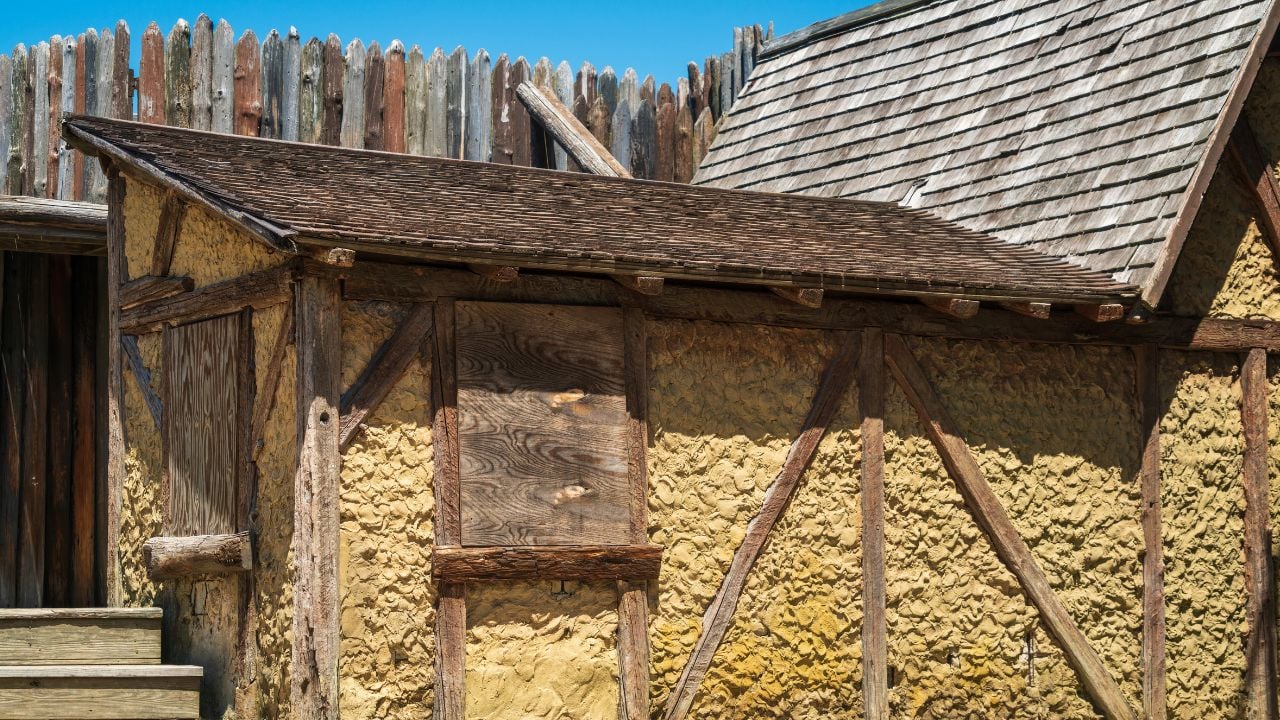
When John White returned in 1590, he found the Lost Colony’s houses taken down.
A high palisade of large trees still enclosed the site.
White also found iron bars, two lead ingots and four iron guns lying around the site.
You may have pictured a camp that emptied in a panic.
A standing palisade and heavy iron may not fit that picture.
Your hasty-exit picture also has to account for five chests the colonists had carefully hidden.
Three of them were White’s.
2. A Signal Agreed in Advance
The Lost Colony’s settlers and John White agreed on a signal before he sailed for England in 1587.
If the colonists moved, they’d carve their destination on a tree.
If an attack forced them out, they’d add a Maltese cross.
When White got back on August 18, 1590, he found CROATOAN carved on a post in the fort.
He had already found the first three letters, C-R-O, carved nearby.
There was no cross.
What Roanoke’s Missing Cross Can’t Tell You
The Lost Colony’s missing cross tells you only that the colonists didn’t signal an attack.
The National Park Service says there have been many theories about their fate, but none can be proved.
3. The Trip White Never Made to Croatoan
The Lost Colony’s message pointed to Croatoan, the principal town of the Croatoan people near Cape Hatteras.
In 1587, the colonists reportedly discussed moving about 50 miles inland rather than about 60 miles south to a barrier island.
The Croatoan people’s fields and towns were on the sound side of Hatteras Island, between today’s Buxton and Hatteras.
If you’ve driven that stretch, you’ve been near them.
White never got there.
Stormy weather and ship problems made a trip to Croatoan impossible in 1590.
Seven mariners drowned, and White sailed away without searching nearby areas.
He couldn’t make contact with any of the colonists.
By 2006, archaeologists had partly excavated a site on Cape Creek, near Cape Hatteras, that may be the principal Croatoan town.
The finds include European trade goods, though that alone doesn’t tie them to the colonists.
Psst! How much do you know about the Outer Banks? Take our quiz and see how many you can get right.
Quiz
Outer Banks IQ
Answer these questions on the Outer Banks and its early English history. We bet you can’t get them all right. Prove us wrong?
Blackbeard’s last battle, at Ocracoke Inlet, took place in which year?
4. Bertie County Pottery
The First Colony Foundation dug for traces of the Lost Colony's settlers on the north side of Salmon Creek in Bertie County, first in 2012 and more widely in 2014.
The crews found English pottery, including border ware and storage jars.
Archaeologist Nick Luccketti estimated that six to eight colonists, possibly ten, were there for an undetermined length of time.
He has argued the main group didn't go to Croatoan because a drought put heavy pressure on the food supply.
A 2020 Smithsonian report says a second site, two miles away, has yielded many more ceramic fragments.
Not everyone is convinced.
East Carolina University archaeologist Charles Ewen says he's skeptical of the dig team's theory.
Scott Dawson of the Croatoan Archaeological Society argues that all the colonists went to Hatteras Island and that the pottery probably arrived through trade.
If the dig team is right, your picture of one colony at one fort needs a second location.
5. Dare Stones
The Lost Colony story gained a new chapter in November 1937, when a California tourist named Louis Hammond showed up at Emory University in Atlanta with a 21-pound stone.
He said he'd found it near Edenton.
The inscription was signed with the initials E.W.D., which people took to mean Eleanor White Dare, one of the colonists.
It told of an attack that left only seven colonists alive.
More stones followed.
In all, 48 stones turned up between 1937 and 1940.
Bill Eberhardt supplied 42 of them, and NCpedia says all 42 were later deemed forgeries.
If you see a Dare Stone message quoted online, check which stone it came from before you trust it.
Reporter Boyden Sparkes exposed the hoax in the April 26, 1941, Saturday Evening Post.
Emory history professor Haywood Pearce Jr., who had championed the first stone, went to the newspapers and admitted he'd been duped.
Hammond's first stone is still up for debate, and NCpedia says it has the potential to date from the colonists' era.
Roanoke's 1937 Outdoor Play
Roanoke's story reached the stage on July 4, 1937, when the outdoor play The Lost Colony premiered at the newly built Waterside Theatre on Roanoke Island.
Playwright Paul Green was hired that January.
President Franklin D. Roosevelt saw it on August 18, 1937, the 350th anniversary of Virginia Dare's birth.
Organizers reached out to the Works Progress Administration, the Civilian Conservation Corps and the Federal Theatre Project for help.
The play ran 37 shows its first season.
If you wanted a seat that first summer, you paid $1.00 for an adult ticket and 25 cents for a child under 12.
The Waterside Theatre went unused from 1942 to 1945.
The play returned in 1946.
A National Park Service page updated in 2025 says Native people have played all of the Native roles since the 2021 season.
In 2024, the show's summer season was set to run every night except Sunday through Aug. 24.
14 Things Only a North Carolina Childhood Teaches You
What did growing up in North Carolina teach you?
Some of the lessons might surprise even lifelong locals.
14 Things Only a North Carolina Childhood Teaches You
12 North Carolina Weather Records That Still Stand Today
How long can a weather record last?
Some North Carolina records are older than you'd think.
