
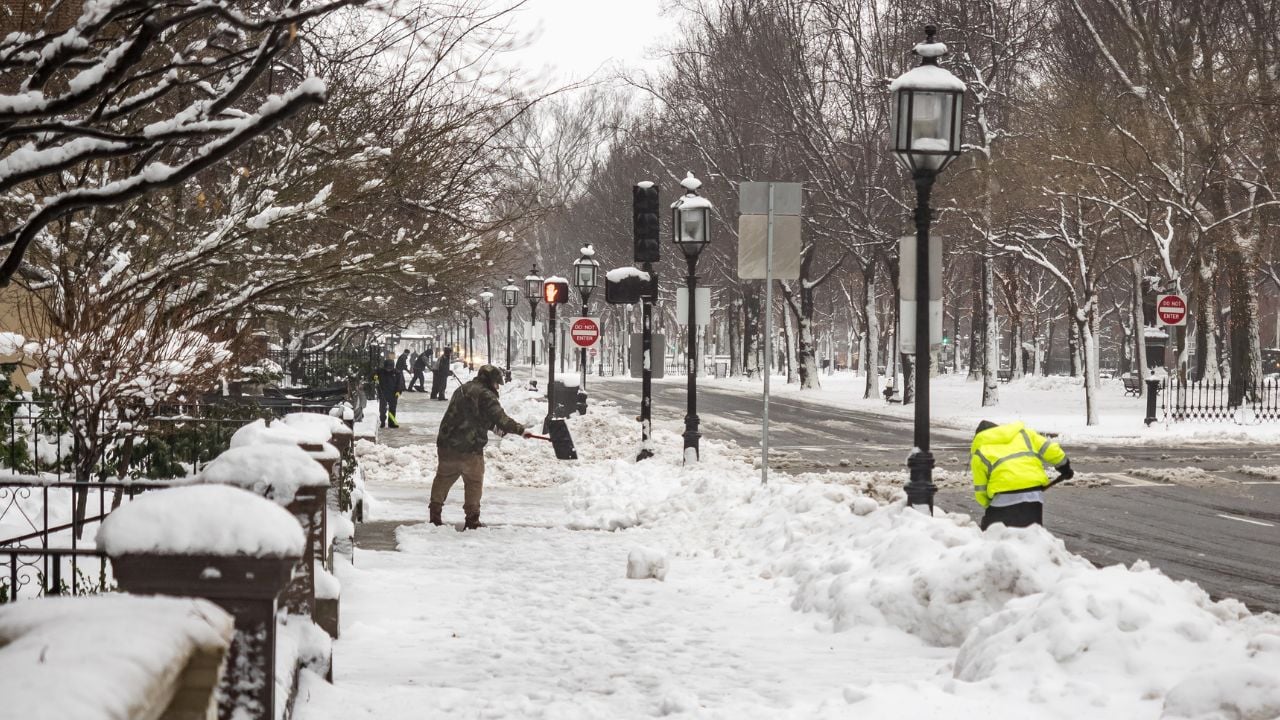
5 Snow Shoveling Rules That Can Get Bay Staters Fined

If you own a home in Boston, the morning after a big storm probably starts with a cup of coffee and a shovel.
Where you toss that snow matters as much as how fast you clear it.
Here are the snow shoveling rules that can get Bay Staters fined.
Note: This is general information, not legal advice. Snow rules and fine amounts are subject to change.
1. Sidewalk Clearing Deadline
Boston’s sidewalk rule gives you three hours after the snow stops falling.
If you own property in Boston, you have to clear the sidewalks and curb ramps next to it within that window.
When the snow falls overnight, the three hours start after sunrise.
The rule is three hours, but the city says it tries to be reasonable about when it starts counting.
The fine depends on the building.
Residential property with 16 or fewer units pays $50.
A larger residential building pays $100.
Commercial property pays $200.
Boston counts each day you leave the snow as a separate violation, so two days at $200 a day costs $400 on a commercial sidewalk.
What Counts as Cleared in Boston
Boston’s sidewalk rule asks for a path at least 42 inches wide, enough for a wheelchair or a stroller.
Ice gets a separate standard. Remove it down to bare pavement, or level it as much as you can and treat it with sand, sawdust, or similar material.
Boston’s rules page puts it simply: “Our goal isn’t to fine you.”
The city is looking for an accessible path of travel.
2. Snow Pushed Into the Street
Boston asks residents not to shovel or push snow into the street.
If you do, the city may fine you, and the amount depends on how much snow ends up in the street.
Residential property with 16 or fewer units pays $50 for one cubic yard or less and $100 for more than that.
Larger residential buildings face $100 and $150 for the same two amounts.
For commercial property, the fines are $150 and $200.
The same fines apply if you move snow from private property onto a sidewalk, not only into the street.
3. Somerville’s Daylight Deadline
Property owners in Somerville have six daylight hours after the snow stops to clear the sidewalks next to their property.
The rule covers residents and businesses alike.
The fines rise with each offense.
For a house with one, two or three units, the fines run $100, $200 and $300 for the first, second and later offenses.
Commercial property and residential buildings with more than four units pay $150 the first time and $300 for later offenses.
A three-family house in Somerville pays $100 for a first offense, double the $50 Boston charges residential property with 16 or fewer units.
If Somerville has to clear your sidewalk, the city may add fines and place a lien on your property.
4. Worcester’s 10-Hour Window
Worcester wants sidewalks cleared within 10 hours after the snow stops falling.
The job falls to property owners or occupants.
The path has to be 4 feet wide.
Clear the curb ramps at corners that border your property, too.
The fine for missing the deadline is $75 a day.
If you don’t clear the sidewalk, the city may clear it and seek reimbursement from the owner or occupant.
5. Cambridge’s 1 p.m. Cutoff
Cambridge property owners have 12 hours after daytime snow stops falling to clear the sidewalk.
When the snow falls overnight, the deadline is 1 p.m.
If an overnight storm leaves you shoveling at 2 p.m., you’re already late.
Cambridge wants ice removed within 6 hours of forming.
The fine is $50 a day.
Psst! How much do you know about Boston’s snowiest storms? Take our quiz and see if you can ace it.
Quiz
Boston Snow IQ
Answer these questions on Boston storms and New England winters. We bet you can’t get them all right. Prove us wrong?
What share of Boston-area commuter rail trains ran on time in February 2015?
Snow Emergency Arteries
Boston will ticket and tow your car if you park on a posted snow emergency artery during a declared snow emergency.
Both conditions have to apply. The street has to be a posted artery, and the city has to have declared an emergency.
The city's snow pages don't list a dollar amount for that ticket, which is why this rule sits outside the numbered list.
Space Savers and Hydrants
Boston's fine schedule lists $100 for parking at a fire hydrant and the same amount for parking on a handicap ramp.
The city asks you to clear any snow that may be blocking a handicap ramp, fire hydrant or storm drain.
Boston allows a space saver only when the city has declared a snow emergency.
After the emergency ends, you have 48 hours to use a space saver.
After the February 2026 emergency, that deadline was 6 p.m. on Feb. 26.
In the South End and Bay Village, space savers are banned at all times.
Space savers that break these rules may be collected and discarded by the Public Works Department.
Liability Beyond the Fine
In Massachusetts, a fall on an icy sidewalk can lead to a lawsuit, not just a fine.
In 2010, the Supreme Judicial Court ended the old split between natural and unnatural accumulations of snow and ice in Papadopoulos v. Target.
Before that ruling, a slip-and-fall case could turn on whether the snow fell naturally or was moved there.
That old defense is gone.
Now property owners owe the same duty of reasonable care for snow and ice as for any other hazard on their property.
If someone slips on your sidewalk, the question becomes whether you used reasonable care.
The justices applied the new rule to that case.
They set aside the summary judgment for the defendants and sent the case back for another look.
7 Heating System Problems Bay Staters Find on the First Cold Night

Is your furnace ready for the first cold night?
Finding out the hard way is no fun.
7 Heating System Problems Bay Staters Find on the First Cold Night
9 Things That Confuse Everyone Who Moves to Massachusetts

Nobody hands newcomers a manual when they move to Massachusetts.
They sign a lease, register a car, and find out things work differently than back home.
