
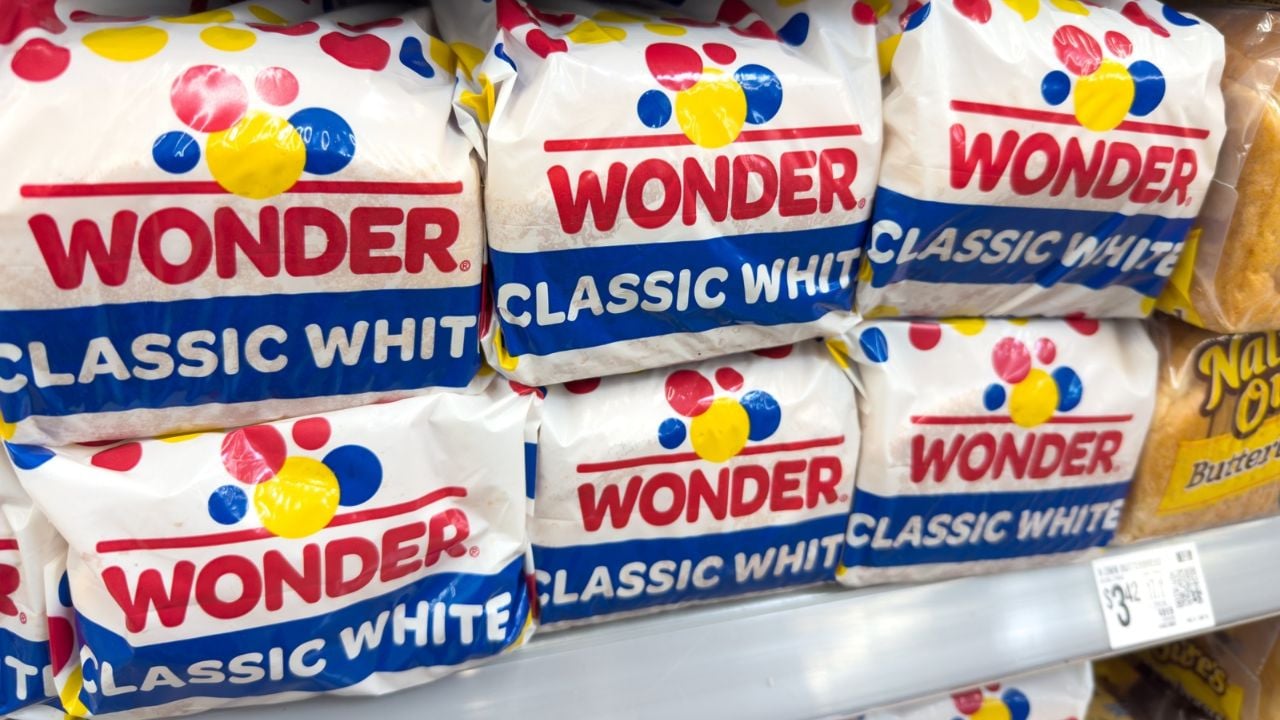
A Loaf of White Bread Costs Minnesotans Over 30% More Than in 2019, Even After Falling From Its 2024 Peak

Making turkey sandwiches with your Thanksgiving leftovers today?
The price on your bag of bread depends on a lot more than the wheat inside it.
Here’s why white bread still costs over 30% more than in 2019, even after falling from its 2024 peak, and where Minnesota fits into the story.
White Bread in September
White bread averaged $1.830 a pound across the United States in September 2026, according to the Bureau of Labor Statistics (BLS).
It’s a U.S. city average, so it isn’t a Minnesota price.
The figure is a price per pound for all pre-packaged white bread, whatever size the loaf is.
So think of it as an average per pound, not the sticker on one loaf in your cart.
In November 2019, the same series showed $1.361 a pound.
Only December’s $1.363 was higher that year.
From that November to September 2026, the change in the average price was a 34.5% rise.
For every pound, that’s 47 cents more.
BLS notes that average prices show a month’s price level, not price change over time, so read these percentages as changes in the average price.
The Math Behind White Bread’s Rise
To get white bread’s 34.5% rise, subtract $1.361 from $1.830 to get $0.469, then divide by $1.361.
That math compares September 2026 with November 2019, so the two months differ.
Compare September with September instead, and the rise is 41.2%, from $1.296 in September 2019.
Compare November with November, using the latest November published so far, and the rise is 31.5%, from $1.361 to $1.790 in November 2025.
Every comparison lands above 30%.
Run-Up to $2.03
White bread cost less in January 2019 than it did seven years earlier, falling from $1.423 a pound in January 2012 to $1.274.
That ended in 2020.
By November 2020, the average had risen 11.3% from the year before, to $1.515.
It reached $1.547 in November 2021; the next year’s jump, to $1.847 in November 2022, was 19.4%.
If you shopped for bread in November 2022, the average price was about 36% above November 2019.
Averaged over a full calendar year, white bread cost about $1.30 a pound in 2019, $1.70 in 2022 and $1.97 in 2024.
2024’s yearly average sat about 52% above 2019’s, which is about $35 more over a year if you buy a pound a week.
The series peaked in January 2024 at $2.033, about 49% above that November 2019 price.
BLS data back to January 1980 shows no higher month.
What Drives the Price
White bread’s price isn’t set by wheat alone, the Department of Agriculture’s Economic Research Service (ERS) shows.
From 2000 to 2013, wheat prices rose 162%, flour prices rose 79%, and retail bread rose 52%.
Bread also has to be mixed, baked, sliced, packaged and advertised before it reaches your store shelf.
The gap between farm and store averaged $1.13 a pound across 2000 to 2013.
Flour prices followed a similar pattern.
The wheat in a pound of all-purpose flour went from 11.8 cents in 2021 to 16.3 cents in 2022, then fell to 10.5 cents by 2024.
On the shelf, that pound of flour rose from 40.4 cents in 2021 to 49.4 cents in 2022, then 56.5 cents in 2024.
Wheat fell, but flour didn’t.
Farmers’ share of flour’s shelf price was 33.0% in 2022 and 18.5% in 2024, against a 2015 to 2023 average of 21%.
In its September 2026 outlook, ERS forecast farm-level wheat prices up 18.3% for 2026, on a large projected decline in U.S. wheat output.
Down From the Peak
White bread’s average price has dropped about 10% since its January 2024 peak, from $2.033 a pound to $1.830 in September 2026.
You’d have paid 20.3 cents more for a pound at the peak.
The drop came in stages.
The average dipped to $1.790 in November 2025, then stayed between $1.808 and $1.869 in every month of 2026 through September.
Against 2024’s yearly average, September 2026’s $1.830 sits about 7% lower.
Through the first nine months of 2026, the average ran $1.83 a pound.
Compare September to September, and you’ll see white bread down 2.0%, from $1.867 to $1.830.
Grocery prices overall went the other way.
The Consumer Price Index for food at home rose 5.5% from January 2024 to September 2026.
Bread Versus the Grocery Bill
White bread has risen at nearly the same pace as the rest of your grocery bill since 2019.
As a cross-check, the food-at-home index rose 33.1% between November 2019 and September 2026.
White bread’s 34.5% rise ran 1.4 percentage points ahead of it.
Bread more than kept up.
In its September 2026 outlook, ERS forecast grocery prices to rise 2.4% in 2026, after a 2.3% rise in 2025.
ERS also expected cereal and bakery prices to grow more slowly than their 20-year average in 2026.
Psst! How much do you know about bread and baking? Take our quiz and see if you can ace it.
Quiz
Bread and Flour IQ
Answer these questions on bread, baking and the flour behind it. We bet you can’t get them all right. Prove us wrong?
How long did the federal ban on sliced bread last in 1943?
Minneapolis Flour Roots
Every loaf of white bread you buy starts as flour.
Minneapolis was the flour milling capital of the world for about 50 years starting in 1880, the Minnesota Historical Society says.
At peak production, the Washburn A Mill there ground enough flour to make 12 million loaves of bread in a day.
The Washburn-Crosby Company, formed in 1877, was best known for Gold Medal Flour, a name you may know from the baking aisle.
Then came 1928.
Washburn-Crosby merged with 28 other mills that year and became General Mills.
Buffalo, New York, overtook Minneapolis in 1930, milling 11 million barrels to Minneapolis's 10.8 million.
General Mills bought Pillsbury in 2001, uniting Minnesota's two largest flour manufacturers.
6 Hy-Vee Perks Minnesotans Leave on the Table
A Hy-Vee account can do more than knock a little off your grocery total.
Here are the Hy-Vee perks worth claiming on your next trip.
6 Hy-Vee Perks Minnesotans Leave on the Table
5 Things Minnesota Lakes Do in Late Fall That People Watch For

The boats may be out of the water, but the lakes are far from done for the year.
Lake regulars notice changes right up to the first skim of ice.
5 Things Minnesota Lakes Do in Late Fall That People Watch For
