

6 Things Michiganders Can Be Ticketed for Because of What’s on Their Car

If you’re driving across Michigan for Thanksgiving, you’ve probably checked your tires, your gas tank and the weather.
But what’s attached to your car might not have crossed your mind.
Here are the things Michiganders can be ticketed for because of what’s on their car.
Note: This is general information, not legal advice. Equipment rules, fines and fees are subject to change, so confirm the current requirements in the Michigan Vehicle Code or with your local police department.
1. Film on Front Side Windows
Slap film over the glass next to the driver or front passenger, beyond a narrow strip at the top, and an officer can write you up.
The vehicle code bars signs, posters and even nonreflective film on the front windshield and on the side windows next to the driver and front passenger.
Film on that glass is an equipment violation, which makes it a civil infraction with a fine of up to $100.
There’s one allowance. It’s a tinted strip along the top edge of the windshield or of those front side windows.
It can’t reach more than 4 inches down from the top of the windshield, or below the shade band, whichever is closer.
There’s a medical exemption, too.
If a physician or optometrist signs a letter saying the treatment is medically necessary, a special window treatment can stay.
You need to have that letter in your possession, and the treatment can’t block your clear view of the road.
Without the paperwork, a darkened front window is just an invitation to a ticket.
2. Frames That Cover Your License Plate
The trouble with a plate frame or cover starts when it hides part of the plate.
Your plate has to stay free of foreign material that hides any of its registration information.
Partly hidden still counts.
A frame whose edge sits over a letter or number can run into trouble.
The same rule bars attaching a name plate, insignia or advertising device to your plate in a way that covers that information.
A violation of the plate rule is a civil infraction.
If a bicycle rack, tow ball or removable hitch on the back of your car blocks the plate, that doesn’t count as a violation, and neither does whatever it’s carrying.
3. Burned-Out License Plate Light
The little bulb that lights your license plate is required equipment, so a dead one is a ticket waiting to happen.
A lamp has to light your rear plate with white light so the plate is clearly legible from 50 feet behind your car.
That lamp has to come on whenever your headlamps or auxiliary driving lamps are on.
A quick look at the back of your car before a night drive will tell you if it’s working.
A dead plate lamp is an equipment violation like the others, so the fine can reach $100.
Hauling a pickup camper? Mount it so your plate stays clearly visible.
10 Things That Change the Second You Cross From Michigan Into Indiana
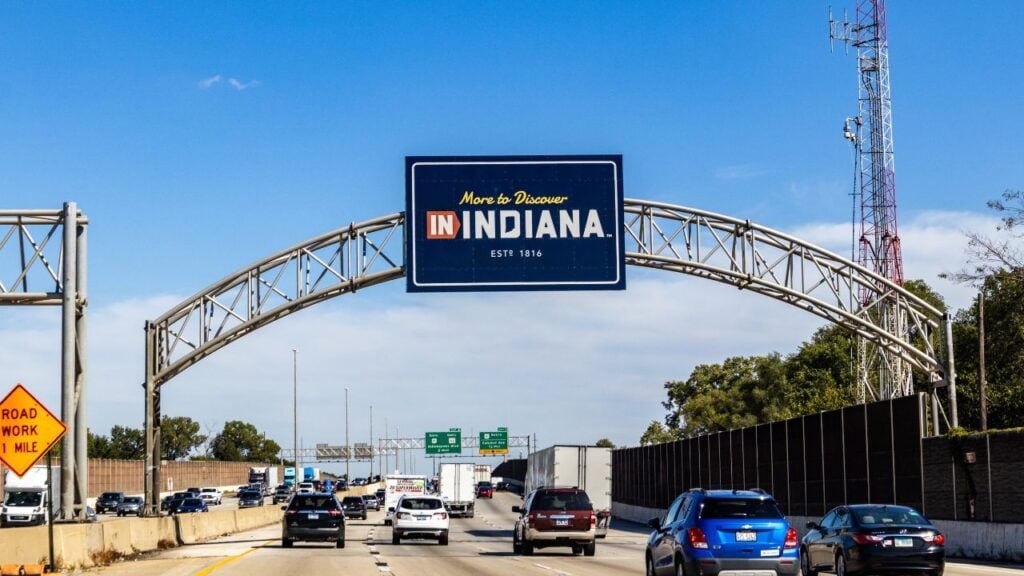
Michigan and Indiana share a border, but a lot changes at the line.
It’s a short drive with a long list of differences.
10 Things That Change the Second You Cross From Michigan Into Indiana
4. Cutouts and Missing Mufflers
Your exhaust is where a loud car turns into a ticketed one.
State law requires a muffler in good working order, and it bars removing, destroying or damaging the baffles inside it.
Driving with a cutout, a bypass, an amplifier or a similar device on your exhaust is off limits too.
A cutout, bypass or amplifier is a civil infraction with a fine of up to $100.
Then there’s the volume cap.
For a car on a road with a speed limit above 35 miles per hour, the limit is 82 decibels, measured from 50 feet away.
So “too loud” has a number attached, not just an officer’s ear.
5. Objects Blocking Your View
Dangling décor looks festive until it hides a stop sign.
The vehicle code bars any object that obstructs the driver’s vision, except as the law authorizes.
That can take in a holiday ornament on your mirror or a phone mount on your windshield, if either blocks what you need to see.
A necessary certificate or sticker is fine as long as it doesn’t block your clear view of the roadway or an intersecting roadway.
6. Lights in the Wrong Color
The color of a lit lamp on your car isn’t up to you.
A lit lamp on your car has to be one the vehicle code requires or permits, or that meets federal lighting standards.
Unless the vehicle code provides otherwise, a lamp visible from the front has to show white or amber light, from the sides amber or red, and from the rear red.
Backing lights are the rear exception, and they can be red, amber or white.
The code names blue for police vehicles, not for everyday drivers.
Flashing, rotating and oscillating lights of any color are banned unless the law permits them, as it does for police cars, ambulances and snowplows.
A wrong-color lamp can cost you up to $100, so check the color before you add anything glowing to your car.
Rear Window Rules
The windows behind the driver get a lot more freedom than the front glass.
Nonreflective smoked or tinted glass, nonreflective film and perforated window screens are allowed on the rear window and on the side windows behind the driver.
The limit is reflectivity.
A rear or rear side window can’t be covered with a material that reflects 35% or more of visible light, which includes silver or gold reflective film.
Curtains or louvers on the rear are fine too, as long as you have an outside mirror on each side, adjusted so you can see the road behind you.
That’s good news if you want some privacy in the back seat.
None of this applies to a car registered in another state, territory or country, so a visitor’s car may carry tint a Michigan-registered car couldn’t.
Psst! How much do you know about Michigan’s roads? Take our quiz and see if you can ace it.
Quiz
Michigan Road IQ
Answer these questions on Michigan roads, traffic laws and highway history. We bet you can’t get them all right. Prove us wrong?
The Michigan Department of Transportation (MDOT) credits the first four-way red, yellow and green traffic light, put up in Detroit in 1918, to a Detroit worker in which job?
Fixing the Equipment Before Court
An equipment ticket can cost more than the fine printed on the citation.
A court can add costs of up to $100 on top of a fine of up to $100, plus a $40 justice system assessment.
But there's a way out.
Cited for defective safety equipment? The court has to waive the fine, costs and assessments once a law enforcement agency certifies you made the repair before your appearance date.
Whether film, a plate frame or exhaust noise counts as defective safety equipment isn't spelled out, so ask the court before you count on it.
7 Bob-Lo Boat Memories Michiganders Still Talk About

If you grew up in Michigan, the Bob-Lo boat may be a ride you remember.
Here's what stuck with the people who rode it.
