
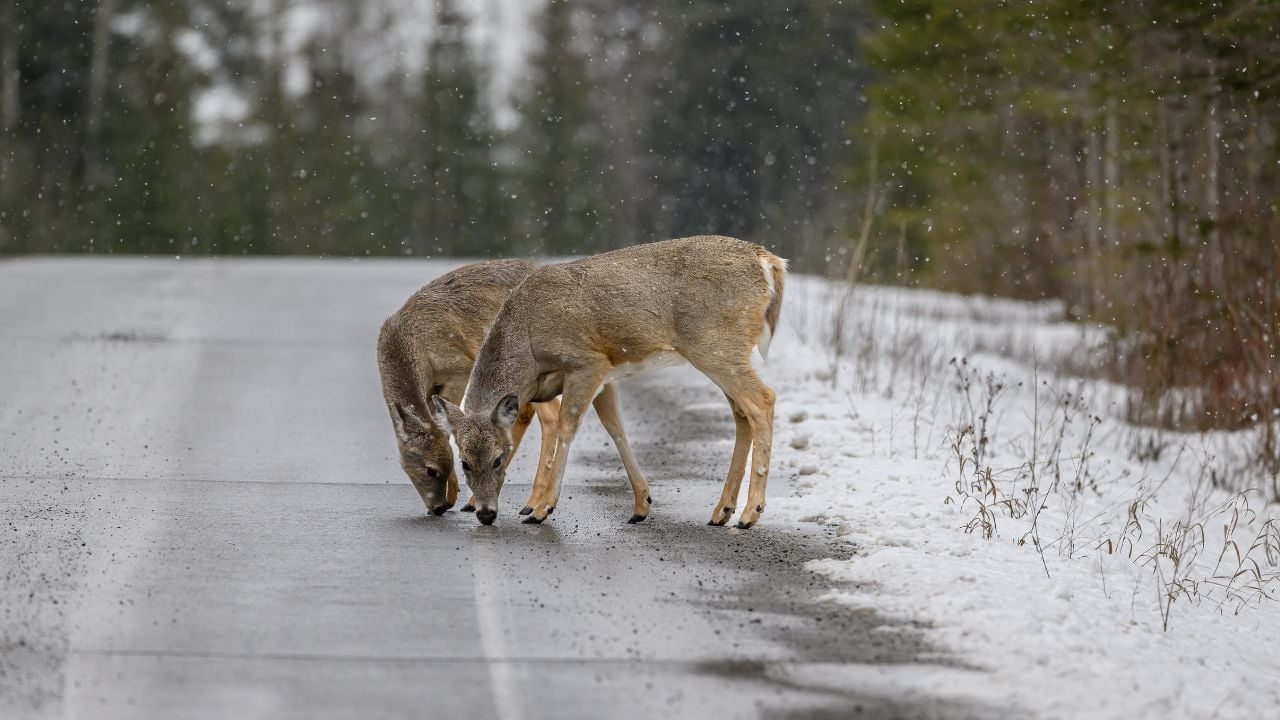
4 Things Kentucky Law Says About a Deer You Hit

Over the river and through the woods is a lovely way to get to Thanksgiving dinner.
The trouble is that those woods are where the deer live.
If one of them ends up in front of your car, you’ve got more to think about than just your bumper.
Here are the things Kentucky law says about a deer you hit.
Note: This is general information, not legal advice. Wildlife and crash-reporting rules are subject to change.
1. Reporting the Crash
A deer you hit can trigger the same crash-reporting law as a collision with another car.
If anyone’s hurt or the crash leaves your car inoperable, Kentucky law says you have to immediately notify law enforcement.
If you don’t make the call, or you can’t, the duty falls to the car’s owner or any occupant.
Your passenger finally gets a job besides picking the music.
The Kentucky Transportation Cabinet goes further and asks drivers to report every deer collision to police.
That ask covers the crash that leaves your car drivable, too.
Traffic engineers use that crash data to help place deer-crossing warning signs and other safety measures, so even a minor crash adds to the picture.
The Ten-Day Written Report
When no officer investigates a crash with more than $500 in property damage, Kentucky law adds a second step.
You file a written report with Kentucky State Police within ten days.
The clock starts at the crash.
2. Humane Kill Rule
Kentucky’s humane-kill statute covers any injured animal, a badly hurt deer included.
Before anything else, stay back from a badly hurt deer and call the county’s regional biologist, the contact Kentucky Fish and Wildlife lists for an injured deer.
The statute lets a person who’s legally allowed to have a firearm use it, or another deadly weapon, to kill the animal for humane purposes.
Its word is “may,” not “must,” so nothing in it requires you to do the killing.
Whoever makes the kill, not whoever called it in, has to report it to a game warden before midnight the same day.
A peace officer can’t cite anyone for a kill that fits those terms.
3. Taking a Live Deer Home
If the deer survives the crash, Kentucky Fish and Wildlife says it’s illegal to remove wildlife from the wild unless you’re a permitted wildlife rehabilitator.
That rules out a ride in your back seat, and keeping the deer anyway ends badly for it, since an illegally held deer must be confiscated and euthanized.
If you ever spot a fawn near a crash, the same rule applies, and the fawn should be left alone.
The exceptions are when its mother is dead nearby, such as one hit by a car, or the fawn is visibly injured.
Then the call goes to a permitted wildlife rehabilitator.
If the deer died at the scene, nothing in that guidance says whether you can keep it, so ask before you load it.
The line for reporting sick or dead wildlife is 1-800-858-1549, weekdays from 8 a.m. to 4:30 p.m. Eastern.
4 Things a Kentucky Neighbor Can’t Legally Do at Your Property Line
Your backyard fence came with your house.
Many Kentuckians go years without learning what a neighbor can and can’t do along a line like that.
4 Things a Kentucky Neighbor Can’t Legally Do at Your Property Line
4. Wasted Meat Exemption
A deer your car takes and a deer a hunter takes don’t follow the same wasted-meat rules.
The wanton waste regulation makes hunters carry the edible parts of a deer, the quarters and the outer loins, out of the field.
The regulation exempts big game taken due to a vehicle collision, and humane dispatch of an injured animal gets the same exemption.
So when a collision is what took the deer, that edible-parts rule doesn’t apply to you.
Psst! How much do you know about Kentucky’s road trip stops? Take our quiz and see if you can ace it.
Quiz
Kentucky Road Trip IQ
Answer these questions on Kentucky’s scenic drives, caves and parks. We bet you can’t get them all right. Prove us wrong?
Kentucky Tourism says Cumberland Falls has the only regular display of which nighttime sight in the Western Hemisphere?
Chronic Wasting Disease Zones
Hardin, Meade, Laurel and Pulaski are among the 23 counties where a deer crash lands inside a chronic wasting disease zone.
The zone exists because of chronic wasting disease detections in Kentucky or in nearby out-of-state areas.
If a crash in one of those counties leaves you with a deer to move, a carcass rule goes along for the ride.
That regulation covers all persons in possession of or transporting a deer carcass from a zone.
Only deboned meat, antlers, a clean skull, clean teeth, hides and finished taxidermy mounts can leave the zone.
A whole deer isn't on that list, so it stays put.
The regulation lists no exception for a deer killed on the road.
Neither the regulation nor the zone page mentions collisions, so the Kentucky Fish and Wildlife number above is the place to ask.
The rehabilitators in the third item also can't rehabilitate fawns from counties in a zone.
Deer Crash Numbers for 2025
Kentucky counted 3,411 deer collisions in 2025, a seven-year high.
Hopkins County had the most deer collisions in 2025 with 134, and Hardin County, one of the zone counties above, came second with 118.
A deer doesn't check county lines, and neither does November.
In 2025, November led every other month with 823 collisions, and October and December added 394 and 330.
So your Thanksgiving drive falls in the month that topped the list.
Over the past five years, the count is up 18.2%, with a rise every year since 2020.
The busiest stretch is 6 to 8 p.m., with 304 crashes at 6 p.m., 242 at 7 and 281 at 8.
That's the drive home from work, and by late November the sun is long gone.
Deer crashes killed no one in 2025, compared with six deaths in 2024, though thirty people were seriously injured.
When a Deer Steps Out
Every deer rule above starts after the impact, so the best help comes in the seconds before it.
The state's tips start with staying alert, especially in forested stretches and at dusk and dawn, when deer are most active.
The tips also say to wear your seat belt and put your phone down.
Neither one costs a dime, so they're the easiest tips on the list to follow.
Keep your headlights on bright unless other vehicles are approaching.
If a deer crosses the road, take your foot off the gas immediately.
Deer often travel in groups, so others may be close behind if you see one.
Your first instinct may be to jerk the wheel.
Don't swerve, though, since trying to avoid a deer can mean a worse crash with an oncoming vehicle or a roadside object.
If a crash is coming anyway, keep both hands on the wheel and brake steadily until you stop.
6 Things Kentuckians Say to Guests That Guests Misread

Some lines from a Kentucky host sound like a flat no.
They can mean the opposite, and hosts rarely stop to explain.
