
8 Things That Change the Second You Cross From Ohio Into Michigan

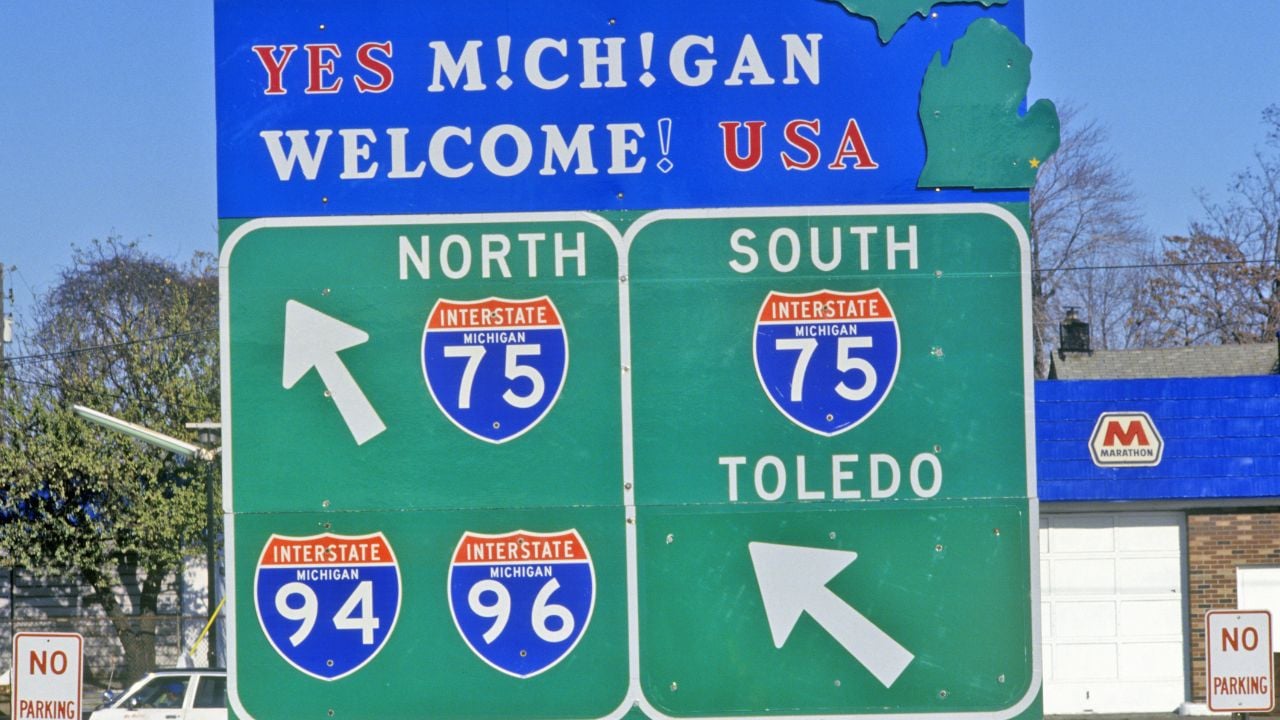
If Thanksgiving has you driving north into Michigan today, the welcome sign is about the only notice you’ll get.
The highway looks the same on both sides of the border.
What you pay and how you drive are another story.
These are the things that change the second you cross from Ohio into Michigan.
Note: This is general information, not legal or tax advice. Tax rates, wages and traffic rules are subject to change.
1. Gas Tax
Ohio’s gas tax holiday has paused the state’s 38.5-cent gasoline tax from October 4 through January 2.
That leaves a fraction of a cent in state tax on every gallon you pump in Ohio right now.
Michigan hasn’t joined in.
Its state tax is about 52 cents a gallon this year, up from 31 cents in 2025.
On a 15-gallon fill-up, that’s close to $8 in state tax at a Michigan pump, or about $10.50 on a 20-gallon tank.
The holiday ends after January 2, so this saving won’t last.
Your best move is to fill up in Ohio before you head north.
2. Minimum Wage
Michigan’s minimum wage is $13.73 an hour for employers with two or more employees, while Ohio’s is $11.00 for employers with gross receipts of $405,000 or more.
Once you cross from Toledo into Michigan, the legal minimum for your job rises $2.73 an hour, or about $109 over a 40-hour week.
Next year, the gap grows.
Michigan’s minimum rises to $15.00 on January 1, 2027, the same day Ohio’s moves to $11.40.
That puts the gap at $3.60 an hour, or about $144 over a 40-hour week.
3. Sales Tax
Michigan charges a flat 6% sales tax statewide, with no local add-ons.
There’s nothing to look up.
In Ohio, what you pay starts at the state’s 5.75% rate and goes up from there.
Local taxes add more, which pushes the total to 8% in places like Franklin and Cuyahoga, the counties around Columbus and Cleveland.
A small part of Reynoldsburg, in Licking County, reaches 8.25%.
On a $100 purchase, you’d pay $6.00 in tax anywhere in Michigan, but $8.00 in Franklin or Cuyahoga County.
15 Things Only People Who Grew Up in Ohio Truly Understand

Growing up in Ohio comes with a lot of unwritten rules.
Visitors rarely get them.
15 Things Only People Who Grew Up in Ohio Truly Understand
4. Bottle Deposits
Ohio has no container deposit law, so cans you buy at home carry no deposit and there’s nothing to claim back.
Not so in Michigan.
Michigan charges a 10-cent deposit on eligible drink containers, which adds $2.40 to a 24-pack of cans and $1.20 to a 12-pack.
You pay that dime up front, and you get it back when you return each empty.
Michigan’s Bottle Return Rules
Michigan’s bottle deposit law makes it illegal to bring in out-of-state containers, including Ohio cans, to collect a refund.
A Michigan container sold with a deposit must show the refund value and the state’s name.
Michigan stores can refuse returns once you pass $25 in refunds in one day.
A Michigan store can also refuse containers it doesn’t sell and ones that are very dirty.
5. Seat Belt Stops
In Ohio, officers can’t stop you only to check whether you’re wearing a seat belt.
Another violation, such as speeding or a broken taillight, has to come first, and then a belt ticket can follow.
Michigan doesn’t give you that.
Front-seat belt use has been a primary offense in Michigan since 2000, so an officer can stop you for it alone.
If you skip your belt on short trips at home, that habit can get you pulled over in Michigan.
6. Michigan Lefts
You turn left at the intersection in Ohio, but many divided roads in Michigan don’t allow it.
At a Michigan left, you drive straight through the intersection or turn right, then make a U-turn at a median crossover.
A median crossover is a gap in the strip between the two directions of traffic.
It takes practice.
You’ll often run into one in a city, and you won’t meet one on a freeway like I-75.
It sounds slower, but Michigan’s transportation department says the design can handle 20 to 50% more traffic than direct left turns.
Nearly 58% of Michigan’s intersection crashes are head-on left-turn and angle crashes, and the design can reduce crashes and fatalities by 30 to 60%.
Michigan lefts have been part of the state’s roads since the late 1960s, so locals have had decades to adjust to them.
7. Cigarette Tax
Michigan’s cigarette tax has been $2.00 a pack since July 2004, compared with Ohio’s $1.60.
That’s 40 cents more in tax on every pack you buy, or $4 more on a carton of 10 packs.
The yearly math?
A pack a day in Michigan costs you about $146 more in tax over a year than the same habit in Ohio.
Psst! How much do you know about the Ohio-Michigan border region? Take our quiz and see if you can ace it.
Quiz
Border Region Trivia
Answer these questions on the history and geography of the Ohio-Michigan border region. We bet you can’t get them all right. Prove us wrong?
According to Michigan’s military history page, the Toledo War’s only casualties came from what?
8. Paid Sick Time
Ohio doesn't have a statewide paid sick leave law, but Michigan does, according to 2025 tracking by the nonprofit health policy research organization KFF.
At an Ohio job, whether you have paid sick days depends on your employer.
Michigan's Earned Sick Time Act lets workers earn one hour of paid sick time for every 30 hours on the job.
It starts at hire.
At 40 hours a week, you'd earn about 1.3 hours of sick time, and at 20 hours a week, about 40 minutes.
Michigan limits use to 72 hours a year at larger employers, or 40 hours at businesses with 10 or fewer employees.
A full year of full-time work comes to about 69 hours, just under the 72-hour limit at larger employers.
14 Words Ohioans Use That Out-of-Staters Don't Understand

Ohio has words that stop visitors cold.
Some of them even change from one end of the state to the other.
