
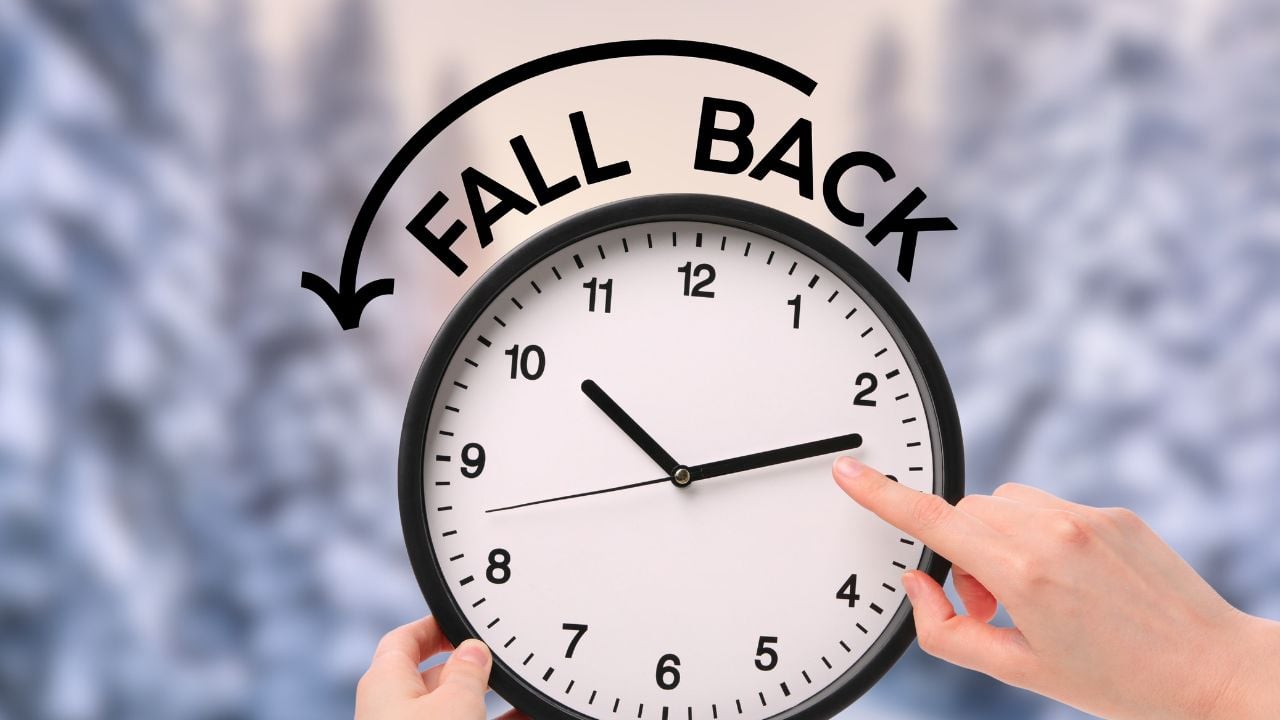
Clocks Fall Back Sunday. 6 Things That Change Across Michigan the First Week of Standard Time

If you leave work at 5:45 p.m. on Monday, the sun will already be down in Detroit and Grand Rapids.
Sunset is only one thing that changes with the clock falling back.
These are the things that change across Michigan the first week of standard time.
Note: This is general information, not legal advice. Driving rules are subject to change, so confirm the current requirements with the Michigan Department of State.
1. Sunday’s Extra Hour
At 2 a.m. on Sunday, Nov. 1, federal law ends daylight saving time for the year.
Your clocks go back to 1 a.m., so you live through the 1 a.m. hour twice.
That makes Sunday 25 hours long.
When All of Michigan Reads the Same Clock
Standard time puts the whole state on the same clock time for one hour on Sunday morning.
Michigan’s Eastern time counties fall back at 2 a.m., which is 1 a.m. in the four Upper Peninsula counties on Central time.
Those four counties keep their clocks on daylight time for one more hour.
At 2 a.m. Central, they fall back to 1 a.m., and the usual one-hour gap returns.
2. Sunsets About an Hour Earlier
Detroit’s sunset moves from 6:27 p.m. on Saturday, Oct. 31, to 5:25 p.m. on Sunday, according to the U.S. Naval Observatory.
That’s 62 minutes less light.
Grand Rapids loses 61 minutes, with sunset moving from 6:36 p.m. to 5:35 p.m.
Ironwood, in Gogebic County, loses 61 minutes too, from 5:47 p.m. Central daylight time on Saturday to 4:46 p.m. Central standard time on Sunday.
Gogebic, Iron, Dickinson and Menominee counties run on Central time, so Ironwood’s clock reads an hour behind Detroit’s.
On an Eastern clock, Ironwood’s 4:46 p.m. sunset would read 5:46 p.m., 21 minutes after Detroit’s.
Evening twilight ends sooner as well, at 5:55 p.m. in Detroit instead of 6:56 p.m.
By Monday, sunset comes at 5:24 p.m. in Detroit and 5:33 p.m. in Grand Rapids, so your 5:45 p.m. drive home starts after sunset.
By Saturday, Nov. 7, sunset comes at 5:18 p.m. in Detroit and 5:27 p.m. in Grand Rapids.
If you live in Ironwood, the sun sets before 5 p.m. on Sunday, Monday and Tuesday.
3. Headlights Needed an Hour Sooner
State law requires headlights from a half hour after sunset to a half hour before sunrise.
It also requires them whenever people and vehicles aren’t clearly visible from 500 feet away.
Because the requirement is tied to sunset and sunrise rather than a clock time, the deadline moves about an hour earlier on Sunday.
In Detroit, you need your lights on by about 5:55 p.m. on Sunday instead of 6:57 p.m. on Saturday, and in Grand Rapids by about 6:05 p.m. instead of 7:06 p.m.
In the morning, the requirement ends at about 6:36 a.m. in Detroit on Sunday instead of 7:34 a.m. on Saturday.
Come Saturday, Nov. 7, Detroit drivers need their headlights on by about 5:48 p.m. and Grand Rapids drivers by about 5:57 p.m.
4. Deer-Crash Window
Most deer crashes in Michigan happen from 8 a.m. to 9 a.m. and from 6 p.m. to 9 p.m., according to Michigan State Police data.
Deer are most active at dawn and dusk.
The agency counted more than 58,000 deer crashes in 2024, and about 80 percent of them were on two-lane roads.
The state’s 2024 Traffic Crash Facts report lists 10,017 deer crashes in November, the busiest month.
A total of 13,974 deer crashes that year happened between 6:00 and 8:59 p.m.
The change is small.
Detroit’s sunset was already at 6:27 p.m. on Saturday, so only the first 27 minutes of the 6 p.m. to 9 p.m. window had daylight.
From Sunday on, you’re driving through the whole window after sunset.
Dawn brightens, too. With Detroit’s sunrise now at 7:06 a.m., your 8 a.m. to 9 a.m. drive falls in daylight.
Psst! How much do you know about daylight saving time? Take our quiz and see if you can ace it.
Quiz
Daylight Saving IQ
Answer these questions on daylight saving time and U.S. time zones. We bet you can’t get them all right. Prove us wrong?
In 1919, Congress repealed the daylight saving time section of the Calder Act over the veto of which president?
5. Brighter Mornings
If you're on the road by 7:30 a.m. in Detroit or Grand Rapids, the sun is up every day from Sunday through Saturday, Nov. 7.
On Saturday, Oct. 31, your same drive started before sunrise.
Detroit's sunrise moves from 8:04 a.m. that day to 7:06 a.m. on Sunday, and Grand Rapids' from 8:16 a.m. to 7:17 a.m.
The sky starts brightening earlier as well, with civil twilight beginning at 6:36 a.m. in Detroit instead of 7:35 a.m., and at 6:48 a.m. instead of 7:47 a.m. in Grand Rapids.
By Saturday, Nov. 7, Detroit's sunrise is at 7:13 a.m. and Grand Rapids' is at 7:25 a.m.
6. Election Day Dusk
Standard time begins two days before Michigan's General Election on Tuesday, Nov. 3.
Polls are open from 7 a.m. to 8 p.m. local time.
That morning, Detroit's sun rises at 7:08 a.m., eight minutes after polls open.
Under daylight time, Detroit's sun would have set at 6:23 p.m. that Tuesday.
Standard time moves it to 5:23 p.m., so polls stay open 2 hours and 37 minutes after sunset instead of 1 hour and 37 minutes.
In Grand Rapids, the sun sets at 5:32 p.m., leaving 2 hours and 28 minutes of voting after dark, compared with 1 hour and 28 minutes at the 6:32 p.m. sunset daylight time would have brought.
In Ironwood, the sun sets at 4:43 p.m. Central time, 3 hours and 17 minutes before polls close.
If you vote after 5:45 p.m. in Detroit or Grand Rapids, you'll walk into your polling place after sunset.
Stalled Ballot Bill
Senate Bill 126 would end Michigan's clock change if you and other voters approve it.
The bill calls for that question to go to voters at the Nov. 3, 2026, election, but it won't be on your ballot.
Michigan Public lists only two statewide questions for this November. They cover a constitutional convention and limits on political donations from some utilities and large government contractors.
If a majority of voters approve, the change would take effect 30 days after the official declaration of the vote.
Federal law lets a state exempt itself and keep standard time year-round.
The Senate sent the bill to the Government Operations Committee on March 6, 2025.
The bill lists 13 senators as sponsors.
As of Oct. 23, the bill page lists no action since a co-sponsor was named on March 11, 2025.
7 Words Michiganders Used in the 1960s That Make No Sense Today

Some words Michiganders once used have faded from everyday speech.
Here's what the words meant and why you rarely hear them now.
7 Words Michiganders Used in the 1960s That Make No Sense Today
12 Things From a 1970s Michigan Childhood That Kids Today Won't Believe

Michiganders who grew up decades ago have stories that can stop a younger crowd mid-scroll.
Here's a look at the childhood moments that sound the most surprising today.
12 Things From a 1970s Michigan Childhood That Kids Today Won't Believe
