
5 Things Virginians Get Wrong About the Humpback Whales Off Virginia Beach

Most people picture whale-watching in Alaska or Cape Cod, not on a winter afternoon in Virginia Beach.
But if you spot a humpback, don’t count on seeing the same whale next weekend.
These are the things Virginians get wrong about the humpback whales that spend winter off Virginia Beach.
1. Mostly Young Whales
Young whales make up most of the humpbacks that winter at the mouth of the Chesapeake Bay.
In a 2020 study, researchers estimated that more than three-quarters of the humpbacks they identified and satellite tagged there were juveniles.
Many Virginians picture humpbacks as whales that spend winter in the Caribbean.
Not quite.
The National Oceanic and Atmospheric Administration (NOAA) says North Atlantic humpbacks migrate south to the West Indies and Cape Verde in winter to calve and mate.
The Chesapeake Bay Foundation says juvenile whales are too young to breed and tend to go where the food is.
A humpback you spot from a boat or the shore in January is likely a young whale.
2. Feeding at the Bay Mouth
At the mouth of the Chesapeake Bay, humpback whales come to eat.
In a 2020 Frontiers in Marine Science study, researchers put 35 satellite tags on humpbacks there over two winters, from 2015 to 2017.
About 82% of the tagged whales’ modeled locations were classed as foraging behavior, mostly around the Bay mouth.
That’s a lot of foraging.
Researchers also watched for lunges, when a whale rushes to the surface with its mouth open under a school of fish.
Lunges showed up in about one-third of the feeding observations.
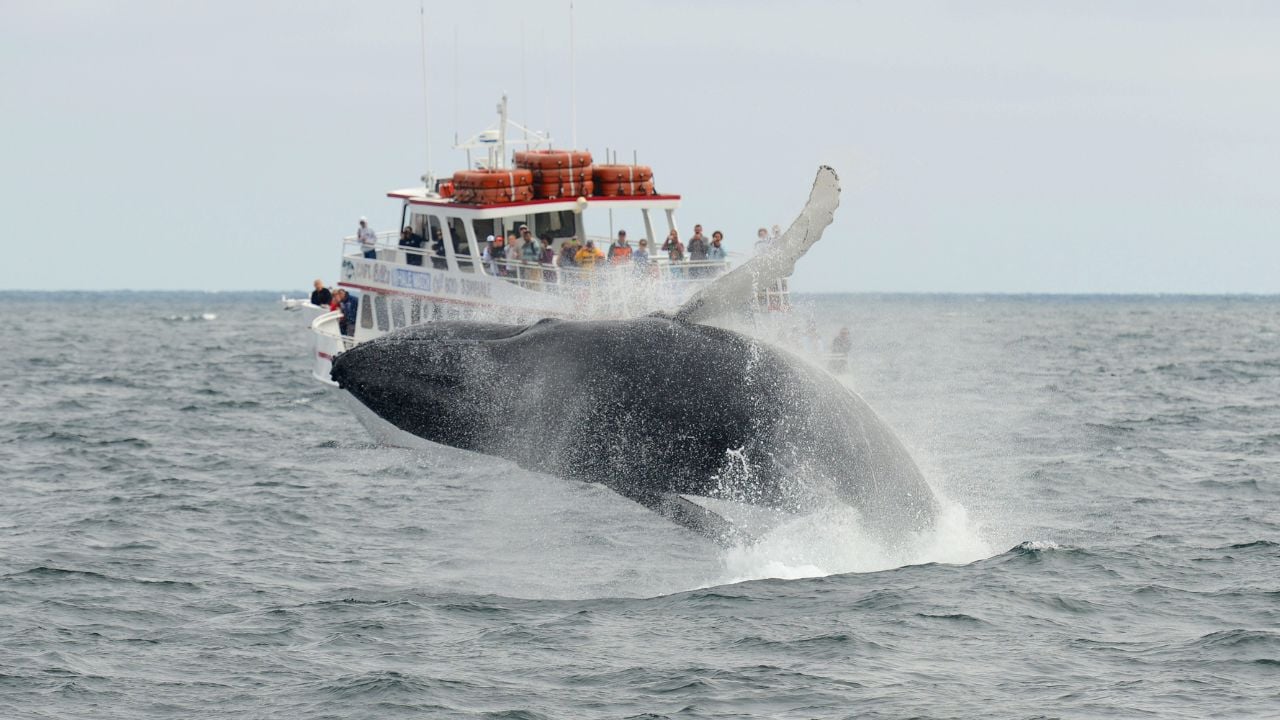
From the deck of a boat, a lunge means you’re watching a humpback feed.
Those feeding observations also noted small schooling fish, including Atlantic menhaden.
The Chesapeake Bay Foundation says whales often enter the Bay to feed on schools of menhaden.
3. Short Winter Stays
For young humpbacks, a visit to the Virginia Beach coast typically lasts days to weeks in shallow coastal water, according to researchers working under a U.S. Navy monitoring program.
Then they move on.
So a humpback you see in January may not be there in February.
In the 2020 study, satellite tags on 35 humpbacks transmitted data for an average of 13.7 days, with the longest running more than 43.
That is how long the tags transmitted, not how long the whales stayed.
Previous research has shown that some individuals return in later years, the Navy program’s blog says.
The same blog says the broader area off Virginia Beach may act as a supplemental winter feeding ground for the returning whales.
Psst! How much do you know about whales and coastal Virginia? Take our quiz and see if you can ace it.
Quiz
Coastal Whale IQ
Answer these questions on whales, marine wildlife and coastal Virginia. We bet you can’t get them all right. Prove us wrong?
About how many North Atlantic right whales does NOAA Fisheries estimate are left?
4. Shipping Channels
A constant heavy flow of vessel traffic moves through the water where humpback whales feed at the mouth of the Chesapeake Bay.
About a quarter of the tagged whales' modeled locations, across the whole study area, fell inside the shipping channels.
Many Virginians think of those channels as ship territory.
The whales use them too.
If you boat off Virginia Beach in winter, you may be sharing the water with humpbacks.
Of 106 humpbacks photographed in the study, nine had evidence of propeller strikes.
One of the tagged whales later washed ashore dead in Virginia Beach, with injuries consistent with a propeller strike.
Keeping Distance From Humpback Whales
NOAA Fisheries asks boaters to watch humpback whales and other large whales from at least 100 yards away.
That distance is a guideline.
Federal law does require boaters to stay 500 yards from a North Atlantic right whale.
Federal law also bars harassing marine mammals, and changing a whale's behavior may be considered harassment.
5. Winter Strandings
Dead humpback whales have washed up at Virginia Beach in winter.
In March 2024, Chesapeake Bay Magazine reported that two dead humpbacks were found in Virginia Beach on the same day.
Winter and early spring are a common time for dead whales to wash up, the magazine said.
In February 2023, the Virginia Aquarium's Stranding Response Team worked with the U.S. Coast Guard to secure a dead humpback floating near the mouth of the Bay, then examined it.
The aquarium described the team in a February 2023 release as largely volunteer-based.
Seen a stranded whale?
The aquarium's hotline is (757) 385-7575.
NOAA advises against touching wild marine mammals, even if they approach you.
Unusual Mortality Event
Humpback whales along the Atlantic coast have been part of a federal Unusual Mortality Event since April 2017.
The table for 2016 through 2026 lists 270 dead humpbacks along the coast, counted by year, so you can't tell from it which deaths came in winter.
How many in Virginia?
The table lists 34, with 20 in state waters and 14 offshore.
Of the 129 whales examined along the coast as of July 2025, about 45 percent had evidence of human interaction, either vessel strike or entanglement.
The event is ongoing as of NOAA's Oct. 1, 2026 update.
Whale-Watching Boat Tours
The Virginia Aquarium & Marine Science Center's winter boat tours go out in search of humpback whales.
For its 2024-25 season, the aquarium scheduled the tours on a boat called the Atlantic Explorer from Dec. 20, 2024, to March 9, 2025.
A naturalist narrated those trips, which lasted about two and a half hours.
Sightings aren't guaranteed.
The aquarium says tours depend on weather, and it strongly encourages you to book online in advance.
Its boat-tours page currently says the whale-watching tours, which search for humpbacks, begin Dec. 16, though it doesn't state the year.
8 Virginia Town Names That Make Out-of-Staters Do a Double Take
Many visitors from other states may do a double take at some Virginia town names.
If you grew up in Virginia, you may have stopped noticing them, but many out-of-staters probably haven't.
8 Virginia Town Names That Make Out-of-Staters Do a Double Take
8 Things Virginia Cemeteries Can Remove From a Grave Without Telling the Family

You bring flowers to a loved one's grave before the holidays, and you never thought to question it.
Those flowers might not stay around for long, though.
8 Things Virginia Cemeteries Can Remove From a Grave Without Telling the Family
