

17 Statistics About Firearms in Mass Shootings

The number of illegally obtained firearms in mass shootings might come as a surprise to some Americans. According to Statista data, most mass shootings in the United States occurred using firearms that were legally obtained.
Statista used the Federal Bureau of Investigation’s (FBI’s) definition of a mass shooting to compile their data. That means any of the shootings before 2013 involved four fatalities, and those after 2013 involved three. All of them took place in a public place and involved a single attack.
Statista’s data did not include the legality of the weapons used in the Sunnyvale, California, shooting on February 16, 1986. In that case, the shooter had passed criminal background checks but only because the Air Force failed to provide his criminal record to the FBI. Taking these caveats into account, Mindfully American studied Statista’s data, bringing you some of the most notable points of their study as well as other noteworthy statistics on the topic.
1: Number of Shootings

Statista’s research department compiled a list of mass shootings in the U.S. by the legality of the shooter’s weapon. Researchers looked at 149 incidents from 1982 to 2023. Per Statista’s research, only 16 of the mass shootings between 1982 and 2023 involved firearms obtained illegally.
2: Legally Obtained Firearms

Most of the weapons used in mass shootings during Statista’s study period used legally obtained firearms. The exact count was 100 shootings using firearms that were legally obtained.
3: Mixed or Unknown

If you’re staying on your toes, you know that 16 and 100 don’t add up to 149 mass shootings. In the case of the remaining 33 mass shootings, it’s unclear whether the shooter obtained their firearm legally or not. In one shooting, some of the weapons used were legally obtained while others were illegal.
4: Who Can Legally Own a Firearm

The U.S. requires firearm owners to be at least 18 years old. Some states, like California, Connecticut, and Hawaii, require owners to be 21. According to federal law, any customer purchasing a firearm from a licensed dealer must pass a background check. People with certain criminal histories or dishonorable Armed Forces discharges may not own a weapon.
5: The Gun Show Loophole

The “gun show loophole” allows prospective firearm buyers to sidestep background checks, as federal law only says that licensed dealers must require their customers to pass a background check. Unlicenced dealers may legally sell firearms at places like gun shows, flea markets, and online.
6: State Exceptions
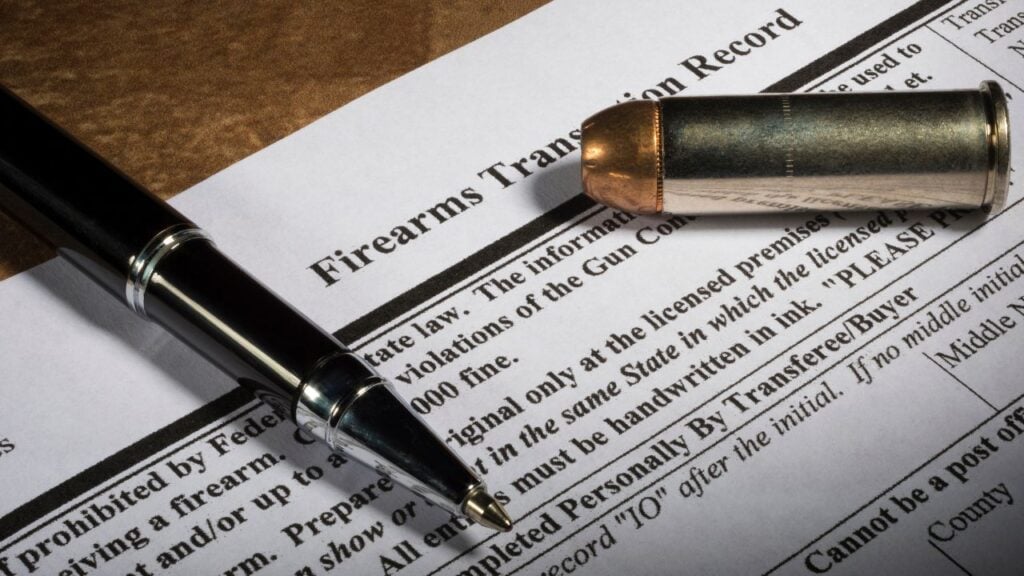
Some experts estimate that private sales account for 40% of all firearm sales, and they are entirely unregulated. Seventeen states require universal background checks, requiring all firearms to be sold through licensed dealers rather than private sales.
7: Skirting the Law

Some mass shooters have used the gun show loophole or have sidestepped legalities in other ways in order to obtain their weapons. For example, on August 31, 2019, Seth Aaron Ator obtained an AR-style rifle in a private sale.
Ator would not have passed a federal background check as a court had deemed him mentally ill in 2014. After obtaining the weapon, he fired into a shopping plaza, taking the lives of six people.
8: The Violence Project

Besides the tendency to obtain their weapons legally, mass shooters often share other common traits. The National Institute of Justice created “The Violence Project” database, which reveals trends amongst mass shooting perpetrators.
The Violence Project database includes data on 172 mass shooters from 1966 to 2019. It covers over 150 psychosocial variables, including past traumas, health history, and situational triggers.
9: Ending Life

According to the Violence Project data, 30% of mass shooters had thoughts of taking their lives before the shooting. The percentage is much higher amongst younger shooters, with 92% of k-12 shooters and 100% of university student shooters found to have thoughts of ending their lives.
10: State of Crisis

Violence Project data suggests mental health plays a role in mass shootings, and many of the shooters dealt with some sort of mental health problem. However, more predictive of an imminent act of violence was being in a state of crisis in the days or weeks prior.
11: Leaked Plans

Almost half (48%) of mass shooters leaked their plans to friends, colleagues, and, in some cases, even law enforcement officers before they attacked. The National Institute of Justice suggests the “leakage” phenomenon provides an opportunity for threat assessment teams to intervene and prevent future shootings.
12: Type of Weapon

Most firearms used by mass shooters were handguns (77%). Notably, younger shooters often stole handguns from other family members. The National Institute of Justice suggests this finding supports universal safe storage laws.
13: Following a Script

Prior to committing their crimes, many mass shooters study former mass shootings. They also tend to be radicalized online. The Violence Project database refers to this as following a script.
14: Mostly Male

Demographically, the vast majority of mass shooters have been male (97.7%). And, though their ages range from 11 to 70, most are in their thirties. Over half have a prior criminal record and a history of violence.
15: Usually at Work

Mass shootings at schools often have a big emotional impact on the American public and for a good reason. However, historically, most mass shootings have occurred at the shooter’s workplace, a retail establishment, or a bar. Only 7.6% have been at a school.
16: Qualitative Findings

The Violence Project research team conducted interviews with shooters to gather qualitative data on past traumas. They found that many shooters experienced early childhood trauma and exposure to violence. They also reached an identifiable crisis point and found validation or justification for their actions.
17: Increasing With Time

Unfortunately, the number of mass shootings is increasing in the U.S. Though the Violence Project database only includes 50 years of data, 20% of the mass shootings occurred within the last five years of the study.
A Complicated Issue

While firearm ownership plays a role in the complex issue of mass shootings, the Violence Project Database shows it’s not the sole contributing factor. Understanding the multifaceted nature of this issue involves acknowledging various societal, mental health, and other elements.
How US Firearm Violence Compares With 14 High-Income Nations

The United States takes center stage in many of the wrong ways when it comes to global firearm violence. Data reveals stark differences in firearm trends in fellow high-income countries.
How US Firearm Violence Compares With 14 High-Income Nations
States With the Highest and Lowest Firearm Fatality Rates

Some states have higher rates of firearm fatalities than others. These are the states with the most and least annual firearm fatalities.
States With the Highest and Lowest Firearm Fatality Rates Ranked From 1 to 50
