

Social Security’s Trust Fund Is Projected to Run Short in 2032. What a 22% Cut Would Mean for Pennsylvania Retirees

Social Security keeps two separate funds, and only one of them pays your retirement check.
The other pays disability benefits, and it’s on steadier ground.
Here’s what a 22% cut would mean for Pennsylvania retirees if Social Security’s trust fund runs short in 2032.
Note: This is general information, not financial advice. Social Security projections and benefit rules are subject to change, so confirm the current details with the Social Security Administration.
The 2032 Projection
Social Security’s retirement and survivors fund can pay 100% of its scheduled benefits, the amounts current law promises you, until the fourth quarter of 2032.
The trustees formally call that fund Old-Age and Survivors Insurance, and it pays retirement and survivors benefits.
After that quarter, the reserves run out, but program income keeps arriving and would cover 78% of scheduled benefits.
The trustees call that 78% the payable share, the portion that income arriving in each year could cover once the reserves are gone.
Reserves cover the gap between income and scheduled benefits. Once they’re gone, only the year’s incoming money can pay benefits.
Benefits wouldn’t stop.
Your check would come in about 22% below the scheduled amount if lawmakers take no action.
Retirement Fund vs. Combined Funds
Social Security keeps two trust funds, one for retirement and survivors benefits and one for disability benefits.
The disability fund is projected to pay 100% of scheduled benefits through at least 2100.
The trustees also run the numbers as if the two funds were one, a combined projection formally called Old-Age, Survivors, and Disability Insurance.
In that combined version, reserves last until the third quarter of 2034, and continuing income would cover 83% of scheduled benefits after that.
From the retirement fund’s fourth quarter of 2032 to the combined fund’s third quarter of 2034 is seven quarters, or 21 months by our count.
That works out to a 17% reduction instead of 22%.
Because the combined figure pools in the disability fund, it isn’t the projection for the fund that pays your retirement check.
The Retirement Fund’s Wider Shortfall
The retirement and survivors fund’s 75-year shortfall grew from 3.95% to 4.55% of taxable payroll in the 2026 report.
That is a 0.60 percentage-point increase, by our subtraction, and the trustees measure it over the next 75 years.
Taxable payroll is the pool of earnings that Social Security taxes, and the shortfall is measured against it.
The trustees say lower projected fertility, lower projected immigration and a new law that cuts income from taxing benefits all hurt the program’s finances.
Fertility is the biggest of the three, with the report now assuming 1.75 children per woman in the long run, down from 1.90.
The law, P.L. 119-21, lowers the income the trust funds receive from taxes on benefits.
The fund’s depletion date moved one quarter earlier, from the first quarter of 2033 to the fourth quarter of 2032.
Its reserves fell by $200 billion during 2025, from $2.54 trillion to $2.34 trillion.
If you collect a retirement check, this fund pays it.
Psst! How much do you know about Social Security’s basics? Take our quiz and see if you can ace it.
Quiz
Social Security Pop Quiz
Answer these questions on Social Security’s rules, numbers and history. We bet you can’t get them all right. Prove us wrong?
If you are under full retirement age for all of 2026, how much can you earn from a job before Social Security starts withholding benefits?
Pennsylvania's Average Benefit
In December 2025, Social Security was paying benefits to 3,035,656 Pennsylvanians, according to the Social Security Administration.
That total includes 2,319,503 retired workers, which counts you if your retirement check comes from your work record.
Retired workers make up about 76% of Pennsylvania's beneficiaries, our arithmetic from the same two state totals.
Those retirees were receiving about $4.97 billion a month combined.
Divide that by 2,319,503 retired workers, and the average works out to about $2,140 a month.
That average is our calculation from the agency's state totals.
Nationally, the agency's December 2025 snapshot put the average retired worker benefit at $2,071.30.
That puts Pennsylvania's average about $70 above the national average.
The Cut in Monthly Dollars
A 22% cut to Social Security would take about $470 a month off a $2,140 check.
That leaves about $1,670 a month, or roughly $5,650 less over a year.
On the national average of $2,071.30, the same cut works out to about $456 a month, leaving about $1,616, by our calculation.
If your check is $1,500, a 22% cut takes $330 and leaves $1,170.
If it's $2,500, the cut takes $550 and leaves $1,950.
Under the combined version's 17% reduction, the same $2,140 check would lose about $360 and leave about $1,780.
Applied evenly to the $4.97 billion that Pennsylvania's retired workers received in December 2025, a 22% cut would take roughly $1.1 billion a month from their checks.
The combined version's 17% reduction would take about $845 million a month from those same checks.
Your Check at 78% and 83%
Social Security's payable percentages work on any monthly amount, so you can test your check.
Multiply your scheduled monthly benefit by 0.78 to see what the retirement and survivors fund's projection would leave you.
On an $1,800 benefit, that's $1,404 a month, which is $396 less.
Use 0.83 instead for the combined fund's 2034 projection, which turns $1,800 into $1,494.
What Congress Can Still Change
The 78% figure describes what happens if lawmakers change nothing, so your check isn't locked in at that level.
The trustees say acting sooner would allow more generations to share in the needed revenue increases or reductions in scheduled benefits.
Social Security's policy options range from the size of monthly benefits and the retirement age to payroll taxes, the cap on taxed earnings and other sources of revenue.
Each comes with an estimated effect on the trust funds.
A smaller step is a payroll tax rate that rises 0.1 percentage point a year from 2028 through 2037, ending at 13.4% in place of today's 12.4% (employer and employee shares together).
The actuaries' summary estimates that path would eliminate about 20% of the combined funds' 75-year shortfall.
A far larger jump to a 17.0% rate in 2027 would eliminate 101% of it, and raising the full retirement age two months a year until it reaches 69 would eliminate 32%.
Social Security's payroll tax applies only to the first $184,500 of a worker's earnings in 2026.
Eliminating that cap starting in 2027, with no extra benefit credit for the added earnings, would close about 58% of the combined funds' 75-year shortfall, the agency's actuaries estimate.
6 Pennsylvania Rules That Decide Who Pays When a Pothole Wrecks Your Car
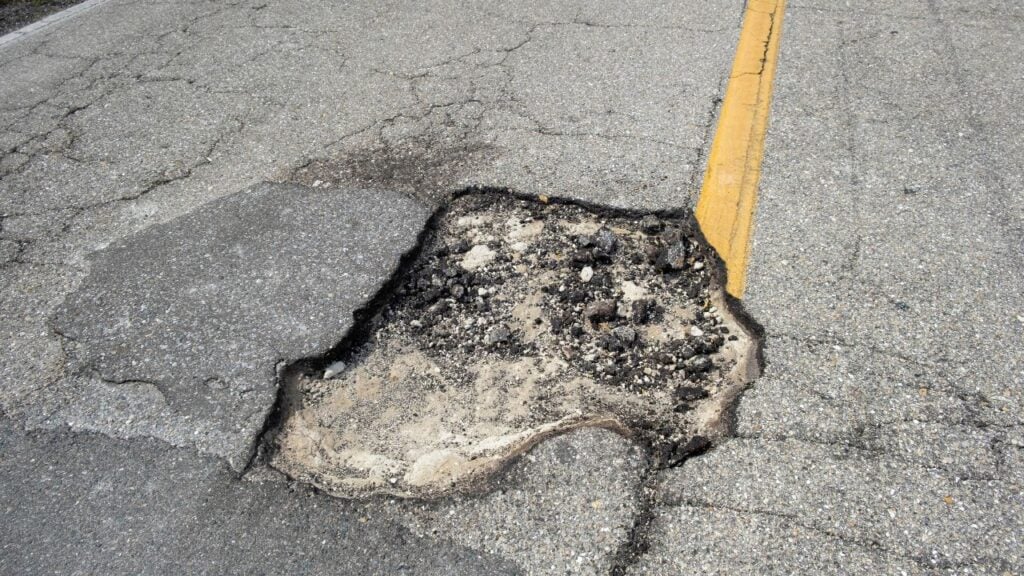
Picture a pothole, a damaged car and a hefty repair bill.
Then it's time to find out who foots the bill.
6 Pennsylvania Rules That Decide Who Pays When a Pothole Wrecks Your Car
11 Things Pennsylvanians Call by Different Names Than the Rest of America

Ask a Pennsylvanian what to call certain everyday things, and the answer may not match what you'd say.
This list gathers the names that set the state apart.
11 Things Pennsylvanians Call by Different Names Than the Rest of America
