
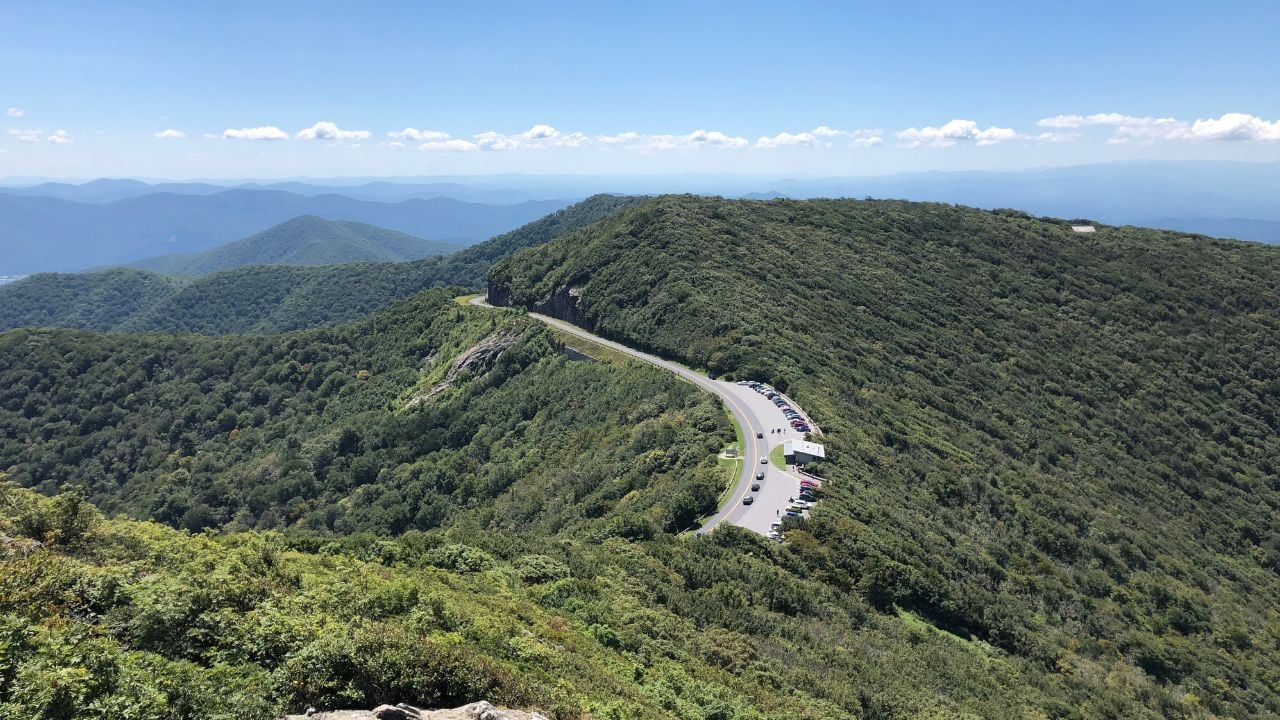
The Real Reason North Carolina’s Mountains Turn Blue in the Distance

Ask ten hikers on the Blue Ridge Parkway why the ridges look blue, and many will guess the sky or the altitude.
The real answer took scientists more than a century to pin down.
Here’s the real reason North Carolina’s mountains turn blue in the distance.
Light Doing the Work
What you’re seeing off that overlook comes down to physics, not weather.
Sunlight carries every color at once, and each color travels in a different size of wave.
Blue light moves in short, tight waves.
Red and orange light move in long, lazy waves.
When those waves hit tiny particles floating in the air, the short blue waves scatter far more than the long red waves do.
That’s the same scattering that makes a clear sky read blue.
Point that same physics at a mountain range, and a distant ridge reads a deeper blue than the ridge standing in front of it.
Stack enough ridges one behind another, each a little farther from your eye, and the color compounds.
Distance does the rest.
What the Trees Add
Bare air alone doesn’t explain the deep, almost solid blue you see off a Blue Ridge overlook.
Oaks, hickories, and other trees across the Blue Ridge release chemical compounds into the air, especially once the heat sets in.
Those chemicals react with sunlight and moisture already in the air.
The reaction builds microscopic aerosols that come out just the right size to scatter blue light the same way air molecules do, only stronger.
Isoprene is the main compound scientists point to, and it helps a tree cope with heat stress.
Rhododendrons and hemlocks rank among the heaviest emitters in the region.
More heat means more particles.
More particles mean a thicker blue curtain over the ridges.
Land of the Blue Smoke
North Carolina’s mountains carried a name for that color long before any scientist explained it.
The Cherokee called the range Shaconage, often translated as the place of blue smoke.
They watched the same bluish curl settle over the ridges every warm afternoon, centuries before anyone knew a single tree was involved.
No fire was required.
English speakers later folded the same idea into another name, Great Smoky Mountains, for the section of the range along the Tennessee border.
One blue haze ended up naming two separate mountain chains.
The Eastern Band of Cherokee Indians still calls western North Carolina home today, on the Qualla Boundary near the entrance to Great Smoky Mountains National Park.
The name outlasted the mystery.
The Doctor Who Named It
Europeans reached the Blue Ridge more than three centuries after the Cherokee already had a name for it.
A German-born physician named John Lederer led the first documented European party over the range in 1669, commissioned by Virginia’s colonial governor to search for a route west.
He never found that route.
What he did find was a mountain wall that looked distinctly blue from a distance.
Later mapmakers picked up that color as a description and turned it into a name.
The name stuck because generation after generation of travelers kept seeing the same color.
Lederer’s account survived because Sir William Talbot, secretary of the Maryland colony, translated it from Latin and published it in London two years later, map included.
Psst! How much do you know about the Blue Ridge Mountains? Take our quiz and see if you can ace it.
Quiz
Blue Ridge Mountain IQ
Answer these questions on Blue Ridge geography, geology, and history. We bet you can’t get them all right. Prove us wrong?
Geologists estimate the Appalachian Mountains, including the Blue Ridge, first began forming how long ago?
Two Kinds of Haze
Not every blue haze over North Carolina's mountains comes from a tree.
Pollution creates its own version, and a casual glance can't tell the two apart.
Power plants, factories, and vehicle exhaust add particles of their own to the same sky.
Those particles scatter light too.
The difference shows up over time.
Visibility across the southern Appalachians has dropped by 40% in winter and by 80% in summer over the last 50 years, almost entirely from pollution layered on top of the natural haze.
Ozone at some ridge-top monitors in the Smokies has measured about twice what nearby cities like Atlanta and Knoxville record, one more sign the modern haze isn't the same haze that named the mountains.
That's not the mountains changing.
It's the air around them changing.
Best Months to Catch It
Timing your visit right decides whether you catch the color at its best.
Isoprene emissions rise and fall with heat, so the deepest blue shows up on warm, sunny afternoons, especially through July and August.
Midday hours bring it out strongest, once a few hours of sun have built up the haze.
Elevation helps too.
Mount Mitchell tops out at 6,684 feet, the highest point east of the Mississippi River, and its overlooks stack ridge after ridge into the distance.
Nearby, Waterrock Knob rises to 6,273 feet off the parkway near Maggie Valley, among the highest overlooks on the whole drive.
A little farther north, Grandfather Mountain reaches 5,946 feet near Linville and offers its own wide sweep of blue ridgelines.
Want a different color entirely?
Craggy Gardens, along the parkway between Asheville and Mount Mitchell, turns the same overlooks pink and purple with rhododendron blooms every late May and June.
The 469 miles of the Blue Ridge Parkway connect Waterrock Knob, Craggy Gardens, and dozens of other overlooks in one continuous drive between Virginia's Shenandoah Valley and the edge of the Smokies.
Aim for late morning through mid-afternoon.
By then the heat has pushed enough isoprene into the air to deepen the color, but the haze hasn't thickened enough yet to block the ridgelines from view.
8 North Carolina Mountain Towns Locals Love (and 3 Tourists Overrun)
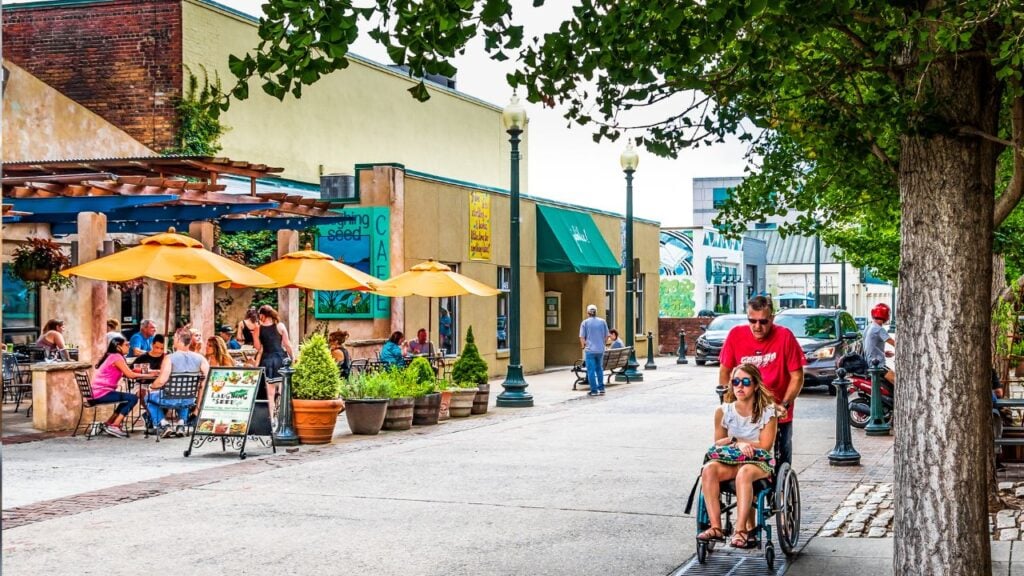
A line of out-of-state plates crawls toward the same famous overlook while everyone reaches for the same photo.
A few miles back, locals turn off toward a town those cars will never find, and North Carolina's mountains hold dozens more like it.
8 North Carolina Mountain Towns Locals Love (and 3 Tourists Overrun)
How Much Does a Nursing Home Cost in North Carolina in 2026?

A month in a North Carolina nursing home costs more than most families expect, and the number keeps rising every year.
Where you land in the state changes that number by a wide margin, and a private room costs more than a shared one.
How Much Does a Nursing Home Cost in North Carolina in 2026?
