
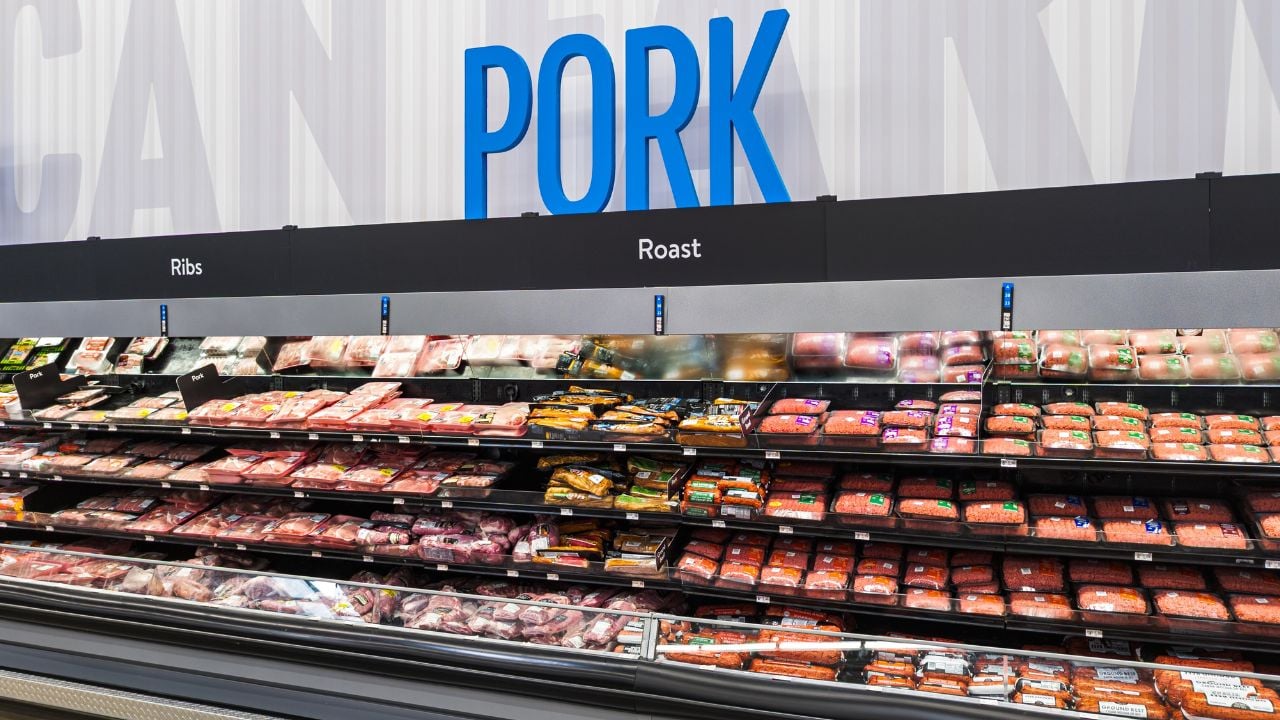
Which Holiday Roast Will Cost North Carolinians More, Pork or Beef? USDA Has a Forecast

Thanksgiving is Nov. 26, and you’re deciding what goes in the oven.
Pork might be the cheaper choice, relatively speaking.
Here’s how the pork and beef price forecasts differ, and how North Carolinians can use that difference to their advantage at the holidays.
Note: This is general information, not financial advice. Forecasts and prices are subject to change.
Pork and Beef Forecasts
Pork and beef have different price forecasts for 2026.
The Economic Research Service (ERS), part of the United States Department of Agriculture (USDA), posted its latest Food Price Outlook on September 25, 2026, using price data through August.
It forecasts that pork prices will increase 1.2% in 2026.
Beef and veal prices are forecast to increase 9.4%.
Both figures compare the average price across all of 2026 with the average across 2025.
The forecast is a full-year average, so prices in November and December can land above or below it.
Beef pulls ahead.
The gap is 8.2 percentage points, and beef’s forecast increase is nearly eight times pork’s.
If you’re deciding between a pork roast and a beef roast, you’d face a much smaller forecast increase with pork.
Forecast Ranges
Pork and beef forecasts both come with a range.
The ranges don’t overlap.
ERS puts pork’s range at -0.1% to 2.6%, so pork could finish 2026 flat or slightly lower.
Beef and veal run from 7.4% to 11.6%, so if you’re buying beef, you’d be budgeting inside that range.
ERS reports the lower and upper bounds of each forecast interval to reflect the level of uncertainty.
Even the low end of beef’s range sits 4.8 points above the high end of pork’s.
Price data from August points the same direction.
Beef prices were 5.9% higher in August 2026 than in August 2025, while pork prices were 0.6% higher.
That’s a 5.3-point gap, narrower than the full-year forecast but pointing the same way.
A forecast is an estimate that can change as new price data comes in.
The Math on Pork and Beef Forecasts
Pork and beef forecasts are easier to judge in dollars.
Say you spent $100 on pork in 2025 and $100 on beef.
The same pork would cost you about $101.20 in 2026 at the forecast rate.
The same beef would cost about $109.40.
That leaves $8.20 between them on every $100, or $4.10 on every $50.
These examples use the forecast averages, so a store’s price on any one day will differ.
Prices Across the South
Pork chops cost less than ground beef across the South, based on Bureau of Labor Statistics (BLS) average prices for August 2026.
A pound of pork chops averaged $4.16 that month, and a pound of ground beef averaged $7.08.
That’s a $2.92 gap.
Ground beef also cost 5.6% more than it did in August 2025, while pork chops cost 4.0% less.
Both are averages for the Census Bureau’s South Region, which includes North Carolina, so neither is a North Carolina-only price.
They’re one month’s averages for one cut of each meat, so they won’t match the full-year forecasts above.
Pork chops are one cut, so a pork roast or a ham may cost you something different.
Buy four pounds of each, and you’d pay about $16.64 for the pork chops and about $28.32 for the ground beef.
Psst! How much do you know about holiday hams and roasts? Take our quiz and see if you can ace it.
Quiz
Holiday Meat IQ
Answer nine questions on holiday hams, roasts and leftovers. We bet you can’t get them all right. Prove us wrong?
A whole, uncut country ham can be stored safely at room temperature for up to how long, USDA says?
Beef Against the Grocery Average
Beef and pork sit far apart against USDA's 2026 grocery forecast.
ERS forecasts food-at-home prices, meaning what you spend on groceries, to increase 2.4%, with a range of 1.8% to 3.0%.
Beef's 9.4% forecast sits 7.0 points above that, while pork's 1.2% sits 1.2 points below it.
The forecast for all food is 2.9%, with a range of 2.5% to 3.2%.
Beef sits 6.5 points above that figure, and pork sits 1.7 points below it.
Beef sits well above both.
Supply is part of it, according to the ERS Food Price Outlook.
ERS says federally inspected beef production was about 2% lower than a year earlier, and it's expected to stay below year-ago levels through the end of 2026.
If beef is on your holiday list, you may want to budget for the upper end of its range.
Hog Country
Pork production is big business in North Carolina, which ranks third in the nation, the state Department of Agriculture and Consumer Services said in July 2025.
ERS also names eastern North Carolina as a place where hog operations tend to be concentrated, along with the Midwest, particularly Iowa and southern Minnesota.
Hog country doesn't set your store's price; a forecast is one figure for the whole year.
You may pay more or less than it shows, depending on your store.
Think direction, not total.
Poultry and Eggs
Poultry and eggs have forecasts too, and both sit below pork's.
Poultry prices are forecast to increase 1.0% in 2026, with a range of 0.0% to 2.1%.
That puts poultry about 0.2 points under pork.
Poultry's range overlaps with pork's, so the two could finish 2026 close together.
If you're weighing a turkey or chicken main, its forecast sits close to pork's.
Egg prices are forecast to decrease 29.4%, with a range of 32.9% to 25.2% lower.
Together, the four forecasts run from a 29.4% decrease for eggs to a 9.4% increase for beef and veal.
Eggs go the other way.
If you bake for the holidays, eggs are the only one of these four forecasts that falls, which could ease the cost of your pies and rolls.
At the Holiday Table
Swapping a beef roast for a pork roast at your holiday table changes the price more than the cooking.
USDA's food safety guidance sets the same minimum internal temperature for raw beef roasts and raw pork roasts, 145°F.
Your target stays 145°F.
It also calls for a rest of at least three minutes before you carve.
14 Things North Carolina Boomers Say Without Realizing They're Offensive Nowadays

A word you've used your whole life can land differently with someone younger.
Dictionaries and style guides now flag some once-familiar North Carolina sayings, and these are the words and why they've fallen out of favor.
14 Things North Carolina Boomers Say Without Realizing They're Offensive Nowadays
6 North Carolina Words and Phrases Linguists Have Tracked From the Mountains to the Coast

Order a drink or ask for directions in a different part of North Carolina, and the language may sound a little different.
Some of these words may sound like home to you, while others may stump even lifelong North Carolinians.
6 North Carolina Words and Phrases Linguists Have Tracked From the Mountains to the Coast
