
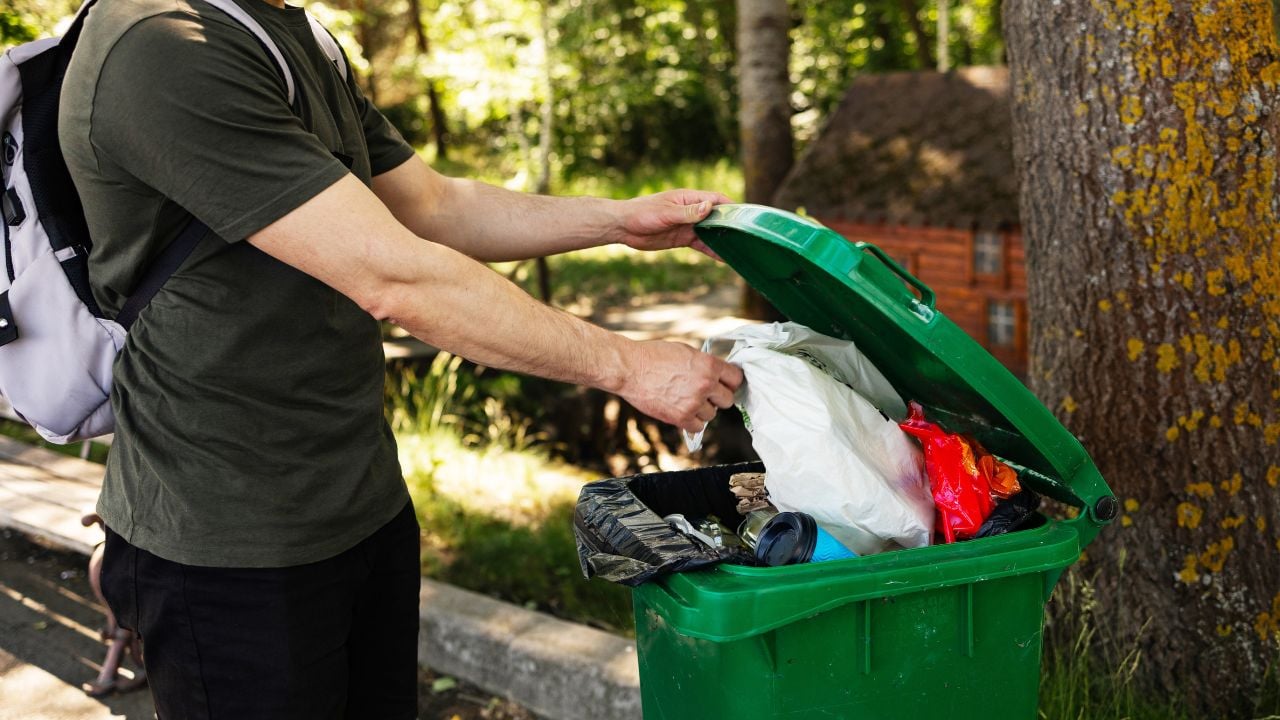
10 Things Californians Can’t Legally Toss in a Household Garbage Bin

You’re clearing out your garage this fall, and your garbage bin is undoubtedly the easiest place to toss what you no longer need.
But California law bans many of the things that are likely in your home from that bin.
These are the things Californians can’t legally toss in a household garbage bin.
Note: This is general information, not legal advice. Disposal rules are subject to change, so confirm the current requirements with the Department of Toxic Substances Control (DTSC) or the California Department of Resources Recycling and Recovery (CalRecycle).
1. Aerosol Cans With Product Left
A spray can that still releases product when you press the nozzle can’t go in your garbage bin, and that includes cooking spray.
DTSC classes those cans as universal waste, and state law keeps them out of household trash and recycling bins.
Spray paint, disinfectant spray, bug repellent, and sunscreen spray fall under the same rule.
If nothing comes out when you press the nozzle, and the nozzle isn’t clogged, the can is empty and goes in the trash.
If it isn’t empty, ask your municipal waste service provider about a local collection program.
2. Batteries
California keeps batteries of every kind out of your garbage bin, from D cells to button cells to 9-volts.
Lithium-ion, alkaline, nickel cadmium, and nickel metal hydride types are all covered.
Lead-acid batteries like the one in your car can leak toxic fluids.
Batteries cause fires that injure workers at sorting and recycling facilities.
A separate recycling law for battery-embedded products, Senate Bill (SB) 1215, was signed to reduce those fires and injuries to sanitation workers.
For extra safety, put masking tape or another seal over the terminals to avoid fire hazards.
3. Electronics
When your old TV dies, your household garbage bin isn’t where it goes.
CalRecycle’s banned list names televisions, monitors, laptops, printers, radios, and even microwave ovens.
DTSC calls e-waste hazardous because it may contain materials such as lead and mercury.
Take your device to an authorized e-waste handler instead.
If you aren’t authorized, you can’t smash or destroy e-waste first.
4. Fluorescent Bulbs
A broken fluorescent tube can release mercury into the air and water, and state law keeps it out of your garbage bin.
The ban reaches compact fluorescent bulbs, high intensity discharge bulbs, metal halide bulbs, sodium bulbs, and neon bulbs.
Until you drop them off, store used lamps in a safe, dry place where they can’t be broken.
Many retailers and local government programs accept used lamps for recycling.
5. Mercury Thermostats and Thermometers
Your garbage bin can’t take an old mercury thermostat, which contains small glass capsules of mercury.
Modern electronic thermostats don’t.
A mercury fever thermometer is universal waste too, so the same ban applies.
If you have either one, DTSC says to keep it intact when possible and not to attempt to remove the mercury.
6. Needles and Sharps
California’s Health and Safety Code bars you from knowingly putting home-generated sharps waste in a garbage, recycling, or greenwaste container.
That waste covers hypodermic needles, pen needles, intravenous needles, and lancets used for household medications.
You can carry sharps only in a sharps container, or another container your local enforcement agency approves.
Industry-run programs must offer disposal options for sharps at no cost to you, including a mail-back container.
7. Motor Oil, Filters, and Antifreeze
If you change your oil at home, the used filter can’t go in your garbage bin.
Each one contains about 10 ounces of used oil, which makes it hazardous waste.
California requires the oil itself to be managed as hazardous waste unless it has been recycled.
CalRecycle’s banned list names motor oil, oil filters, and antifreeze.
A certified collection center must accept at least 5 gallons of used oil per person per day, and CalRecycle urges centers to take oil from do-it-yourselfers, so call ahead.
Used motor oil mixed with anything else, including water, can’t be recycled and must be disposed of as hazardous waste.
8. Leftover Paint
Both latex paint and oil-based paint are on the state’s list of items banned from your garbage bin.
Oil-based paint waste is hazardous in California, and latex paint waste is presumed hazardous.
PaintCare drop-off sites take house paint, primers, stains, sealers, and clear coatings such as shellac and varnish.
There’s no charge to drop off your paint.
Aerosol paint and empty paint cans aren’t currently part of the program.
Empty paint containers should be recycled or sent to an appropriate solid waste facility.
Dried Paint and the Rules
CalRecycle says intentionally drying paint without a permit to treat hazardous waste is prohibited in California.
Its paint page says leftover paint, including dried paint, should be taken to a paint drop-off location.
9. Pesticides and Pool Chemicals
Pesticides and herbicides are on the list of items banned from your garbage bin, along with acids, oxidizers, and bases such as some pool chemicals and cleaners.
It’s illegal to dispose of hazardous waste in the garbage, down storm drains, or onto the ground.
Contact your local household hazardous waste facility about your leftover weed killer and pool chemicals.
10. Propane Tanks and Compressed Gas
A propane tank from your barbecue can’t go in your household garbage bin.
The banned list covers compressed gas cylinders, including propane tanks used for camping or plumbing.
CalRecycle’s household hazardous waste page points you to Earth911 for local collection options.
Food Scraps and the Gray Bin
Whether food scraps can go in your garbage bin depends on where you live.
A city or county with a three-container service may allow food waste in the gray container, if the contents go to a facility that recovers organics.
That gray container has to be labeled with the types of organic waste it accepts, so check your lid before you toss food in.
The state’s SB 1383 regulations took effect on January 1, 2022.
Under them, you either subscribe to your city or county’s organic waste service or self-haul your scraps under the state’s rules.
Organics made up about 29% of the 40 million tons of trash California sent to landfills in 2021, or 11.3 million tons.
Psst! How much do you know about what belongs in your garbage bin? Take our quiz and see if you can ace it.
Quiz
Bin Rules IQ
Answer ten questions on hazardous waste, recycling fees, and the rules behind your bin. We bet you can’t get them all right. Prove us wrong?
CalRecycle says tires aren’t hazardous but are still banned from the trash. What reason does it give?
Bin Rule Enforcement
Your city or county may fine you for a contaminated garbage bin, but the state doesn't require it to.
CalRecycle can fine a city or county up to $10,000 per day for violations of the organics rules.
For hazardous waste, DTSC says local Unified Program agencies carry out the enforcement.
Your household may be exempt from some universal waste rules, but not from the ban on putting universal waste in the trash.
When a city or county penalizes a violation of the organics rules, the state's regulations set the base penalty at $50 to $100 for a first violation.
The base penalty rises to $100 to $200 for a second violation and $250 to $500 for a third or later violation.
10 Things California Neighbors Report You For That Are Perfectly Legal

Some of what your neighbors report to your homeowners association doesn't break a single rule.
Some boards still open a file and mail you a notice.
10 Things California Neighbors Report You For That Are Perfectly Legal
12 Dead Giveaways You've Spent Too Many Years in California

Anyone can visit California for a week.
Living there rewires you, and the signs show up in tiny ways, like how you say a freeway number.
