
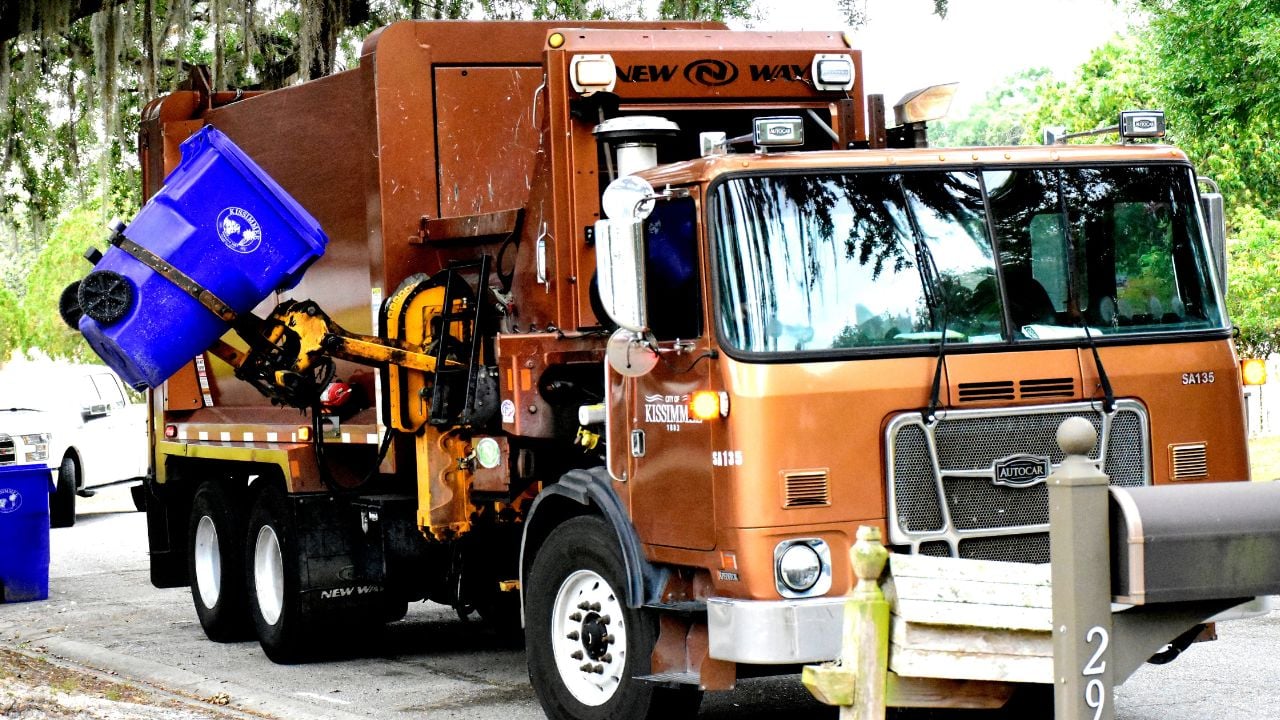
10 Things Your Florida Garbage Collector Wants You to Know

Most Floridians don’t give their garbage much thought once it reaches the curb.
Your garbage collector doesn’t have that luxury.
One badly placed bin or deceptively heavy bag can slow an entire route, damage equipment, or put a worker at risk.
Here’s what your garbage collector wishes you knew.
1. Slow Down for the Truck
Florida law protects garbage collectors on the road, and it’s stricter than many drivers realize.
The state’s Move Over law expanded in 2014 to cover garbage and recycling trucks, not just police cars and tow trucks.
The law spells it out.
Pass a stopped collection truck with its lights flashing, and drivers now have to slow down or change lanes the same way they would for a trooper on the shoulder.
Skip that step on a narrow street, and there’s no room for the person working the back of the truck to step clear in time.
Waste and recycling collection ranked as the fifth deadliest job in the country in 2024, and transportation incidents caused most of those deaths, per Bureau of Labor Statistics data.
2. Give the Cart Room
Florida haulers like Waste Management need open space around a cart, not just an empty curb.
Orange County’s collection rules keep every cart at least three feet from parked cars, mailboxes, and poles, with the wheels set against the curb.
Crowd the cart in, and the truck’s mechanical arm can’t get a clean grip on it.
No grip, no pickup.
The driver has to climb down, walk over, and drag the cart out by hand instead.
Multiply that by every tight driveway on the block, and a route that should wrap up by early afternoon drags on for hours.
3. Skip the Bag on Recycling
Florida recycling haulers want cans, bottles, and paper loose in the bin, never bagged.
Seminole County’s guidelines tell residents to skip the plastic bag entirely because the sorting facility’s machinery catches bagged recyclables whole.
Plastic bags jam the line.
Sorting facility workers usually pull a bagged batch off the belt and toss it out as trash before it ever reaches a sorter.
So the bag meant to keep things tidy ends up canceling out the whole effort.
4. Keep Yard Waste Bundled Right
Florida yard waste collectors expect a bundle they can lift, not a mystery pile of clippings.
Seminole County limits bundles to four feet long, with branches no thicker than four inches across.
Crews leave bigger bundles behind.
A stack of storm-trimmed palm fronds that runs too long or too thick just sits at the curb until someone cuts it down to size.
5. Weigh Your Trash Bag
Florida haulers cap how much a single bag or can may weigh before it becomes a safety problem.
Jacksonville caps bags and cans at 40 pounds each only in its non-automated City and Meridian Waste service areas, and Seminole County allows up to 50 across the whole county.
Crews skip heavier bags.
Jacksonville’s automated cart routes, which Waste Pro runs for many residents, set no fixed weight limit on the cart itself, but crews won’t collect anything that overflows outside it.
A bag stuffed with wet cat litter or old paving stones can split at the seam or throw out a collector’s back mid-lift.
Split a heavy load across two lighter bags instead, and crews take both of them.
Psst! How trash-smart are you about Florida pickup day? Run through this checklist and see where you stand.
6. Never Curb the Hazardous Stuff
Florida haulers refuse a long list of items no matter how carefully they’re bagged.
Waste Management’s Orange County rules turn away paint, oil, and household cleaners, along with any medical or electronic waste.
Crews won’t take it.
Curbside crews aren’t equipped to handle chemicals or sharp medical waste safely, so those items have to go to a household hazardous waste drop-off instead.
A can of old paint left at the curb usually just sits there until someone hauls it back inside.
What Florida Haulers Call Hazardous
Florida haulers draw the hazardous line around anything that can leak, spark, or cut someone inside the truck.
Paint, motor oil, and pool chemicals top that list because a punctured can spills straight into the compactor.
Propane tanks count too, since a compactor’s ram can rupture an empty tank and spark a fire, per the City of Miami Springs’ recycling guidelines.
Needles and other sharp medical waste need their own sealed container and a separate drop-off, never the everyday cart.
7. Sort Storm Debris by Type
Florida hurricane debris rules keep piles sorted by type, never one heap at the curb.
Orange County keeps vegetative debris, think tree limbs and branches, separated from construction debris like shingles, fencing, and drywall, and crews won’t touch a mixed pile at all.
Mixed piles stay put.
That split matters to the crew, not just the county: Different trucks haul each debris type to separate facilities, so a mixed pile forces a truck to skip it rather than sort it curbside on the spot.
Household garbage can never ride along with either pile, per the same county’s rules.
A processing facility can often turn clean vegetative debris like palm fronds and tree limbs into mulch, but only if it never touches a chunk of drywall or a broken fence panel.
8. Bring the Cart Back In
Florida garbage collectors want an empty cart out of their way fast, and cities like Jacksonville back that expectation with a hard deadline.
Jacksonville’s solid waste standards give residents until 6 a.m. the day after collection to bring the empty container back in.
Missing it is a violation.
A cart parked at the curb well past that window can put a resident on the wrong side of the city’s solid waste code, the same as an overgrown lawn or a broken fence.
Collectors would rather see the space open for the next truck than dodge a row of empty cans all week.
9. Skip the Greasy Box
Florida recycling collectors can reject a whole load the moment leftover food shows up in it.
Pinellas County’s recycling guidance lists food residue and items smaller than a fist among the top contaminants that spoil an otherwise clean batch.
One bad box spoils it.
A pizza box with cheese and crust still stuck to the lid carries exactly that kind of food residue, and it can contaminate the paper around it enough that a sorting facility rejects the whole truckload.
Rinse a jar, tear the food-stained flap off a box, and the sorting facility can send the rest of that batch to recycling instead of the landfill.
10. Bag It, Don’t Stack It
Florida garbage collectors like Waste Management need trash contained, not piled loose beside the can.
Orange County’s rules state plainly that all trash should be bagged, with the lid closing tight and nothing overflowing the top.
Loose trash blows away.
Wind off an afternoon storm scatters anything that isn’t bagged or sealed under a lid, and crews often leave that overflow behind entirely when it’s piled loose next to a full can.
A tied bag with a tight lid on the can is what makes it onto the truck instead of the street.
Where the Extra Batteries Go
Florida garbage collectors don’t want a car battery anywhere near the truck, which is exactly why state law bans lead-acid batteries from landfills and pushes them toward a take-back program instead.
O’Reilly Auto Parts takes used motor oil and car batteries for free at many stores, no curbside pickup required.
There’s a Florida catch, though.
O’Reilly caps free battery recycling at two batteries a day per customer at Florida locations, the lowest daily limit the chain sets anywhere: Most other states get five a day, and California gets six.
Clearing out a garage full of dead batteries after a move takes more than one trip.
Bulky Items Need a Phone Call First
Florida counties don’t treat a mattress or a couch like ordinary trash.
Hillsborough County requires residents to call and schedule bulky item pickup before setting anything at the curb, and charges a fee that runs $30 to $50 per item depending on size.
Set an old couch out without calling first, and the crew can leave it right at the curb.
That call isn’t optional.
A resident who assumes bulky pickup works like regular trash day usually ends up staring at that same couch for another week.
Florida haulers keep that scheduling rule in place because an unscheduled item can sit at the curb through several regular collection days before a crew ever circles back for it.
A five-minute call is the difference between a couch that’s gone by Friday and a couch still sitting in the driveway a month later.
9 Questions Every Floridian Dreads When Family Visits From Up North

A brother-in-law from Buffalo drops his bag in the driveway, looks over the yard, and asks which tree is the orange tree.
He’s just getting started, and the postcard version of Florida he packed for is years out of date.
9 Questions Every Floridian Dreads When Family Visits From Up North
9 Money Mistakes Florida Homeowners Make Every Hurricane Season

A homeowner in Punta Gorda calls her insurance company eleven months after landfall, the week her contractor finally has an opening.
She’s four weeks from losing the claim entirely, and a contractor’s calendar has nothing to do with the clock her insurer is running.
9 Money Mistakes Florida Homeowners Make Every Hurricane Season
