
12 Disappearing Things Floridians Won’t Be Able to Enjoy Much Longer

A study published in the journal Science in 2025 found that two of Florida’s reef-building corals, staghorn and elkhorn, are functionally extinct in the wild.
Plenty more across the state is slipping away, too.
These are the disappearing things Floridians won’t be able to enjoy much longer.
1. Apalachicola’s Wild Oysters
Apalachicola Bay used to supply more than 90% of Florida’s wild oysters and about a tenth of the oysters sold nationwide, before the fishery collapsed around 2013.
Florida shut the whole bay down to wild harvesting in 2020.
Five winters passed.
Limited harvesting finally returned in January 2026, but only across about 500 acres of the bay, a sliver of the roughly 10,000 acres once considered good oyster habitat there.
Commercial crews can work weekdays now, recreational harvesters get weekends, and everyone needs a permit.
Anyone who wants Apalachicola oysters now has to work around the calendar: A commercial permit and a weekday, or a recreational permit and a weekend.
2. Florida’s Coral Reef Tract
Florida’s coral reef, North America’s only coral barrier reef, has already had three of its reef-building species declared functionally extinct.
Marine scientists declared staghorn and elkhorn coral functionally extinct in 2025, a few years after pillar coral got that same label.
In the Keys and the Dry Tortugas, 98% to 100% of the colonies they tracked died.
That’s nearly all of them.
A marine heat wave in the summer of 2023 pushed water in parts of the Keys past 100 degrees.
Even before that heat wave, a NOAA-led study found that 70% of the reef sites it surveyed were losing more reef than they were building.
A snorkel trip over what used to be a thriving reef increasingly means swimming past bare rock.
3. Florida’s Shrinking Groves
Florida’s orange groves have shrunk from more than 665,000 acres in the 2000-01 season to about 184,000 acres for 2025-26, and the pace is picking up, not slowing down.
That’s a 72% drop.
Citrus greening disease is the main reason, but hurricanes and development pressure are hurting the groves too.
Fewer groves standing also means fewer of the stretches where a family could still pull over for a bag of fruit picked that morning.
Alico, one of Florida’s biggest citrus growers, ended its citrus operations after the 2024-25 harvest and plans about 9,000 homes on old grove land instead.
Old citrus rows are turning into rooftops.
Grove acreage keeps falling every single year now, not just in the bad ones.
What’s Killing the Groves
Citrus greening is the main disease behind Florida’s lost grove acreage, and it has no cure.
A tiny invasive insect called the Asian citrus psyllid spreads the bacteria as it feeds, and growers first confirmed the disease in a Florida grove back in 2005.
An infected tree can keep producing fruit for years while it slowly starves, so a grove can look healthy right up until it isn’t.
California grew 79% of the country’s citrus in the 2023-24 season, according to USDA, while Florida grew 17%.
4. Stone Crab Claws
Stone crab claws are a Florida tradition every October, but the state has had to shrink the season to protect what’s left of the population.
Florida shortened the season by two weeks and raised the minimum claw size back in 2020, after landings had fallen 22% since the late 1990s.
Warmer water, red tide, and traps lost to hurricanes all share the blame.
Dockside prices rose as the catch shrank.
Heading into the 2025-26 season, some South Florida seafood markets were charging about $25 to $35 a pound for medium claws.
5. Florida’s Natural Springs
Florida’s springs have lost about a third of their combined flow over 70 years of rising groundwater pumping, the Florida Springs Institute reports.
The state has more than 1,000 springs, one of the largest concentrations anywhere in the world.
A Wekiva River advocacy group told NPR that about half of the water pulled from the aquifer goes to watering residential lawns.
A swim in a Florida spring that still runs clear and full from bank to bank is turning into the exception, not the rule.
6. Florida’s Eroding Beaches
Sandy beaches are disappearing faster than the state can keep sand on them.
Florida’s Department of Environmental Protection puts 457.8 miles of the state’s 825 miles of sandy shoreline in critically eroded condition, 55% of the coast, as of its June 2026 count.
Renourishment projects pump in fresh sand to fix that.
Not always fast enough.
The Army Corps of Engineers now wants an easement from every private beachfront owner along a federally funded stretch, so a single holdout can stall the whole project.
A stalled project just means more months of narrowing beach for every neighbor downshore.
Wide, walkable beaches keep getting narrower every hurricane season, and fixing them keeps getting harder.
7. Florida’s Drive-In Theaters
Florida’s drive-in movie theaters are down to four theaters, all of them clustered around Tampa Bay and Central Florida.
Silver Moon in Lakeland, Joy-Lan in Dade City, the Ocala Drive-In, and Ruskin Family Drive-In are the four still running.
That’s the whole list now.
Drive-ins nationwide went from thousands at their peak to a few hundred today.
A summer night watching a double feature from the hood of a car is a smaller club than it used to be.
8. Florida’s Winter Manatees
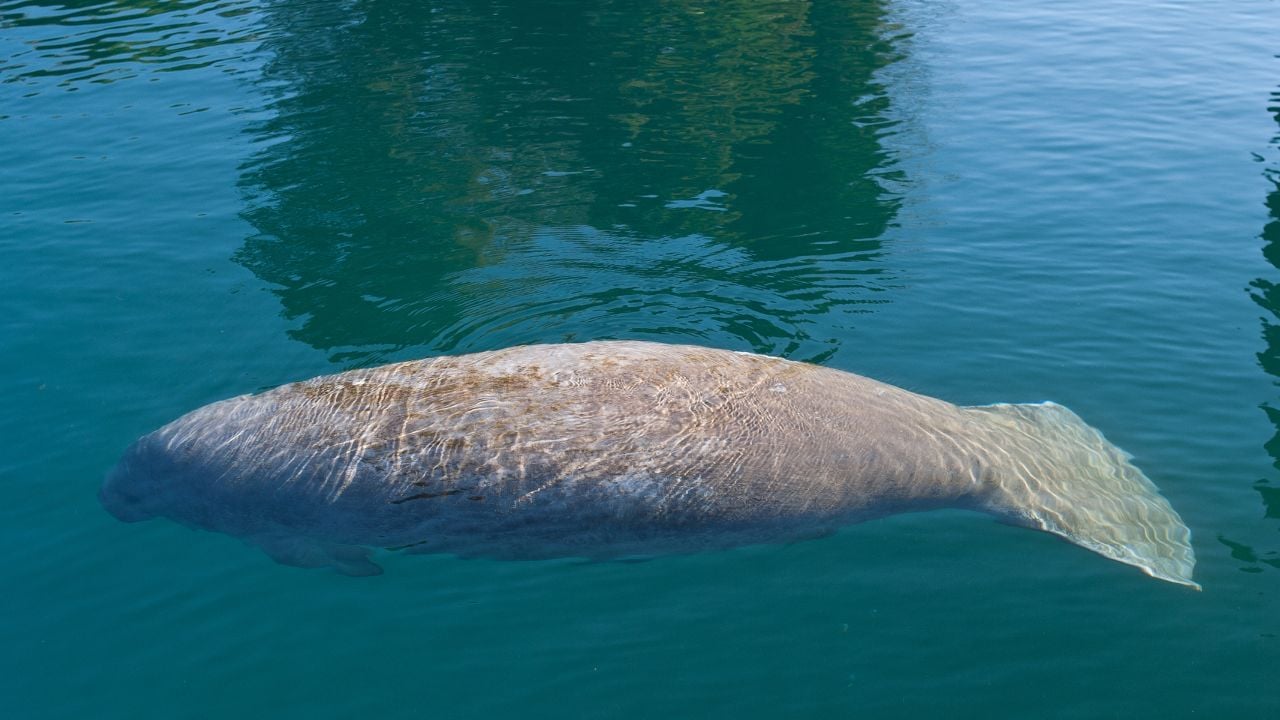
Manatees gather by the hundreds in warm, spring-fed water every winter, and snorkelers slip into the water nearby to enjoy watching them drift past.
Federal wildlife officials allow exactly that kind of close, in-water encounter at Crystal River’s Three Sisters Springs.
Visitors just have to keep still and never touch or chase a manatee.
No touching. No chasing. Just watching.
Florida’s wildlife agency tracked an Unusual Mortality Event that started in December 2020, when seagrass loss in the Indian River Lagoon left Atlantic coast manatees starving.
The agency closed it in March 2025.
Warm water is the bigger long-term worry, since the Marine Mammal Commission says about two-thirds of manatees rely on power plant outfalls to survive the coldest days.
Those plants won’t run forever, and the springs manatees fall back on are losing flow to groundwater pumping.
9. Habitat for the Scrub-Jay
The Florida scrub-jay is the only bird species found nowhere on Earth except Florida.
Its population has fallen to fewer than 10,000 birds, about 90% fewer than before European settlement.
Its scrub keeps disappearing too.
Developers and farmers want the same sandy, open scrubland the birds need to nest and feed.
A Charlotte County landowner sued in 2024, arguing the federal government can’t regulate a bird found in only one state.
Four conservation groups stepped in during 2025 to defend the scrub-jay’s protections in court.
The case was still unresolved in April 2026, and a win for the landowner could weaken protections for other species that live in only one state.
10. Key Deer’s High Ground
The Key deer is found only in the Lower Florida Keys, nowhere else in the world.
About 75% of the population is concentrated on just Big Pine Key and No Name Key.
Fewer than 1,000 of them survive today, up from only a few dozen in the 1950s.
That comeback took decades.
Key deer on Big Pine Key live right alongside homes and roads.
Even small increases in sea level could shrink the refuge’s protected high ground by thousands of acres.
Vehicle collisions are already a leading cause of death for the deer, especially at night.
A deer barely bigger than a large dog depends on high ground that keeps getting smaller every year.
11. Florida’s Open Cattle Ranches
Florida’s farms and ranches are projected to disappear at about 120 acres a day, mostly to development rather than rising seas.
That’s almost 45,000 acres a year.
A drive past open pasture and grazing cattle on the way to the coast is still common enough, at least for now.
Researchers project the state could lose as much as 2.2 million acres of agricultural land by 2070.
Roughly a third of the state is still working farm or ranch country today.
Psst! How much do you know about Florida’s history and geography? Take our quiz and see how many you can get right.
Quiz
Florida Firsts & Facts
Answer these questions on Florida history and geography. We bet you can’t get them all right. Prove us wrong?
Before the Overseas Highway connected the Florida Keys, what ran along much of that same route?
12. Shade Trees in Older Neighborhoods
Shade trees will take a long time to grow back in Tampa and St. Petersburg after the beating they took in the 2024 hurricane season.
Tampa's tree canopy fell from 31.4% to 29.9% in a single year, a loss of about 1,200 acres.
That's nearly 5% of the whole city's canopy.
Gone in a year.
St. Petersburg lost trees too, with about 6% of them knocked down and canopy coverage dropping from 29% to 27%.
Both cities are replanting, with Tampa's program putting in about 500 trees a year.
The wide oak canopy that makes an old Florida street feel cooler in July is thinner than it was two years ago.
A mature oak takes decades to grow back the canopy a single storm season took down in hours.
9 Things Florida Parents Always Do When Their Adult Children Come Home
An adult child can live across the country for years and still turn back into a kid the moment they walk through the front door in Florida.
Parents slip right back into an old rhythm without even noticing they're doing it, from the same questions at the door to the same food waiting in the fridge.
9 Things Florida Parents Always Do When Their Adult Children Come Home
8 Golf Cart Rules Floridians Break in Their Neighborhoods
Sumter County, home to much of The Villages, logged 85 golf cart crashes in the first six months it started tracking the number.
A lot of those carts were breaking a rule the driver never realized applied to them in the first place.
