
12 Frugal Boomer Habits Younger Alabamians Laugh At Until They Try Them

If you’re packing Thanksgiving leftovers into old margarine tubs this week, someone at the table is probably going to tease you about it.
That habit’s worth more than they’d guess, though.
Here are the frugal boomer habits younger Alabamians laugh at until they try them.
Note: This is general information, not financial advice. Savings estimates are subject to change.
1. Cooking at Home
Many boomers grew up treating a restaurant meal as an occasion and supper at home as the default.
In a 2016 chart, the U.S. Department of Agriculture’s Economic Research Service said food bought away from home is generally higher priced than food prepared at home.
The agency’s food price outlook shows restaurant prices rose 3.8% in 2025, while grocery prices rose 2.3%.
The average household spent $3,945 on food away from home in 2024.
Start with one more night at your stove each week.
2. Shopping the Weekly Ad
University of Georgia Extension says shopping the ads lets you adjust your meal plan to include what’s on sale.
A lot of boomers circle the sale items in the Sunday paper before they shop.
The extension adds that many grocery stores post their ads on their websites, and local papers carry them too.
It also says to check your fridge, freezer and pantry before you head to the store.
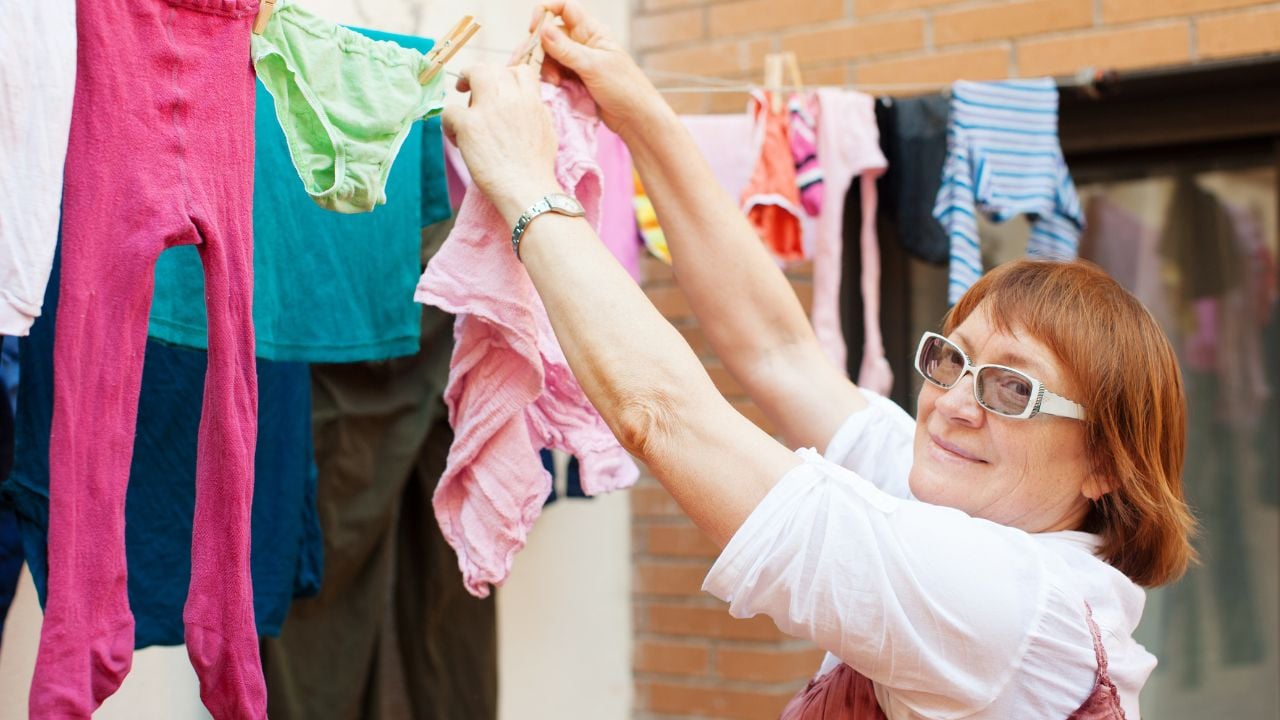
3. Hanging Laundry on the Line
A clothesline uses no electricity.
You can start with a single load.
Lots of boomers still reach for the clothespins before the dryer.
The Clothesline vs. Dryer Math
A clothesline load costs nothing to dry, while a dryer load at the federal minimum costs about 37 cents in Alabama.
Right now, the federal minimum for a standard-size electric dryer is 3.73 pounds of test load dried per kilowatt-hour (kWh) of electricity.
The Department of Energy’s test load for that dryer is 8.45 pounds.
Dividing 8.45 by 3.73 comes to about 2.27 kWh a load.
At Alabama’s residential rate of 16.54 cents a kWh, that’s about 37 cents a load.
The test procedure assumes 283 loads a year, which is about 640 kWh and about $106 on your electric bill.
If you hang half your loads, you keep about $53 of it.
Both the federal minimum and the 283-load assumption are set to change on March 1, 2028.
4. Setting the Thermostat at 78
The Department of Energy’s 2012 list of summer tips says running your air conditioning at 78°F instead of 72°F can save 6% to 18% on your cooling bill.
Your bill drops as the gap between the temperature inside and out shrinks.
Some boomers keep the house warmer in summer than their kids do.
Raise the setting a degree or two at a time until the house feels right.
5. Writing a Grocery List
The U.S. Department of Agriculture’s 2021 food-waste guidance says to make a list before you shop so you don’t buy more than you need.
The back of an envelope works.
Many boomers keep a running list on the kitchen counter.
Then stick to it when you grab a buggy.
6. Turning Down the Water Heater
The Department of Energy’s 2012 summer-tips list says heating water can account for 14% to 25% of the energy a home uses.
It says to turn the water heater down to the warm setting, 120°F, to save energy and avoid scalding at the faucet.
Boomers often check that setting once a year.
Look at what your water heater is set to.
7. Eating Leftovers
The average family of four wastes nearly $1,500 worth of food each year, according to U.S. Department of Agriculture research.
More than a few boomers treat Sunday dinner as two meals, not one.
The agency’s guidance says to pack your leftovers in small portions in shallow containers, mark the contents and date, and refrigerate or freeze them right away.
Psst! How much do you know about household money in Alabama? Take our quiz and see how many you can get right.
Quiz
Alabama Money Quiz
Answer these questions on Alabama taxes, wages and household money. We bet you can’t get them all right. Prove us wrong?
Alabama’s state sales tax on groceries dropped to what rate in 2025?
8. Cleaning the Lint Trap
A lot of boomers swipe the lint screen without a second thought.
ENERGY STAR, the federal energy-efficiency program, says cleaning the lint trap before each and every load can save up to $34 a year.
The program says a clean filter also improves air circulation and makes the dryer more efficient.
Make it part of loading your dryer.
9. Slowing Down on the Highway
Gas mileage usually decreases rapidly at speeds above 50 mph, according to FuelEconomy.gov, the federal fuel economy site.
The site says you can assume each 5 mph you drive over 50 is like paying an additional $0.30 per gallon for gas.
Quite a few boomers treat the speed limit as a ceiling, not a target.
10. Running a Ceiling Fan
Many boomers reach for the ceiling fan before the thermostat.
The Department of Energy says a ceiling fan lets you raise the thermostat setting about 4°F with no reduction in comfort.
ENERGY STAR, the federal energy-efficiency program, says ceiling fans cool people, not rooms, so switch the fan off when you leave.
11. Washing in Cold Water
Water heating accounts for about 90% of the energy a clothes washer uses, according to ENERGY STAR, the federal efficiency program.
Switching the setting from hot to warm can cut that energy use in half.
Cold cuts even more.
Some boomers have run the washer on cold for years.
Try it on your next load of towels.
12. Paying With Cash
A 2001 study in Marketing Letters found that people were willing to pay more when told to use a credit card instead of cash.
The researchers said the effect on willingness to pay may be large, up to 100%.
Adults 55 and older relied more on cash than other age groups in 2024, according to the Federal Reserve's Diary of Consumer Payment Choice.
That age range takes in the boomer generation.
Try cash for your groceries and see how the month goes.
Who Counts as a Boomer
Boomers are adults born between 1946 and 1964, according to Pew Research Center.
That was an estimated 67 million people as of July 1, 2024.
That's one in five Americans.
The oldest boomers turn 80 in 2026.
The youngest boomers turn 62 in 2026.
5 Alabama Property Tax Breaks Homeowners Over 65 Never Apply For

With everything costing more, a tax break you never claim hurts extra.
Older Alabamians who own their homes may qualify for some relief, though you often have to apply for it.
5 Alabama Property Tax Breaks Homeowners Over 65 Never Apply For
5 Things About Alabama That Haven't Changed Since the 1970s

Phones, cars and fashion look nothing like they did decades ago.
A few things in Alabama have stayed put through all of it, though, and locals may pass them every day without a second thought.
