
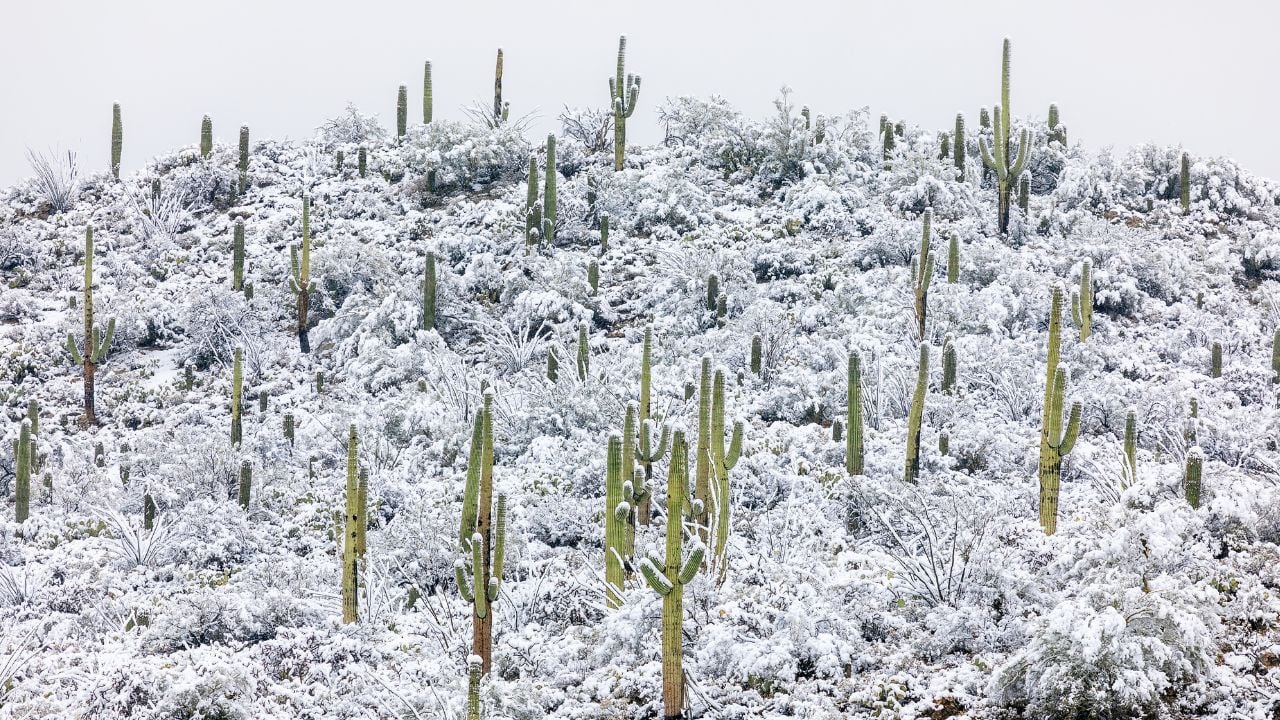
12 Snow and Freeze Facts About Arizona Winters That Snowbirds Should Know Before They Pack

Many newbie snowbirds pick Arizona for the sunshine.
The state’s winter still has a cold side, though.
Here’s how to plan for its snow and freezes before you pack.
1. Sunrise Mountain’s Record Snow Season
Arizona’s record for snow in a single winter is 400.9 inches, and it fell on Sunrise Mountain in 1972-1973.
That’s more than 33 feet.
If your plans include the state’s mountains, that record shows how much snow you could run into.
2. Flagstaff’s Average Snowfall
Flagstaff Pulliam Airport receives an average of 90.1 inches of snow between October and May, according to the National Weather Service in Flagstaff.
Spread across those eight months, that’s about 11 inches a month.
If Flagstaff is a day trip on your winter list, pack boots and a heavy coat.
Save the sandals for Phoenix.
3. Flagstaff’s One-Day Snow Record
In February 2019, a single storm broke Flagstaff’s one-day snow record when 35.9 inches fell at the airport in 24 hours.
It was nearly three feet.
If you’re driving north from the Phoenix area, check the forecast the morning you leave, not just the week before.
4. Phoenix’s Greatest Snowfall
Phoenix’s official weather station measured its greatest snowfall, 1.0 inch, on January 20, 1933, and again on January 21 and 22, 1937.
One inch isn’t much.
So if your winter stays in the city, you can leave the snow shovel at home.
Measurable snow is still quite rare in most of the city.
5. Foothill Snow Reports
Where does Phoenix get snow?
The weather service says it has become more common to see snowfall reports from residential areas in the higher foothills of the north valley.
If you’re renting in those foothills, ask your host how high the street sits.
6. Phoenix’s Record Low
Phoenix’s coldest winter temperature on record is 16 degrees, set on January 7, 1913.
That’s 16 degrees below freezing.
If Phoenix is your winter base, that’s the lowest reading the weather service lists for the city.
Psst! How much do you know about winter weather in the desert Southwest? Take our quiz and see if you can ace it.
Quiz
Winter Weather Quiz
Answer these questions on snow, freezes and record lows. We bet you can’t get them all right. Prove us wrong?
In the January 1937 storm, Phoenix’s official station recorded 1.0 inch of snow. Up to how many inches did other parts of what’s now the metro area report?
7. Desert Freezing Nights
Freezing isn't only for mountains.
The Arizona State Climate Office says nighttime winter temperatures in the desert can drop slightly below freezing.
Phoenix's freeze warning is set at 32 degrees or lower.
When a freeze warning goes out, bring in or cover your potted plants and anything else that can't take the cold.
When Phoenix Gets a Freeze Warning
The National Weather Service office in Phoenix issues a freeze warning for the first freeze of the winter season.
The office also issues a warning for any freeze in major population areas.
That means a freeze in a major population area can bring a warning even after the season's first freeze has passed.
8. Hawley Lake's Deepest Freeze
Arizona's deepest freeze on record hit Hawley Lake, at 40 below zero on January 7, 1971, according to the National Weather Service.
Phoenix's record low of 16 degrees sits 56 degrees above Hawley Lake's.
That's a wide gap.
If your route leaves the desert for higher country, you'll want to pack for it.
9. Alpine and Greer's Frosty Nights
Winter nights in Alpine and Greer frequently drop into the 20s, the Arizona State Climate Office says.
That's below freezing.
In the desert, nighttime winter temperatures can drop slightly below freezing.
If you book a stay in either town, expect colder winter nights than the desert has.
10. Mount Lemmon Road Conditions
Tucson's ski hill is on Mount Lemmon, and the Coronado National Forest lists Mount Lemmon Ski Valley at 8,297 feet.
It's about an hour from Tucson.
After snowstorms, the road may close temporarily, and drivers may need snow tires, chains or four-wheel drive.
If you're staying in Tucson, check the road conditions before you head up after a storm.
11. Grand Canyon's North Rim Closure
Winter conditions force the closure of the entire northern portion of Grand Canyon National Park.
The National Park Service says the North Rim closes to vehicles once the state closes Highway 67 south of Jacob Lake, usually by December 1.
In November, the North Rim is open for day use only, unless snow closes Highway 67 first.
Vehicles return in mid-May, when North Rim facilities open for the season.
If a North Rim trip is on your winter list, check the park's conditions page before you drive.
12. Tucson's Freeze Dates
Under the 1991 to 2020 normals, Tucson's first freeze, a low of 32 degrees or lower, normally arrives on December 3.
The last freeze normally falls on February 7.
That's about two months.
If your stay falls between those dates, bring a jacket for the desert nights.
The record reaches past that window, with a first freeze as early as October 16, 1899, and, in a different winter, a last freeze as late as May 3, 1899.
Driving Checklist
Before a snowy drive, the Arizona Department of Transportation tells you to fill your fuel tank and try to keep it at three-quarters full.
Never drive into snowy, icy or cold conditions without a fully charged phone, drinking water and winter coats or warm blankets.
A longer kit list adds a small bag of sand or kitty litter for wheel traction and a small folding shovel.
The list also includes an ice scraper and a flashlight with batteries.
Antifreeze is easy to forget.
Make sure the antifreeze in your radiator can handle freezing temperatures.
Studded Tires and Road Conditions
Before you drive in snow, plan to drive for conditions, with slower speed and slower acceleration.
If you're bringing studded tires, they're permitted on Arizona highways from October 1 to May 1, and state law spells out the same dates.
The window runs seven months.
For updated road and weather conditions, use Arizona Traveler Information, the state's 511 app or dial 511.
Where the Snow Line Sits
Where does the snow start?
The National Oceanic and Atmospheric Administration's state climate summary says snowfall is rare in the southern desert region.
Snow does occur at the higher elevations, where it can reach depths of more than 100 inches.
If you're hoping to see snow, plan on going up in elevation.
The snow line is the average lowest elevation at which snow falls.
Rising temperatures are projected to raise the snow line, which would make rain more likely than snow at lower mountain elevations.
14 Things Arizonans Say That Baffle Everyone Else
A tourist eases a rental car around the barricade at a flooded wash outside Tucson.
The driver ends up on the roof, waiting on a swift-water rescue crew, and Arizona has a name for that mistake.
14 Things Arizonans Say That Baffle Everyone Else
9 Arizona Foods and Drinks Visitors Order Wrong Every Time

Arizona menus hold a few traps for visitors who order by name.
A chimichanga is easy to order by name, but the locals' way of ordering it is another story.
