
12 Things Floridians Keep in Their Car That Confuse Visitors

Florida drivers can end up carrying a lot more than a spare tire.
Between the heat, the bugs and storm season, visitors may wonder why their trunk looks so full.
These are the things Floridians keep in their cars that visitors don’t always get.
1. SunPass Transponder
A SunPass transponder connects a car to SunPass, Florida’s prepaid toll program, which Florida’s Turnpike calls the preferred method of payment for tolls.
SunPass’s installation page tells you to mount the transponder at the top center of the windshield when possible.
Cash isn’t accepted in those lanes.
If your car has no transponder, its license plate is photographed and a Toll Enforcement Invoice is mailed to the registered owner.
Transponders Florida’s Turnpike Accepts
SunPass, E-PASS, E-ZPass, LeeWay, ExpressToll, Peach Pass, NC Quick Pass, PIKEPASS, K-TAG, EZTAG and TollTag are accepted in the turnpike’s electronic toll collection lanes.
Rental cars handle tolls differently because Florida’s Turnpike says each rental company has a different payment arrangement for tolls.
Review rental agreements carefully for all fees.
2. Windshield Sunshade
Researchers at the Florida Solar Energy Center tested windshield sunshades on parked cars at Cape Canaveral in a 1990 study.
Without shades, interior temperatures commonly reached 150°F and dashboards rose to nearly 200°F.
Conventional cardboard shades lowered interior air temperatures by about 15°F.
They cut dashboard temperatures by about 40°F.
Foil-backed shades did better still, keeping the inside of the car 3 to 5°F cooler than cardboard shades.
The study is from 1990, so the car you drive may behave differently, and your dashboard may not read the same.
3. Love Bug Rag
The University of Florida’s extension office in Sarasota County says Florida has two distinct love bug seasons.
They run in spring (April and May) and late summer (August and September).
You can avoid damage to the car’s paint if you remove the splatter within 20 minutes.
To loosen splatter, lay a wet towel across the spots for about five minutes and then gently scrub off the rest.
Carry water and a squeegee, towel or paper towels in your car to wash the bugs off the windshield.
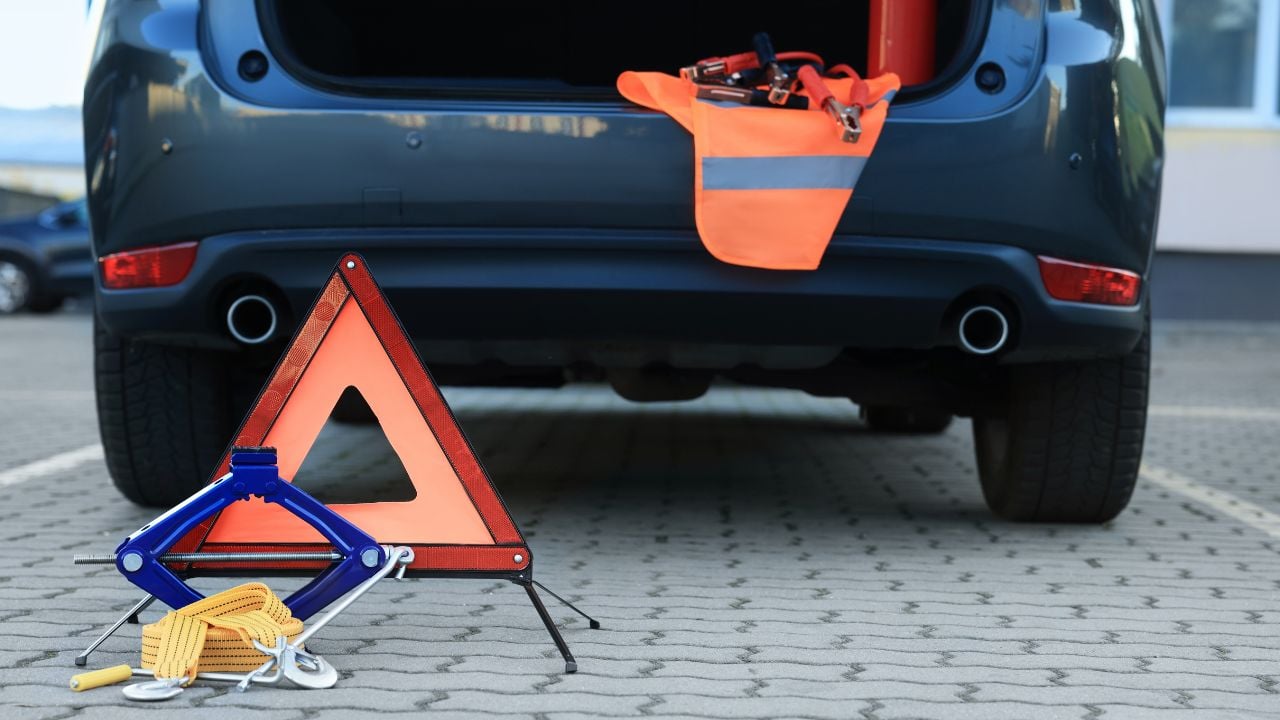
4. Jumper Cables
Florida’s Division of Emergency Management wants gas tanks at least half full during hurricane season, so drivers can evacuate without facing long lines at gas stations.
Vehicle emergency supply kits can include jumper cables, too.
If you don’t have cables, AAA says to keep a compact set in the trunk, or to consider a portable jump starter.
A dead battery can leave you stranded and waiting for help in dangerous conditions.
Extreme heat can also hinder the chemical processes inside car batteries, making it hard for them to hold a charge.
In hot southern locales, a car battery will typically last about three years.
Once a battery reaches its third year, have it tested annually.
5. Rain Poncho
Florida’s Division of Emergency Management also lists rain ponchos among the items a vehicle emergency supply kit can include.
A rain poncho helps you stay dry in unexpected downpours or wet conditions when you need to get out of the car, according to the Red Cross.
In West Central Florida, the National Weather Service’s Tampa Bay office describes the rainy season as warm and humid, with frequent showers and thunderstorms.
From July through early September, heavy rainfall and seasonal river flooding remain significant hazards, along with frequent lightning.
6. First Aid Kit
A first aid kit is one of the most important items you can include in any emergency kit, and your car is no exception, the Red Cross says.
The National Safety Council’s trunk list spells out a first aid kit with gauze, tape, bandages, antibiotic ointment and an instant cold compress, among other items.
Florida’s Division of Emergency Management lists a first aid kit among vehicle emergency supply kit items too.
Psst! Think you can ace a quiz on driving and storms? Take our quiz and see how many you can get right.
Quiz
Florida Driving and Storm IQ
Answer these questions on Florida driving rules and storm season. We bet you can’t get them all right. Prove us wrong?
Under Florida law, when are headlights required besides the hours from sunset to sunrise?
7. Flashlight
Emergency flashlights increase visibility if you're stuck on the side of the road at night, the Red Cross says.
The National Safety Council's trunk list names a flashlight with extra batteries for your car.
The state emergency management division's vehicle kit list names a flashlight with extra batteries too.
8. Emergency Radio
The Red Cross car kit page lists emergency radios for your car.
A radio keeps you updated on emergency alerts, weather warnings and instructions from authorities, even when traditional communication channels are down.
9. Drinking Water
If you're stranded for an extended period, the Red Cross says, you might need clean drinking water and food.
Drinking water also appears on the National Safety Council's trunk list.
AAA's grab bag for your car pairs non-perishable snacks and water.
10. Emergency Cash
After a disaster, banks and ATMs may not be open or available for extended periods, the state's health department says.
The Red Cross car kit guide says a small amount of cash can be helpful in emergencies, especially if you're in an area where card payments aren't accepted.
AAA's grab bag list for your car includes cash too.
11. Reflective Triangles
Ready.gov, the federal preparedness site, tells you to keep an emergency supply kit in your car, with flares or a reflective triangle among the extras.
The National Safety Council's trunk list calls for reflective triangles and bright cloth to make your vehicle visible.
12. Phone Charger
Florida's Division of Emergency Management lists electronic device chargers for a vehicle emergency supply kit.
Ready.gov's car list names a car cell phone charger too.
The National Safety Council also says you should keep family and emergency phone numbers, including your auto insurance provider and a towing company, in your phone.
8 Things Floridians Do in the Weeks Before Snowbirds Arrive
Do you know what Floridians do before the first snowbird shows up?
The quieter days of fall come with a job to finish before the pace changes.
8 Things Floridians Do in the Weeks Before Snowbirds Arrive
8 Florida Beach Rules Locals Follow That Are Never Posted

What do locals know about the beach that signs don't say?
The answer starts with a folding chair on wet sand.
