
6 Things Bald Eagles Do at Conowingo Dam Every November That Marylanders Never See

When the siren sounds at Conowingo Dam, bald eagles start circling.
People who stop by in November can miss a lot if they don’t know what to look for.
Here’s what bald eagles do at Conowingo Dam every November that many Marylanders never see.
1. Feeding on Stunned Fish
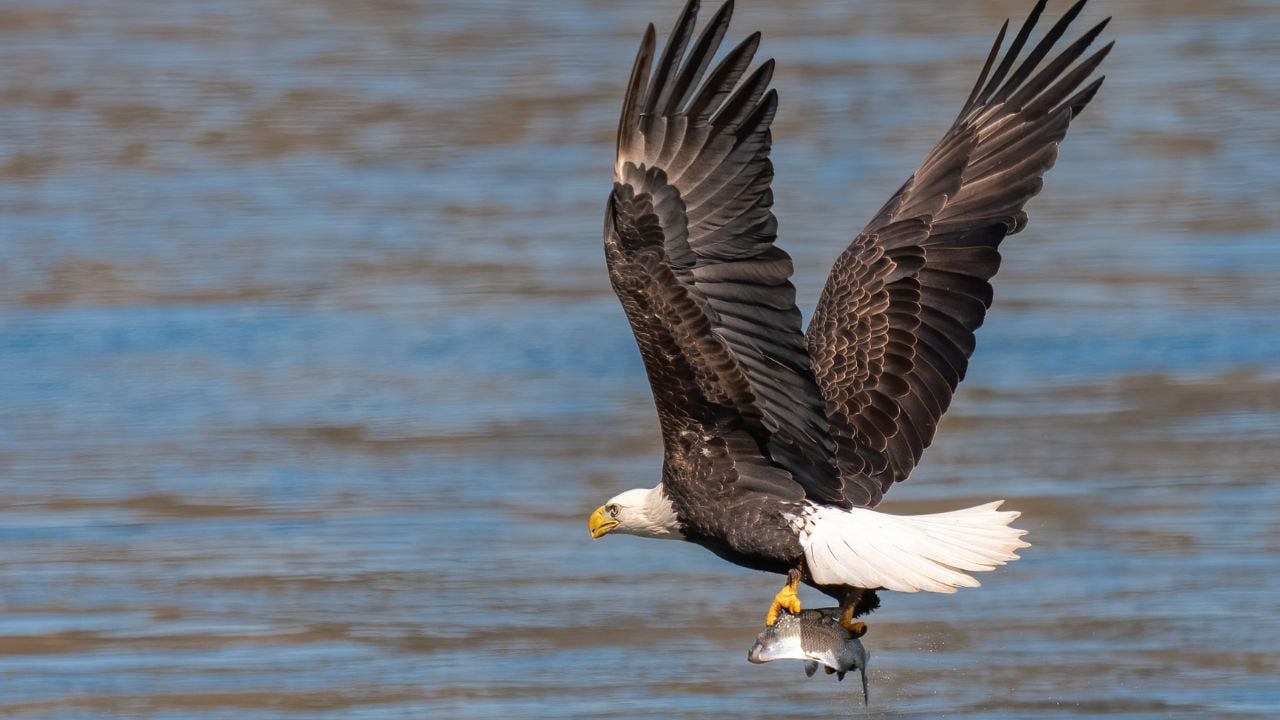
Fish are the reason bald eagles crowd Conowingo Dam, and the plunge pool below the dam holds a lot of them.
You may spot eagles dotting the trees and soaring over the rapids, watching for shad, herring and eels that surface after the turbines injure them.
If you keep your eyes on the water’s surface, an eagle may swoop down after a fish.
The dam’s outflow stays unfrozen in winter, so the hunting stays open.
2. Arriving From the North
In the fall, Conowingo’s resident bald eagles get company.
Resident eagles live near the dam all year, and in November they’re joined by eagles migrating south, mainly from the upper Susquehanna River, New York and Canada.
If you visit in November, you may catch the newcomers.
Stay into winter, and you could see a crowd like the winter 2018 count of about 230 eagles near the dam.
That’s more than twice the summer numbers.
When Bald Eagle Season Runs at Conowingo Dam
Large numbers of bald eagles are typically at Conowingo Dam from mid-October through mid-March.
The Maryland Museum of Natural Sciences says viewing peaks in early winter, and eagles can still be abundant in January.
3. Circling at the Siren
Before the turbines run at Conowingo Dam, an air-raid siren sounds and hazard lights start flashing.
Eagles start calling to each other, and others begin to circle overhead.
Once the turbines are turning, you may see the eagles swoop down to pull larger fish out of the fast-moving water.
Seagulls grab the tiny ones.
When you hear that siren, have your camera ready.
Psst! How much do you know about bald eagles and Maryland wildlife? Take our quiz and see if you can ace it.
Quiz
Maryland Eagle IQ
Answer these questions on bald eagles and Maryland wildlife. We bet you can’t get them all right. Prove us wrong?
In 1977, scientists counted how many bald eagle breeding pairs in Maryland?
4. Stealing Each Other's Fish
Some eagles at Conowingo Dam would rather steal a fish than catch one.
You may see an eagle chase down another that a heavy fish has slowed.
Sometimes the two birds fall in a spiral, both locked onto one fish.
When a chased eagle drops its catch, the fish usually lands in the water, and the thief tries to retrieve it.
One writer saw a chased eagle drop a fish onto a parked car, so you might think twice about where you park.
5. Perching on Power-Line Towers
At Conowingo Dam, bald eagles perch on a high branch or power tower, overseeing the water before they soar and swoop down for a fish.
In a May 2023 piece on the spring shad run, a Chesapeake Bay Magazine writer counted over 150 eagles lining the river on multiple occasions.
They sat on rocks, in the power-line towers and in trees.
A photo from the Center for Conservation Biology shows a group of eagles loafing on a transmission tower along the lower Susquehanna River in the evening.
Check the towers and treetops when you scan the river, and you may find eagles perched there.
6. Cartwheeling in the Air
Courtship takes to the air at Conowingo Dam in the fall.
Some locals keep their eyes on the water and miss what's happening overhead.
At the dam in October and November, you may see an eagle grab another by its talons in midair, according to County Lines magazine.
It's called cartwheeling.
It's part of their mating ritual.
The pair locks talons in a courtship dance and breaks the lock before reaching the ground.
If you're at the river in October or November, look up.
Roosting Together
The Center for Conservation Biology says vagrant eagles on the lower Susquehanna River put on feeding frenzies during the day and settle into large communal roosts in the evening.
If you're wondering how big a roost can get, Maryland's Department of Natural Resources says some roosts in the area have 100 to 200 eagles using them.
Eagles That Stay to Nest
If you visit in November, not every bald eagle you see at Conowingo Dam is passing through.
Constellation says the eagles that gather there by Thanksgiving use it as a major breeding, nesting and foraging ground.
Eagle nests around the dam have tripled since 2010.
The Center for Conservation Biology counted 43 pairs on the lower Susquehanna River in 2023, up from 13 occupied territories in 2010.
Nesting eagles cluster around the lower river's two dams, Conowingo and Holtwood, where the outfalls concentrate fish.
Sharing the Water
The bald eagles at Conowingo Dam share the river with cormorants, seagulls, herons, ospreys and about 220 other species.
If you bring your binoculars, you may pick out the ospreys and herons too.
Watching From Fisherman's Park
Photographers and other observers tend to gather at Fisherman's Park, on the Harford County side of Conowingo Dam, to watch the bald eagles.
Harford County's tourism office lists the park as a place where you can sight bald eagles.
The dam also has a visitors center where you can learn about the history of Conowingo.
Chesapeake Bay Magazine says the best times for birding are early morning and late afternoon.
As of 2023, the dam's turbine schedule is published through a call center.
9 Things That Give a Marylander Away the Moment They Leave the State
Marylanders carry a set of habits with them when they leave the state.
Out in the wider world, those habits can give them away.
9 Things That Give a Marylander Away the Moment They Leave the State
9 Maryland Habits That Place Someone Within an Hour of Home

Some Maryland habits say a lot about where a person comes from.
A few of them can place someone within an hour of home.
