
12 Things Maryland Boomers Say Without Realizing They’re Offensive Nowadays

Thanksgiving is tomorrow, and somewhere between the turkey and the pie, a relative is likely to say something that makes the younger cousins trade a look.
Here are the things many Maryland baby boomers say without realizing they’re offensive nowadays, and the currently acceptable way to say them.
1. Handicapped Parking
Many boomers still call a reserved parking space “handicapped parking.”
The Americans with Disabilities Act (ADA) National Network’s writing guide calls “handicapped” an outdated and unacceptable term for people and for accessible places.
Its list of words to avoid includes handicapped parking, and it offers accessible parking instead.
Merriam-Webster is more cautious, marking the adjective sometimes offensive when it describes a person with a disability.
If you’re giving directions to your cousin, accessible parking is the wording the guide prefers.
2. Deaf and Dumb
The National Association of the Deaf (NAD) calls “deaf and dumb” a relic of medieval English and says the term is offensive for a number of reasons.
It calls “deaf-mute” another offensive term, and technically inaccurate because deaf people generally have functioning vocal cords.
You may remember “hearing impaired” as the preferred term, but it’s no longer accepted by most in the community because it focuses on what people can’t do.
The most commonly accepted terms, it says, are Deaf, DeafBlind, DeafDisabled, Hard of Hearing and Late-Deafened.
3. Oriental
Merriam-Webster labels the noun, when it refers to a person, dated, usually offensive.
Its usage note links the word to a long history of association with colonialism.
In May 2016, a federal law struck “Oriental” from two older statutes and swapped in Asian American and Pacific Islander wording.
Your oriental rug is safe.
You can keep calling it that, since the dictionary doesn’t treat the rug sense as offensive.
4. R-Word
The R-word, an old term for intellectual disability, is marked dated, now offensive by Merriam-Webster.
Its usage note says intellectually disabled is now preferred in medical, educational and regulatory settings, and in general use too.
The family of Rosa Marcellino, a girl with Down syndrome, worked with Maryland lawmakers to remove the old term from the state’s health and education code.
Federal law followed.
Rosa’s Law, approved on October 5, 2010, swapped the old term in federal health, education and rehabilitation laws for “intellectual disability.”
5. Colored
Baltimore’s original Frederick Douglass High School building, finished in 1924, was the city’s first public high school built for Black students.
Maryland Historical Trust records say it stayed a “colored” high school until 1954.
Merriam-Webster labels the noun dated, offensive, and its usage note calls it unacceptable in most nonhistorical contexts.
You’ll still see the word in the full name of the National Association for the Advancement of Colored People (NAACP).
6. Indian Giver
Merriam-Webster labels the phrase dated, offensive.
It defines the phrase as a person who gives something and then takes it back or expects an equivalent in return.
A 2013 report from a New York public radio station says the saying likely grew out of settlers misreading Native gift-giving.
In that account, Native gift-giving worked like trade, and a gift was expected to be returned with something of equal value.
Psst! How much do you know about Maryland history? Take our quiz and see if you can ace it.
Quiz
Maryland History IQ
Answer these questions on Maryland history and culture. We bet you can’t get them all right. Prove us wrong?
Which of these is Maryland’s official state sport, adopted in 1962?
7. Hillbilly
Many boomers use "hillbilly" as a joke, a nickname or a punchline.
Merriam-Webster defines it as a person from a backwoods area and tags the word often disparaging and offensive.
Three Maryland counties, Allegany, Garrett and Washington, belong to the Appalachian Regional Commission's region.
If you have relatives in Garrett County, the commission's map puts them in Appalachia.
8. Wheelchair-Bound
Both "wheelchair-bound" and "confined to a wheelchair" describe the chair instead of the person.
The ADA National Network's guide lists both phrases under wording not to use.
It recommends "person who uses a wheelchair" instead.
If you're describing a neighbor, a coworker or your sister, put the person first and the chair second.
9. Stroke Victim
The ADA National Network's guide warns against language that portrays a person as passive or lacking something, and "victim" is the first word it names.
Its table swaps "stroke victim" for "person who has had a stroke," and "burn victim" for "burn survivor."
"Afflicted" gets the same treatment, with "person afflicted with epilepsy" listed under wording to avoid and "person with epilepsy" preferred.
10. Elderly
Many boomers say "elderly" or "senior citizens" about older relatives.
The American Psychological Association's style guide says to avoid the terms seniors, elderly and the aged because they connote a stereotype.
It also says seniors and senior citizens aren't uniformly recognized age groups.
Older adults is among its preferred wording.
When age matters, it advises stating the age range instead.
11. Addict
The National Institute on Drug Abuse says to use substance use disorder wording instead of addict because the person has a problem rather than is the problem.
That wording, the page says, avoids negative associations, punitive attitudes and individual blame.
The same list also marks "junkie," "alcoholic" and "drunk" as terms to avoid.
12. Gypsy
Merriam-Webster labels Gypsy, as a name for a traditionally itinerant people, usually offensive.
Its usage note says the word is increasingly regarded as offensive because of negative stereotypes, and it recommends Roma or Romani instead for those who don't call themselves Gypsy.
In 2022, the Entomological Society of America dropped "gypsy moth" as the common name of the insect.
The society said the old name used a derogatory term for the Romani people.
The Maryland Department of Agriculture now runs a Spongy Moth Program for the insect.
7 Royal Farms Habits That Give Away a Lifelong Marylander
Chicken at odd hours is only part of the Royal Farms routine many locals could do in their sleep.
A few small habits give away a lifelong Marylander.
7 Royal Farms Habits That Give Away a Lifelong Marylander
6 Unwritten Rules at a Maryland Crab Feast
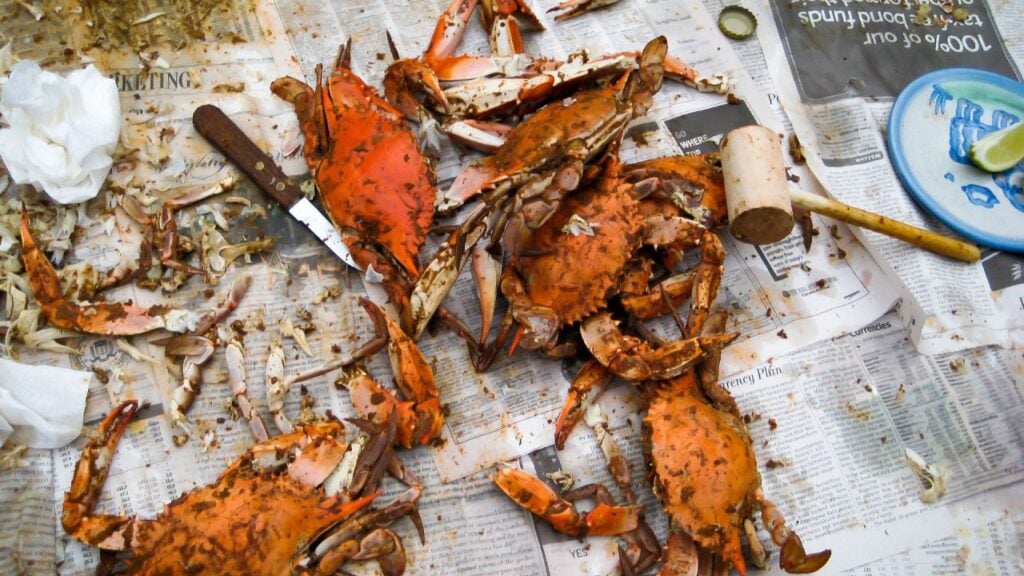
Marylanders who grew up around a crab table don't think twice about how it works.
A first-timer can feel like everyone else got a rulebook.
