
13 Florida Creatures That Can Kill You, and the Deadliest Isn’t the Alligator

Florida runs on warm water and warmer weather, and that combination grows things with teeth, venom, and worse.
You can spot some of these deadly creatures from your lanai. Others you’d never see coming.
A few even hide in the same lake where your grandkids want to swim.
These are the deadly creatures that share your zip code.
Brain-eating amoeba
This one will keep you out of warm, still freshwater in July.
Naegleria fowleri is a single-celled organism that lives in Florida’s lakes, ponds, and slow-moving rivers when the water heats up.
It can’t hurt you if you swallow it.
Instead, it gets you when water shoots up your nose, and the amoeba rides the nerve to your brain.
The infection it causes kills more than 97 percent of the people who get it, often within a week.
Florida has counted dozens of cases over the decades, and a young boy died after a freshwater swim in the summer of 2025.
Hold your nose when you jump in, or wear a clip.
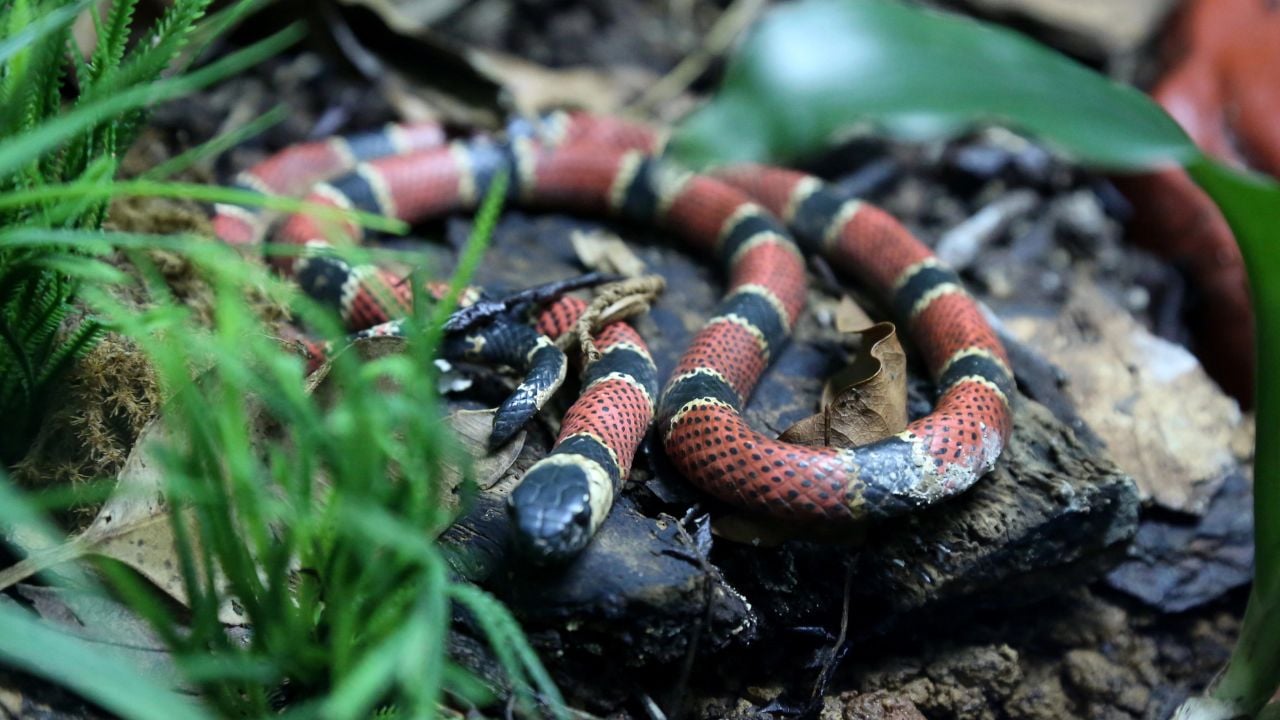
Eastern coral snake
Your grandparents taught you the rhyme for a reason.
Red touch yellow, kill a fellow. Red touch black, friend of Jack.
The eastern coral snake wears those bands, and its venom goes after your nervous system instead of your blood.
It’s an elapid, kin to cobras, with short fixed fangs that have to hang on and chew to deliver a full dose.
That sounds reassuring until you remember it can still strike and release in a blink.
Look for the black snout and the bands that touch red to yellow. You’ll find them under leaf litter and in flower beds.
Leave the pretty one alone and back away.
American alligator
Florida’s unofficial mascot has been here longer than air conditioning, and it shows no plans to leave.
Since 1948, the state has logged more than 450 unprovoked bites on people, and the running list of fatal attacks has passed 30.
Mating runs May into June, when the big males get bold and start crossing golf courses and driveways like they own the place.
They grab and let go more often than not.
More often than not, the trouble starts in the water, where a death roll does the rest.
Gators live in all 67 Florida counties, so that pretty retention pond behind your house could be housing one.
Feeding alligators is illegal, and for good reason. A fed gator forgets you’re not lunch.
Bull shark
Florida tops the country in shark bites every year, and New Smyrna Beach wears the crown as the shark bite capital of the world.
Before you cancel the beach trip, know that most of those bites are minor.
A surfer bumps a small blacktip in murky water and walks away with stitches and a story.
The one with real menace is the bull shark, which tolerates fresh water and swims up river mouths and canals.
It has the build and the bite to do grave damage.
Deaths are rare, but they can happen. Swim in groups, skip dawn and dusk, and stay out of the water with a fresh cut.
Eastern diamondback rattlesnake
The eastern diamondback is the largest venomous snake in the country, and Florida grows them to impressive lengths.
It carries enough hemotoxic venom to put a grown man in the hospital and then some.
The courtesy here is the rattle, an old-fashioned warning that something is very wrong with your next step.
Wildlife experts note these snakes aren’t a threat unless you step on one or corner it.
People still get tagged reaching into woodpiles, stepping over logs, or wandering off the trail at Myakka.
Give it room. It would rather leave than fight.
Cottonmouth
Hang around any Florida pond, swamp, or drainage ditch long enough, and you’ll meet the cottonmouth, also called the water moccasin.
It’s the most aquatic of the state’s venomous snakes, and it turns up in all 67 counties.
When it’s cornered, it gapes its white mouth open as a billboard warning, and that flash of cotton is your cue to be somewhere else.
The bite delivers tissue-killing venom that turns a fishing trip into a hospital stay.
These snakes are thick, dark, and they hold their ground. Watch your hands and feet near water, and never reach blindly into the reeds.
Box jellyfish
The box jellyfish sounds like an Australian problem. But a few species drift through Florida and Caribbean waters under the friendly nickname sea wasp.
Friendly they are not.
Certain box jelly stings can stop a heart within minutes, which puts this near-invisible blob well past the usual beach sting.
The body is small, pale, and almost see-through, so you won’t spot it coming.
If something stings you hard and you start feeling chest pain or trouble breathing, call an ambulance.
Portuguese man o’ war
From November into spring, the Portuguese man o’ war floats up onto Florida beaches looking like a blue balloon somebody lost.
It isn’t one animal at all but a colony, and those tentacles trail an average of 30 feet behind the float, sometimes far longer.
The sting is the kind of pain that brings grown adults to their knees.
It rarely kills on its own.
But an allergic reaction can turn deadly, the same way a bee sting can.
Here’s the kicker: A dried-up man o’ war on the sand still stings days later.
Africanized honey bees
Regular honeybees mind their business. Africanized honeybees, the ones the news likes to call killer bees, don’t.
They’ve spread across Florida since the early 2000s, and they look just like the bees you already know.
The difference is temper.
Bump their hive, and hundreds pour out, defend a wide patch of ground, and chase you far past where a regular bee would quit.
Their venom is no stronger than any other bee’s.
The danger is the sheer number of stings, and healthy adults have died from it.
If a cloud of bees comes after you, don’t swat. Run indoors and keep running until you’re behind a door.
Mosquito
The deadliest animal in Florida doesn’t have teeth or venom. It has a whine you hear at 2 a.m.
Mosquitoes carry a short list of nasty viruses here, and the worst is eastern equine encephalitis, the one folks call triple E.
It’s rare, but about a third of the people who get the brain-swelling form don’t survive, and survivors often carry lasting damage.
There’s no cure and no human vaccine, only supportive care.
So yes, bug spray is doing more than saving you an itch.
Fire ants
Step on the wrong sandy mound in your own yard, and you’ll learn fire ants don’t sting one at a time.
They swarm up your ankle on a silent signal and fire in unison, leaving a row of burning welts that blister into pustules and can itch for ten days.
For a few unlucky people, the venom triggers a full allergic reaction that turns dangerous without a quick shot of epinephrine.
Florida’s sandy soil keeps fire ants’ mounds low and easy to miss, which is how bare feet find them.
Watch your step in flip-flops, keep an eye on little ones in the grass, and treat the mounds before they spread.
Southern black widow
The southern black widow is the spider your dad warned you about, and the warning holds up.
She’s glossy black with a red hourglass on her belly, and her venom carries a neurotoxin that brings cramps, sweating, and misery for days.
She likes the dim corners people forget. Woodpiles. Sheds. The underside of patio furniture you haven’t moved since last snowbird season.
She won’t come after you. The bites happen when a hand lands on her, reaching into firewood or a dark garage shelf.
Deaths are rare these days, but the very young and very old still face real risk.
Always shake out your gardening gloves before putting them on.
Wild boar
Florida’s feral hogs aren’t native. They’ve roamed here since the 1500s, and the state now holds around half a million of them, second only to Texas.
A boar can top 200 pounds, runs faster than you’d guess, and carries tusks that slice.
They would rather root up your yard and vanish. But a cornered hog, or a sow with piglets, will charge.
You’ll find wild boar in all 67 counties, from the panhandle to the ranchland outside Orlando.
If you cross one on a trail, don’t run at it, and don’t get between a sow and her young.
18 Disturbing Facts You’ll Wish You Never Learned
The facts we’re about to share will make you set your coffee down and stare at the wall for a second.
Warning: You can’t unread these.
18 Disturbing Facts You’ll Wish You Never Learned
6 States Snowbirds Are Picking Instead of Florida
Florida still wears the snowbird crown, but the grip is loosening.
So where are snowbirds going instead?
The moving data tells the story, and these states keep coming up.
The Moving Trucks Don’t Lie: 6 States Snowbirds Are Picking Instead of Florida
