
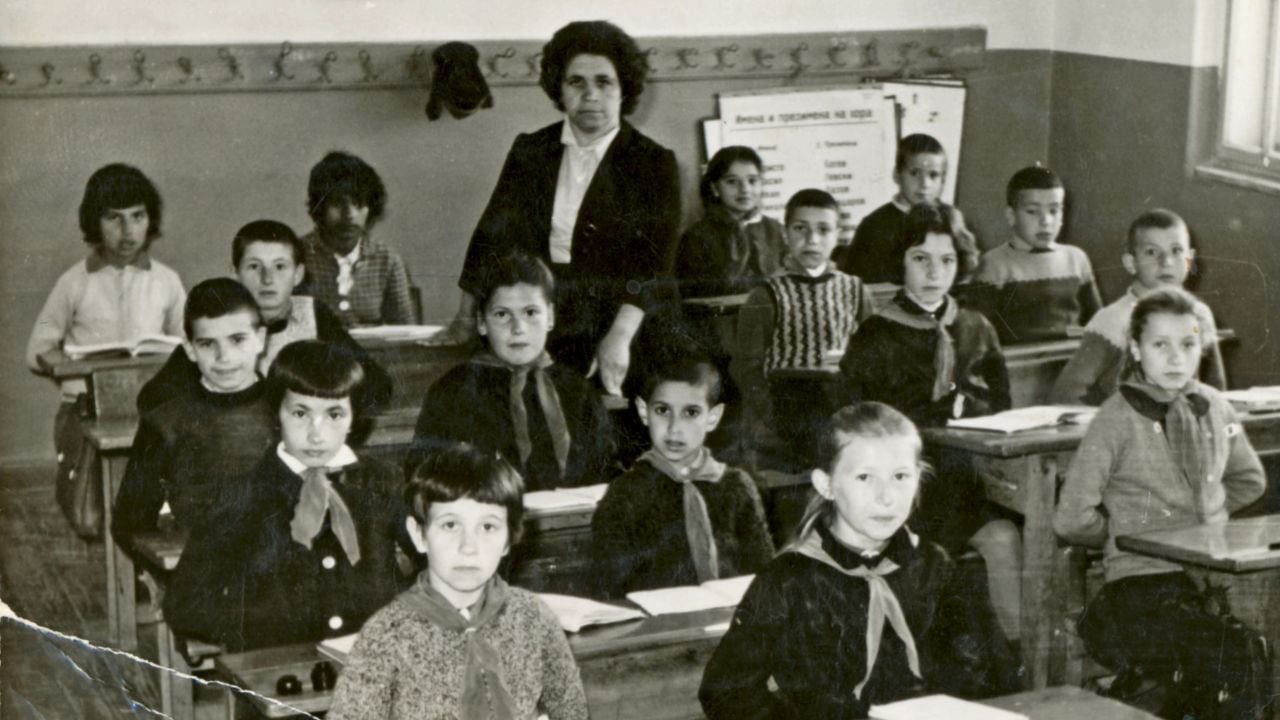
15 School Rules Texas Boomers Grew Up With That Seem Unthinkable Now

The paddle hung on a nail behind the principal’s desk, right out in the open for everyone to see.
Nobody thought that was odd.
You learned young that the walk to that office was the longest one in the building, that the swat waiting at the end of it was perfectly legal, and that your mother would probably agree you had it coming.
Younger generations can’t imagine life used to be this way.
These are the school rules Texas baby boomers grew up with that seem unthinkable now.
Duck-and-Cover Drills
The Cold War came right into the classroom.
When the alarm sounded, you dove under your wooden desk, tucked your head, and waited, as if a school desk could do much against an atomic bomb.
A cartoon turtle named Bert taught a whole generation to “duck and cover.”
Kids practiced it as routinely as a fire drill.
Growing up rehearsing for nuclear war—and thinking nothing of it—is hard to picture now.
Dresses Only for the Girls
For much of the baby boomer era, girls couldn’t show up to school in pants.
Dresses or skirts, full stop, even when it was freezing outside.
Some girls wore shorts underneath just to stay warm at recess, then changed back.
The rules loosened through the seventies. But plenty of women still remember the day their school finally let them wear slacks.
Telling a girl today she can’t wear pants to class would land a school in a lawsuit.
Lefties Forced to Switch Hands
If you were born left-handed, school often tried to fix you.
Teachers tied down or smacked the left hand, insisting you write with your right, because right-handed was considered proper.
A lot of natural lefties grew up with cramped, awkward handwriting because of it.
Some developed stutters and lasting frustration from the forced switch.
We now know you can’t, and shouldn’t, retrain a child’s dominant hand. Back then, it was standard practice.
The Principal’s Paddle
Misbehave in class, and you might get sent down the hall to meet the paddle.
A wooden board, sometimes with holes drilled in for speed, kept in the principal’s office for exactly this purpose.
A few swats in front of the class, or behind a closed door, and you went back to your seat.
It was no secret. Parents often backed it up at home.
And here’s the part that surprises people: Paddling is still legal in roughly 17 states today, though you’ll be hard-pressed to find a school that uses this punishment.
Morning Prayer and Bible Verses
The school day when many baby boomers were kids often opened with a prayer and a reading from the Bible, led by the teacher.
Everyone bowed their heads, recited the Lord’s Prayer, and then got on with arithmetic.
That changed in the early sixties.
The Supreme Court ruled school-sponsored prayer unconstitutional in 1962 and struck down mandatory Bible reading the very next year.
Older boomers remember the prayers. Younger ones remember when they stopped.
Passing Liquid Mercury Around Class
Break a thermometer in science class, and the teacher might let you play with what spilled out.
Shimmering little beads of liquid mercury, rolling around your palm and the desktop.
You would push them together, split them apart, and marvel at the silvery stuff.
Nobody wore gloves. Nobody mentioned that mercury is a potent neurotoxin.
Today, a single broken thermometer triggers a hazmat cleanup. Back then, it was the afternoon’s entertainment.
A Pocketknife in Every Pocket
Boys carried jackknives to school the way they carried a comb.
You used it to whittle, open boxes, fix things, maybe trade with a buddy.
For farm and country kids, a knife in the pocket was simply part of getting dressed.
No one panicked. No one called it a weapon.
A pocketknife in a kid’s jeans today would mean suspension, a meeting, and probably the police.
Home Ec for Girls, Shop for Boys
Your class schedule was decided by your sex, no discussion.
Girls went to home economics to learn cooking, sewing, and how to run a household.
Boys went to shop class for woodworking, metal, and engines.
A girl who wanted to build a birdhouse, or a boy who wanted to bake a pie, was usually out of luck.
The hard split started fading after Title IX in the seventies. But for a long while, biology was your timetable.
The Polio Vaccine on a Sugar Cube
This one boomers remember fondly, because it ended a nightmare.
Polio terrified families in the fifties.
Then came the vaccine, and for the oral version, you got it at school on a sugar cube.
You lined up in the gym, took your sweet little cube, and helped wipe out one of the most feared diseases in the country.
Between 1962 and 1965, around 100 million Americans took it.
A mass vaccination on a sugar cube, right there in the school gym, is a memory worth keeping.
Steel Slides Over Solid Asphalt
Playgrounds were built for fun, not for safety.
Towering metal slides that hit oven temperatures in the sun. Merry-go-rounds that flung kids off at full speed. Monkey bars planted over concrete or packed dirt.
You fell, you bled, you got back up.
Skinned knees and the odd broken arm were just part of recess.
The padded, plastic, soft-landing playgrounds of today would have struck a boomer kid as boring beyond belief.
Walking a Mile to School at Six
Little kids walked to school. Alone, or with a pack of other kids, no adult in sight.
Six years old, a mile each way, crossing real streets, in all kinds of weather.
You left after breakfast and turned up when the bell rang. Nobody tracked you. Nobody worried.
Home when the streetlights come on was the only rule.
A kindergartner walking solo today would have someone calling it in before the second block.
Schools Divided by Race
This one stands apart from the rest of the list. It’s history the country was right to leave behind.
For much of the boomer childhood, many American schools were segregated by law, Black students kept apart from white ones in separate, unequal buildings.
The Supreme Court called that unconstitutional in 1954, in the landmark Brown v. Board of Education ruling.
Even then, real integration took years and met fierce resistance across much of the country.
Many baby boomers lived through that change firsthand.
The Dunce Cap in the Corner
Get something wrong, and the teacher might make an example of you.
A pointed “dunce” cap on your head, a stool in the corner, your back to the laughing class.
Public shaming was a teaching tool. Writing “I will not talk in class” five hundred times was another.
The thinking was that embarrassment would straighten you out.
We have since learned that humiliating a child mostly just teaches them to hate school.
No Seatbelts on the Bus
You piled onto the school bus, three to a seat, and off you went.
No seatbelts. No booster seats. Kids standing in the aisle when it got crowded.
In the family car, it was the same story. You rode in the way-back of the station wagon, or stood on the front bench seat next to mom.
Car seats for babies barely existed.
That a whole generation rode around completely unbuckled, and mostly turned out fine, amazes young people now.
Boys Sent Home for Long Hair
By the late sixties, hair became a flashpoint.
Boys who grew theirs past the collar got sent home, suspended, or hauled to the principal over a few inches of shag.
Schools wrote dress codes measuring exactly how long a boy’s hair could be, and girls’ skirts got the ruler treatment too, hemmed to the knee.
Hair length could bench you from the team or bar you from class.
A teenager’s haircut sparking a school showdown feels old-fashioned now.
15 Once-Popular 1950s Baby Names Rarely Heard Today

Have you ever wondered what happened to some of the most popular baby names from the 1950s?
Travel down memory lane with us and reminisce about the classic names from the ’50s that you hardly hear anymore.
15 Once-Popular 1950s Baby Names Rarely Heard Today
18 All-American Traditions Every Baby Boomer Used to Have

From church on Sundays to dinner at the table every night, there was a rhythm to daily life for kids back in the ’50s and ’60s.
These are some of the boomer traditions that once defined what it meant to be American.
