
5 North Carolina Diner Menu Items You Won’t Find Anywhere Else

North Carolina keeps its own rules for what counts as a barbecue plate, a breakfast loaf, and a dessert.
Some of it is protected by state law. Some of it has never left one county.
These are the North Carolina diner menu items that you’ll be hard-pressed to find anywhere else in the country.
1. Lexington-Style Barbecue Plate
Lexington, North Carolina, built its whole identity around one particular way of cooking a pork shoulder.
Pitmasters smoke the shoulder low and slow, chop it, and dress it in a thin vinegar, ketchup, and pepper sauce that locals just call “dip.”
A pile of red slaw, cabbage mixed with that same dip instead of mayonnaise, goes on top before the plate ever reaches the table.
No mayonnaise anywhere in sight.
It’s a completely different plate from Eastern North Carolina’s whole-hog barbecue, which skips the ketchup for a straight vinegar-and-pepper sauce, and from South Carolina’s mustard-based versions across the state line.
North Carolina’s own General Assembly made the connection official in 2007, naming the Lexington Barbecue Festival the state’s official food festival for the whole Piedmont Triad region.
2. Livermush
Livermush shows up on North Carolina breakfast plates without much explanation.
In the foothills, none is needed.
The loaf starts with ground pork liver, pork parts, and cornmeal, packed together, sliced thick, and fried until the edges turn crisp.
It lands on the plate next to eggs and grits, or between two slices of white bread with mustard.
Not glamorous.
Shelby, North Carolina calls itself the livermush capital of the world and holds an annual festival for it.
The dish traces back to German settlers who carried a similar pork loaf through the Appalachian Mountains in the 1700s.
Two Shelby companies, Jenkins Foods and Mack’s Liver Mush, still ship it out by the loaf today.
What Has to Be in Livermush
North Carolina holds livermush to a legal standard many breakfast foods never get.
State law requires at least 30% pork liver by weight before a company can put the word “livermush” on a label.
That floor is what separates North Carolina’s version from Pennsylvania’s scrapple, a similar pork loaf that carries no such rule.
Cornmeal and spices fill out the rest of the loaf.
The exact recipe still shifts from one Western North Carolina producer to the next.
3. Snappy Lunch’s Pork Chop Sandwich
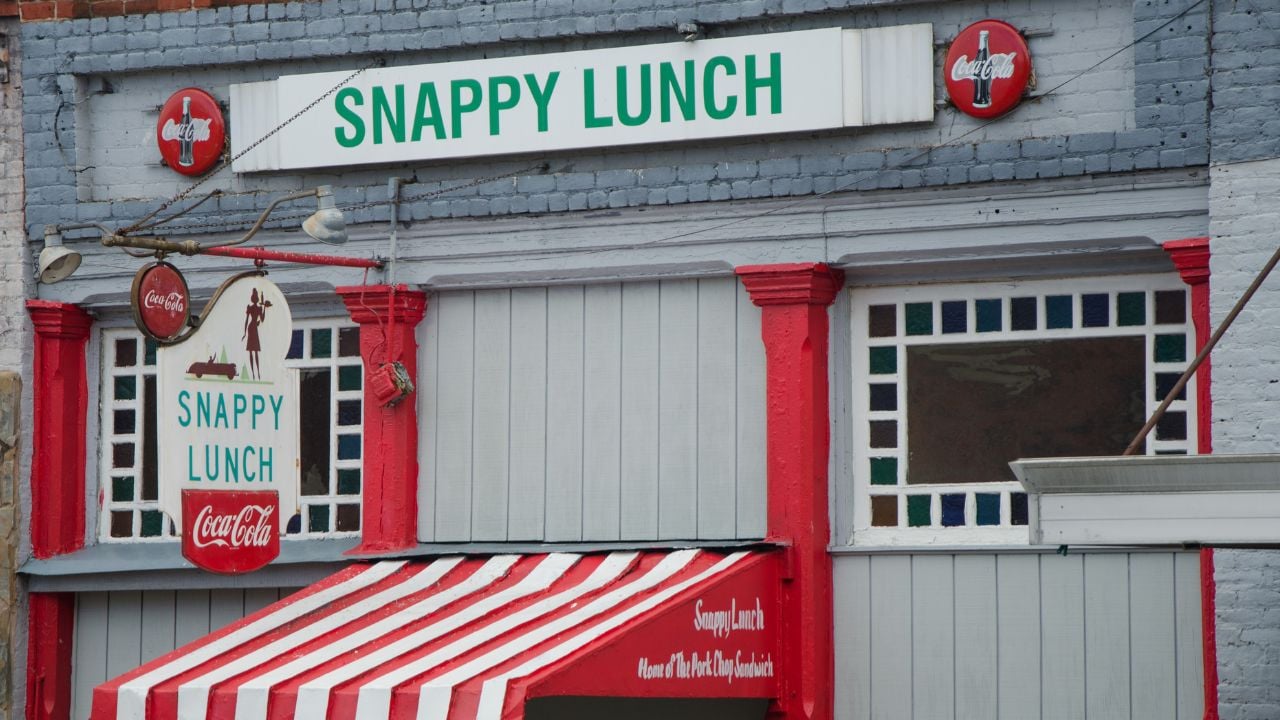
Mount Airy’s Snappy Lunch fries a pork chop sandwich few other diners have ever tried to copy.
Cooks hand-bread a whole bone-in pork chop, flatten it on a machine they still call “The Tenderator,” and fry it until the edges crisp.
It comes stacked on white bread with chili, coleslaw, and mustard, piled higher than the bun can hold.
Eat it standing up.
Snappy Lunch opened its doors in 1923.
Mount Airy native Andy Griffith mentioned the diner by name on his own television show decades later.
The recipe never left that one Mount Airy counter, and no chain or nearby diner has matched the exact combination since.
Psst! How much do you know about North Carolina’s diner history? Take our quiz and see how many you can get right.
Quiz
Carolina Diner IQ
Answer these questions on North Carolina diner and food history. We bet you can’t get them all right. Prove us wrong?
Which North Carolina drive-in, known for its long list of milkshake flavors, opened its first location in Greensboro in 1989?
4. Moravian Chicken Pie
Moravian Chicken Pie follows a rule book unlike any other state's, and it's still baked across North Carolina's Piedmont region.
Moravian settlers carried the recipe into Salem, North Carolina when they founded the town in 1766.
The filling skips the carrots, peas, and celery many cooks add to a pot pie, and it comes wrapped in a double crust instead of just one on top.
Nothing more than that.
Restaurants and church kitchens around Winston-Salem still bake it fresh, and pastors have historically figured out building-fund goals by counting how many pies a congregation needs to sell.
Bakeries around Old Salem still sell it both fresh and frozen for a home oven.
5. Sonker
Surry County, North Carolina, keeps a dessert researchers have never found baked anywhere else in the country.
A historical marker in Dobson traces the sonker back to the mid-1800s, when Scots-Irish settlers started pouring a simple batter over fresh fruit in a shallow pan.
Bakers pour the fruit into a pan just three or four inches deep, thinner than a standard cobbler dish.
The fruit sinks as it bakes, which is likely where the name came from.
That's the whole trick.
A handful of small diners and bakeries along the Surry Sonker Trail still serve it warm, topped with a milk-and-sugar "dip" instead of ice cream.
Order a slice in almost any other state, and the server will ask what a sonker even is.
One Dessert That Didn't Stay Put
Atlantic Beach Pie started at exactly one North Carolina restaurant, the same way everything else on this list did.
Chef Bill Smith built it at Crook's Corner in Chapel Hill in 2011, swapping the usual pastry crust for crushed saltine crackers and finishing salt in place of meringue.
He named it after Atlantic Beach, North Carolina, where he grew up eating tart, citrus-based pies as the traditional closer after a seafood dinner.
Unlike the rest of the dishes on this list, Atlantic Beach Pie didn't stay put.
Not anymore.
Food writers well outside North Carolina picked it up in the years since. The saltine-crust idea now turns up on dessert menus far from the coast that inspired it.
Order the closest thing to it back home, and the crust underneath will likely be an ordinary pastry shell.
8 North Carolina Roadside Finds That Aren't Automatically Finders Keepers
A North Carolina roadside can hand over some surprising finds, and not all of them are legally yours to keep.
These are the North Carolina roadside finds that come with rules many people never think to check.
8 North Carolina Roadside Finds That Aren't Automatically Finders Keepers
6 Lidl Habits That Give Away a North Carolina Shopper
North Carolina shoppers had years of a head start on Lidl before many other states even had a store.
These are the habits that separate a longtime North Carolina Lidl shopper from everyone else at the register.
