
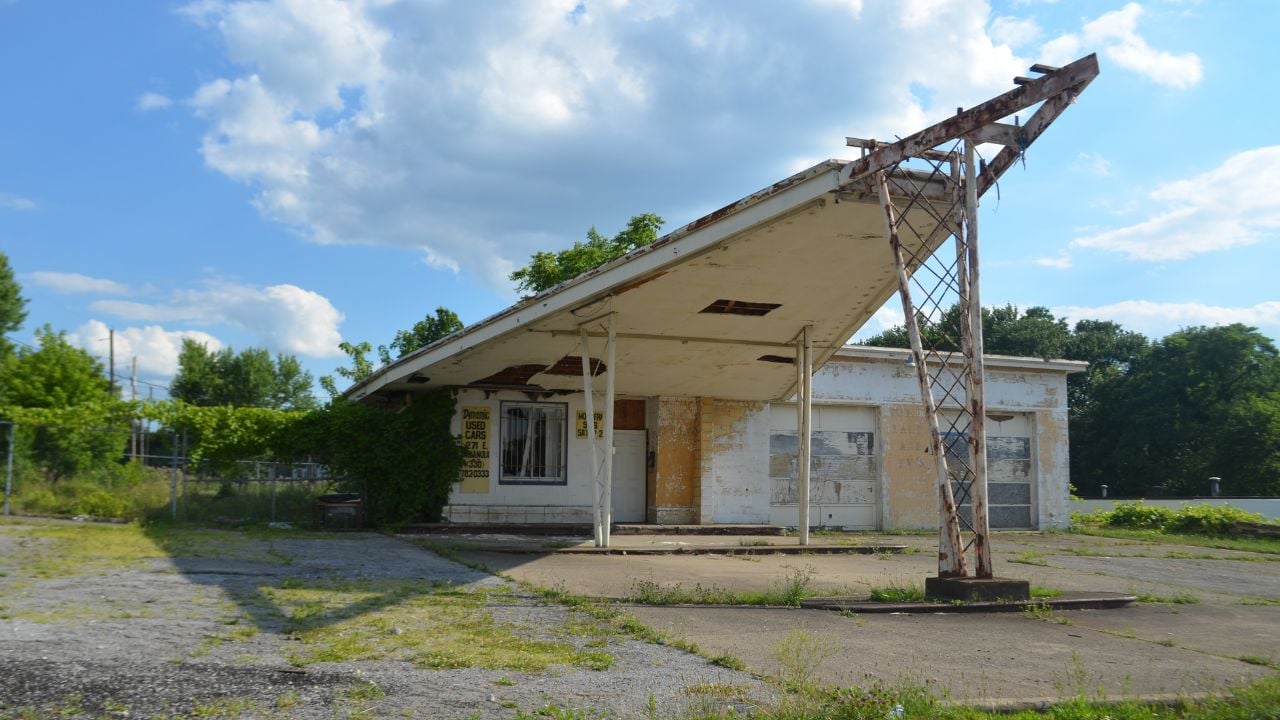
5 Ohio Towns That Were Booming 40 Years Ago and Sit Nearly Empty Now

A “Now Hiring” sign hangs faded in a storefront window across from a “For Sale” sign that’s been up for three years.
Forty years ago, that same block had a line out the door on a Friday.
These are the Ohio towns that were booming 40 years ago and sit nearly empty now.
Youngstown
Youngstown’s population has fallen by nearly half since 1980.
The city counted 115,511 residents that year, built on steel mills that lined the Mahoning River for miles.
That run ended fast.
Youngstown Sheet and Tube closed its Campbell Works on September 19, 1977, a shutdown workers still call Black Monday.
U.S. Steel followed within two years.
The company announced in late 1979 that it would close its own Ohio Works and the nearby McDonald Works.
Republic Steel held on the longest, merging into LTV Steel, a larger steel conglomerate, in 1984 before that mill shut down too.
Youngstown’s population sat at 60,068 people in the 2020 Census.
That’s a loss of about 48% from 1980.
Campbell
Campbell counted 11,619 residents in the 1980 Census, a steel town packed tight along the Mahoning River.
Then came September 19, 1977.
Youngstown Sheet and Tube shut its Campbell Works that day, the same Black Monday closure that hit Youngstown.
The Mahoning Valley lost close to 5,000 jobs within days of that announcement.
Campbell never filled that hole.
The town has since fallen to 7,852 people, a decline of about 32% from 1980.
What Black Monday Cost Ohio
Ohio’s Mahoning Valley lost roughly 50,000 manufacturing jobs within five years of Black Monday, far beyond the single Campbell Works shutdown that started it.
Youngstown Sheet and Tube’s closure of its Campbell Works on September 19, 1977, was the first domino.
That one closure set off a chain reaction across the valley.
The towns built around those mills never filled the gap steel left behind.
Steubenville
Steubenville’s largest employer collapsed within a decade of the city’s peak years.
Wheeling-Pittsburgh Steel filed for bankruptcy in 1985.
The mills that ran the city’s economy started shutting down one by one over the next several years.
The company couldn’t hold on.
Steubenville held 26,400 people in the 1980 Census, a river town that ran on steel from those mills.
The city’s population has since fallen to 18,161, a decline of about 31% from 1980.
Steubenville’s downtown still carries storefronts built for a much bigger crowd.
Psst! Curious how these Ohio towns stack up against each other? Sort this table by population, decline, or the industry that left.
Struthers
Struthers shared that same mill with Campbell, and it shared the same fate.
The Campbell Works complex stretched into Struthers too, with blast furnaces and a hot strip mill running along its end of the property.
When Black Monday hit in 1977, Struthers lost jobs right alongside its neighbor.
The town held 13,624 residents in the 1980 Census.
The 2020 Census counted 10,063 people in Struthers, a decline of more than a quarter from 1980.
The number kept slipping.
A 2025 Census Bureau estimate puts Struthers at 9,837 people, the first time the count has dropped under 10,000.
Streets built to house a shift-working mill town now carry a fraction of that foot traffic.
Struthers has spent the decades since trying to build an economy around something other than steel.
Niles
Niles reached its highest population in decades in 1980, when the Census counted 23,088 residents.
Republic Steel ran a mill complex stretching from Niles into nearby Warren, and it was a major reason the town got that big.
The mid-1980s hit hard.
Republic cut jobs sharply during the 1981-83 recession, then folded into LTV Steel, a larger steel conglomerate, in 1984.
Niles never got back to its 1980 size.
The town sits at 18,443 people now, down a little more than a fifth from its peak.
The Pattern Went Beyond Steel
Ohio’s population losses didn’t stop at the Mahoning Valley’s steel towns.
East Liverpool built its economy on pottery kilns along the Ohio River.
The city held 16,687 people in 1980.
That industry had already thinned out for decades before 1980, and the slide never reversed.
East Liverpool counts 9,958 residents today, a decline of about 40% from 1980.
The kilns went cold.
Ironton, further south on the Ohio River, built its own economy on iron furnaces starting in the 1850s.
The city held 14,290 people in the 1980 Census.
Ironton counts 10,571 people today, a loss of about 26% since 1980, as the region’s iron and steel legacy kept fading through the decades.
Close to 22% of Ironton’s residents are 65 or older today.
The median household income sits at $47,648, according to Census Bureau estimates.
Lawrence County once ran about 45 iron furnaces at once during Ironton’s 19th-century boom, and the last of them shut down decades before Ohio’s steel towns to the north ever did.
11 Foods Ohioans Grew Up Eating That the Rest of America Has Never Heard Of

Readers of an Ohio newspaper once voted a deep-fried ball of sauerkraut their city’s official food.
From Cincinnati goetta to Toledo’s Hungarian hot dogs, these are the dishes that never made it past the state line.
11 Foods Ohioans Grew Up Eating That the Rest of America Has Never Heard Of
9 Things Ohio Landlords Can’t Legally Do to Renters in 2026

A padlock can click shut on a rental door before the tenant inside even knows it happened.
Ohio law draws a hard line on what a landlord can and can’t do, and many renters have never heard the rules.
