
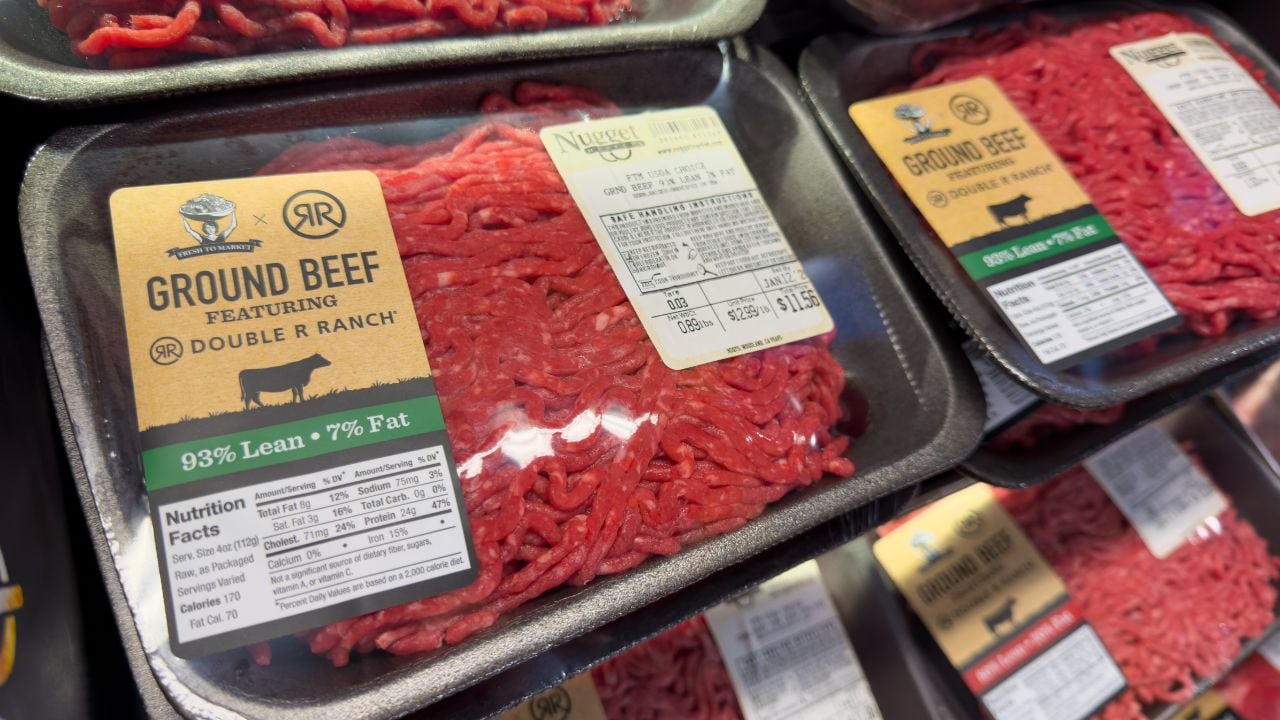
Bad News for Illinoisans: Groceries Are Forecast to Rise 2.3%, and Beef Is Headed for 8.7%

Illinois farms had 980,000 cattle and calves at the start of 2026, down 3% from a year earlier.
Fewer cattle is probably part of why beef is climbing faster than the rest of your grocery cart.
Here’s how the grocery forecast breaks down, and what it means for Illinoisans who buy beef.
2026 Grocery Forecast
The Economic Research Service (ERS), part of the U.S. Department of Agriculture (USDA), forecasts a 2.3% increase in grocery prices for 2026.
That category is food at home, meaning what you spend at grocery stores and supermarkets rather than restaurants.
The October 2026 update, posted October 23, gives a range of 1.9% to 2.7%.
That sits just under the 2.6% yearly average of the past 20 years.
The forecast compares the average price across all of 2026 with the average across 2025.
On average, the groceries in your cart cost 1.8% more in September 2026 than a year earlier.
Beef breaks the pattern.
Beef and veal prices get an 8.7% forecast for 2026, with a range of 7.4% to 10.1%.
That’s nearly four times the grocery figure.
Even the low end of beef’s range sits well above the 2.7% top of the grocery range.
Behind the Forecast
ERS economists update the grocery forecast every month, typically on the 25th, so you can look for a fresh one.
Each update starts with Bureau of Labor Statistics (BLS) price data, which goes through time-series models.
It’s an estimate.
Because no forecast is perfect, each one also has a 95% forecast interval, a range that reflects the uncertainty around each number.
The headline figure is the best estimate inside that range.
Beef at the Register
Beef prices in stores are easy to check because BLS publishes the average each month.
In October 2026, 100% ground beef averaged $6.76 a pound across the U.S.
That’s down 0.5% from September.
A boneless USDA Choice chuck roast averaged $9.08 a pound, down 1.1% from September.
In the Midwest region, which groups Illinois with 11 other states, ground beef averaged $6.69 a pound in October 2026.
That’s down 0.9% from September, a bigger dip than the national one.
Neither is an Illinois-only price.
Treat both as a guide to what you pay.
Beef and veal prices as a whole were 3.5% higher in September 2026 than a year earlier, and they slipped 1.3% from August.
ERS’s 8.7% is a full-year average, while the 3.5% is one month compared with a year earlier, so the two measure different things.
The Math on a Pound of Ground Beef
For scale, an 8.7% rise would add about 59 cents to the national October 2026 average of $6.76 a pound for ground beef.
If you buy one pound a week, that comes to about $31 over 52 weeks.
The same rise would add about $1.20 to a pound of boneless USDA Choice sirloin steak at $13.85.
The 8.7% compares all of 2026 with all of 2025, so it doesn’t mean a further jump from $6.76.
Beef Supply
Beef production is part of that story.
Federally inspected beef production has been lower in most months of 2026 than in the same months of 2025.
It’s expected to stay below year-ago levels through the end of 2026.
USDA’s January cattle report found 86.2 million cattle and calves in the U.S., down slightly from 86.5 million a year earlier.
The number of beef cows slipped 1% to 27.6 million.
The herd is slightly smaller.
Farm-level cattle prices were 7.6% lower in September 2026 than in September 2025.
Farm-level cattle prices are still forecast to rise 5.8% across 2026.
Wholesale beef prices are forecast to rise 8.8% across 2026.
Because beef passes through several processing stages, retail prices typically lag producer prices, so a drop at the ranch may take time to reach your store.
ERS also nudged its U.S. beef import forecast higher in October, citing data on the tariff-free quota for lean beef.
Psst! How much do you know about grocery prices? Take our quiz and see if you can ace it.
Quiz
Grocery Price IQ
Answer these questions on food prices, cattle, and grocery data. We bet you can’t get them all right. Prove us wrong?
ERS forecasts egg prices to move which way in 2026?
Illinois Cattle Herd
Illinois farms had 980,000 cattle and calves on January 1, 2026, down 3% from 1,010,000 a year earlier.
That's just over 1% of the nation's herd, so it's background rather than a measure of what you'll pay.
Illinois feedlots had 220,000 cattle on feed, down 12% from 250,000 a year earlier.
Cattle on feed across the U.S. fell 3% to 13.8 million head.
Illinois fell faster.
The 2.3% and 8.7% forecasts are national, so prices on your shelf can differ.
Pork and Poultry Prices
Pork and poultry barely register next to beef in the forecast.
ERS forecasts pork prices to rise 1.0% in 2026, with a range from 0.2% to 1.9%.
Poultry gets a 1.2% forecast, with a range of 0.5% to 1.9%.
Both sit well below the 2.3% forecast for groceries overall.
In September 2026, pork was down 0.7% from a year earlier, and poultry was up 1.1%.
Neither moved much.
If you compare meats by the pound, boneless chicken breast averaged $4.10 nationally in October 2026, and pork chops overall averaged $4.18.
Ground beef ran $2.66 a pound above the boneless chicken breast.
In the Midwest region, boneless chicken breast averaged $3.77 a pound in October 2026, against $6.69 for ground beef.
6 Documents Illinois Residents Get Turned Away From the REAL ID Counter Without

Few errands feel worse than waiting in line and getting sent home.
At the Illinois REAL ID counter, the wrong paper can do exactly that.
6 Documents Illinois Residents Get Turned Away From the REAL ID Counter Without
