
5 Things Sandhill Cranes Do at Tennessee’s Hiwassee Refuge Every Winter

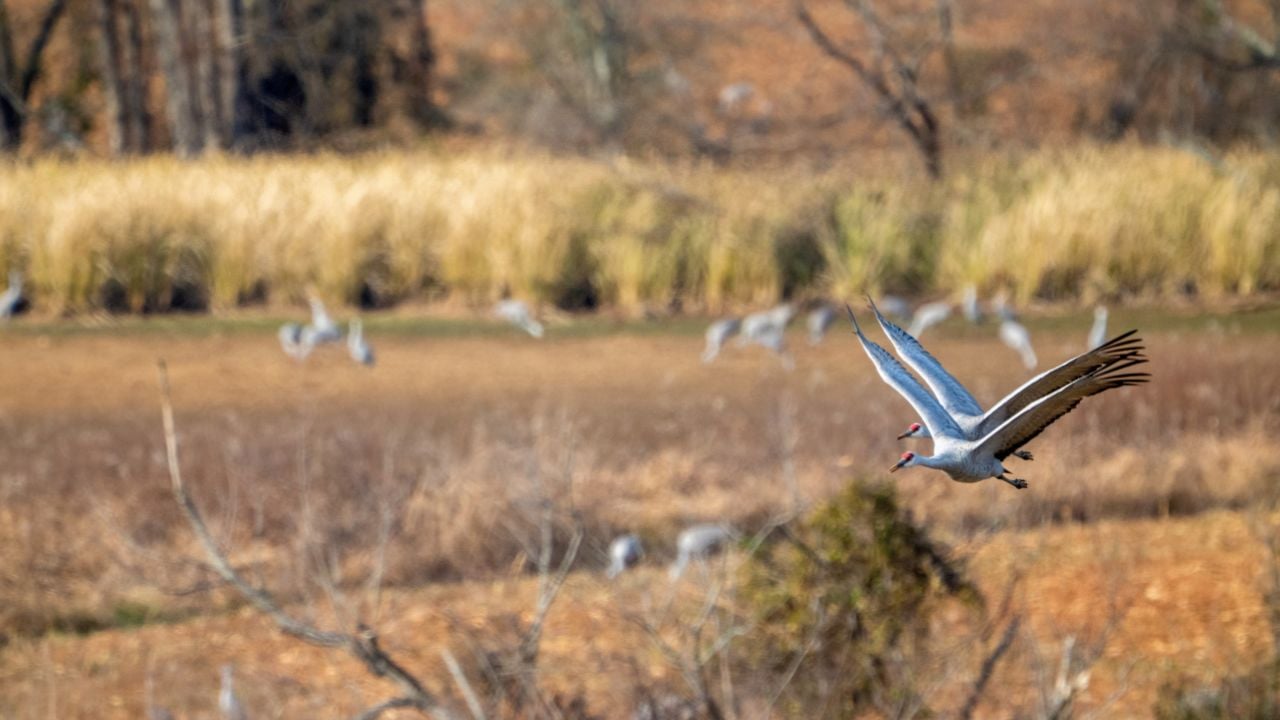
As the sun sets at Tennessee’s Hiwassee Refuge, thousands of sandhill cranes fly in to roost for the night.
The refuge closes to public use on Nov. 15, but you can still watch from the viewing platform.
Here’s what sandhill cranes do at Tennessee’s Hiwassee Refuge every winter.
1. Gathering at the Platform
Sandhill cranes start congregating near the Hiwassee Refuge’s viewing platform in mid-October, and the gatherings last through February, sometimes into March.
Their numbers peak in January.
TWRA says the refuge has the largest winter flock of sandhill cranes in the southeast United States outside of Florida.
In winter, you may find over 20,000 cranes in the Hiwassee River area, with thousands visible from the platform.
Over ten thousand are on and around the refuge in Meigs County.
You can visit that platform year-round, even though the rest of the refuge closes from Nov. 15 through the last day of February.
Directions to the refuge start at I-75 exit 25 in Cleveland, then run north on Highway 60 through Birchwood.
2. Stopping Over or Staying
Is the sandhill crane you’re watching at the Hiwassee Refuge just passing through?
Some are.
Beginning in the early 1990s, the recovering population of eastern sandhill cranes began stopping at the refuge on its way to and from wintering grounds in Georgia and Florida.
TWRA’s festival page lists the refuge as one of two primary migration and wintering areas for sandhill cranes in the state.
Many others now spend the entire winter where the Hiwassee and Tennessee rivers meet.
The Knoxville Mercury reported in 2016 that January brings the biggest crowds, since passing cranes and winter residents are both there.
So the crane you’re watching may be on a layover or settled in for the winter.
3. Roosting in Shallow Water
As the sun begins to set, vast numbers of sandhill cranes fly in to roost at the Hiwassee Refuge for the night, the Mercury reported.
Their rolling, trumpeting call can reach you from a mile away, so you may hear the roost fill before you see it.
They roost in shallow water.
The refuge has about 3,500 acres of water.
A 2010 study from the University of Tennessee at Chattanooga found the cranes preened and loafed in shallow water and on mudflats.
If you see a crane standing in the water, it may be preening or loafing rather than feeding.
Psst! How much do you know about Tennessee’s wildlife? Take our quiz and see if you can ace it.
Quiz
Tennessee Wildlife IQ
Nine questions on Tennessee’s wild side and the birds that pass through it. Think you’ll ace them? We bet a few will surprise you.
According to TWRA, which famous naturalist reported the only historical record of sandhill cranes in Tennessee during winter, back in November 1820?
4. Feeding in Fields
Sandhill cranes at the Hiwassee Refuge foraged mainly in agricultural and grassy fields, the 2010 University of Tennessee at Chattanooga study found.
Compared with how much of each type of field the refuge has, the cranes tended to use grassy fields more and crop fields less.
You can find crops on about 750 of the refuge's 2,500 land acres.
The mix includes corn, wheat, soybeans, milo, millet and buckwheat.
Grain is only part of the menu, since sandhill cranes also eat berries, insects and small mammals.
You may see them picking food off the ground or probing the soil and mud.
5. Heading North
Sandhill cranes head north from the Hiwassee Refuge as winter ends.
TWRA says spring migration across Tennessee runs from mid-February through late March.
Many thousands stay in and around Meigs and Bradley counties until spring, the Mercury reported.
A 2017 study that tracked 42 eastern population sandhill cranes with solar-powered transmitters found they began spring migration in mid-February.
On average, those cranes settled on summer areas in Minnesota, Wisconsin, Michigan and Ontario in late March.
If you visit in late February, you may catch cranes already heading out.
Whooping Crane Visitors
TWRA says you can view an occasional endangered whooping crane from the platform, along with the sandhill cranes, from November through February.
Whooping cranes are rare in Tennessee but often found in the same fields as sandhill cranes.
Adult whooping cranes are white with black wingtips.
If you see a crane with some white below instead of gray, you may be looking at a first-year whooping crane.
Telling Sandhill Cranes From Great Blue Herons
Sandhill cranes share the Hiwassee Refuge with great blue herons in winter.
A sandhill crane flies with its neck stretched straight out.
A great blue heron flies with its neck curled against its body.
If you can see the head, check the crown, where an adult sandhill crane has red skin and a great blue heron has none.
Young cranes lack the red crown, so the neck is your better clue.
Ducks Before Cranes
You might think of the Hiwassee Refuge as a crane refuge.
It wasn't, at first.
A 1940 agreement established the Hiwassee State Game Refuge on Chickamauga Reservoir.
Today the refuge also gives sandhill cranes feeding areas and shallow water for roosting, TWRA says.
From the platform, you can see waterfowl on the lake below, with mallards, gadwalls and northern shovelers the most common ducks.
Festival Weekend
TWRA's festival page says the Sandhill Crane Festival returns to Birchwood on Jan. 16-17, 2027, for its 36th year.
The festival celebrates the sandhill cranes that stop over or spend the winter on or near the Hiwassee Refuge.
The closure covers those dates.
You can watch cranes, pick up educational information and use spotting scopes all weekend at the refuge and the Cherokee Removal Memorial overlook.
At Birchwood School, you'll find vendors, home-cooked meals, a children's craft room and live raptor shows from Wings to Soar.
Volunteers will be on hand with spotting scopes, but you're welcome to bring binoculars.
Parking has changed, and you can't park at the refuge without a handicap placard, so check TWRA's festival page for updates before you go.
9 Tennessee Spots Ruined by Peak Season and Wonderful Right After
Ruby Falls stays at a steady 60 degrees inside Lookout Mountain, whether the surface is baking or freezing.
The cave stays the same in every season, but the crowds don't.
9 Tennessee Spots Ruined by Peak Season and Wonderful Right After
9 Everyday Words That Mean Something Else Once You Cross Into Tennessee

You know what a bag, a shopping cart, and a winter hat are called.
At least you think you do.
9 Everyday Words That Mean Something Else Once You Cross Into Tennessee
