
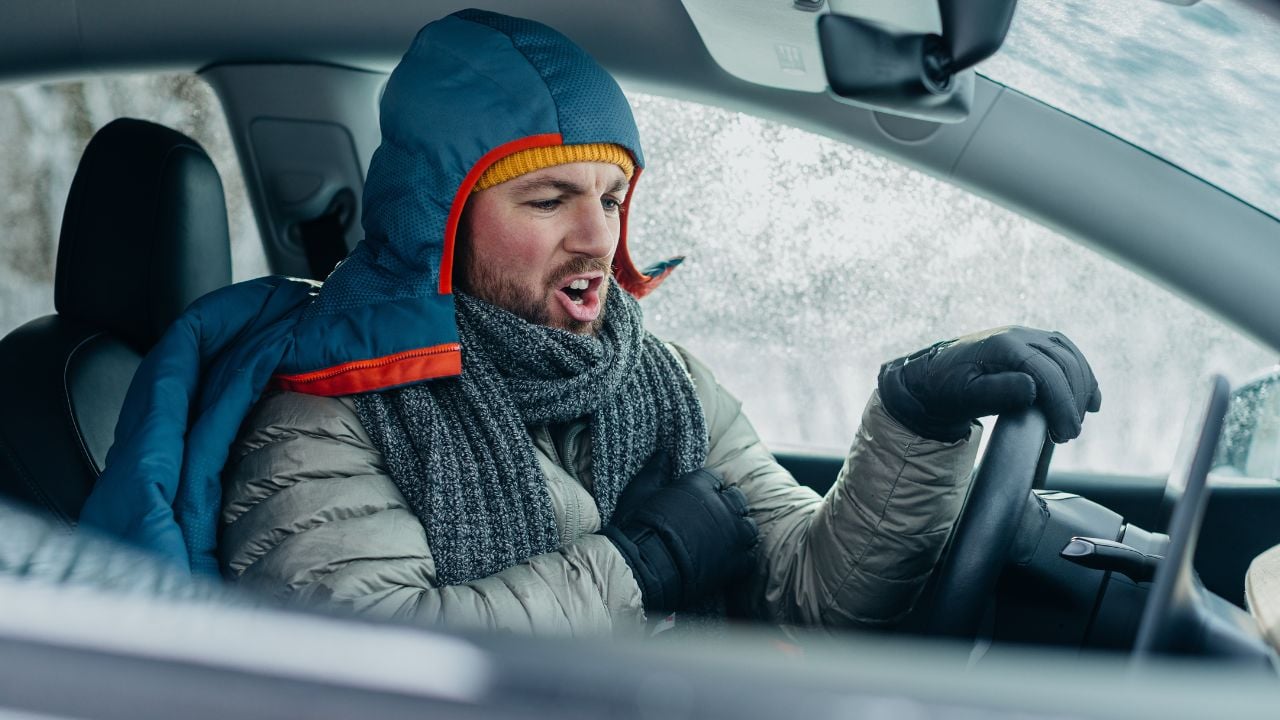
5 Things Virginia Drivers Should Know About Warming Up Their Car

Your car’s engine warms up faster when you drive it than when it sits idling in the driveway.
Virginians who let the car run on cold mornings could be paying for the habit in more ways than gas.
Here’s what Virginia drivers should know about warming up their car.
Note: This is general information, not legal advice. Driving rules are subject to change, so confirm the current requirements with the Virginia Department of Motor Vehicles.
1. Warm-Up Thefts
Thieves watch for a car that’s warming up, and Virginia State Police told a local TV station in 2023 that its exhaust makes the car easy to spot.
The department has a name for leaving a car unlocked, running and unattended to warm up: “puffing.”
In a 2019 campaign release, the department’s Help Eliminate Auto Theft (HEAT) program said a thief needs only seconds to take a car left that way.
Also, 43 percent of Virginia’s motor vehicle thefts in 2017 happened at a residence.
Chesterfield County Police said a car can be taken whether you’re in it or not.
Police often urge drivers to lock their doors, but people continue to forget.
Stay with your car.
What a Remote Starter Changes
A remote starter lets you warm up a car while its doors stay locked, according to the National Insurance Crime Bureau (NICB).
Nationwide, 84,267 vehicles were stolen in 2023 with the key or fob inside.
The U.S. Department of Energy advises against remote starters for a different reason.
Remote starters can encourage unnecessary idling.
2. Warming the Engine by Driving
Argonne National Laboratory says a car’s engine warms up faster than idling, and the car’s interior warms up sooner too.
On a cold morning, once your windows are free of ice, run the engine for about 30 seconds and drive gently, without hard acceleration.
That’s half a minute.
Driving also brings the catalytic converter, which reduces harmful emissions, up to operating temperature much more quickly.
Many automakers recommend against idling even on the coldest days.
3. Restarts and Starter Wear
Shutting off a warming-up car and restarting it costs only about 10 seconds‘ worth of fuel.
Any shutdown longer than a minute saves money, as long as you keep it to about 10 starts a day.
Occasionally going over that limit shouldn’t cause excessive starter wear, according to FuelEconomy.gov.
Turn the engine off when you park, and drive at least 5 miles between starts so the battery fully recharges.
For typical drivers, the starter motor is unlikely to need replacing during the car’s life.
Your starter should hold up.
Unless you drive a vintage, carburetor-equipped car, you’ll save fuel and reduce carbon dioxide emissions by turning the engine off.
Some drivers think idling uses less fuel than restarting, but Argonne’s research found that shutting down for stops as brief as 10 seconds saves fuel.
Psst! How much do you know about driving and cold weather? Take our quiz and see if you can ace it.
Quiz
Road Trip IQ
Answer these questions on roads, mountain drives and winter weather. We bet you can’t get them all right. Prove us wrong?
About how long is the Chesapeake Bay Bridge-Tunnel?
4. Idling in the Garage
A warming-up car is an idling car.
The Virginia Department of Health says not to let a car run idle in the garage and to check your exhaust system each year.
The Centers for Disease Control and Prevention (CDC) says never to run a car in an attached garage.
An open door isn't enough.
For a detached garage, open the door to let in fresh air.
Each year, more than 400 Americans die from unintentional carbon monoxide poisoning that has nothing to do with fires.
Its symptoms are often described as flu-like, including headache, dizziness, weakness and upset stomach.
Pull your car out of the garage before it warms up.
5. Snow-Blocked Tailpipes
A car warming up after a snowstorm needs a clear tailpipe.
If snow blocks it, carbon monoxide can build up quickly inside your car, according to the CDC.
It can poison anyone inside.
The gas has no smell or color, so check the tailpipe before you sit in the driver's seat.
The National Weather Service says to clear snow and ice off your windows and lights, too.
Gas Burned Idling
A warm-up burns gas at a rate of a quarter to half a gallon an hour, depending on engine size and air conditioning use.
As of October 12, 2026, the American Automobile Association's (AAA) Virginia average for regular was $4.17 a gallon.
A year earlier, it was $2.96.
That's about $1.21 more per gallon.
An hour of idling at $4.17 burns roughly $1.04 to $2.08 of gas.
At $4.17, a 10-minute warm-up burns about 17 to 35 cents of gas.
At last year's $2.96, the same warm-up burned about 12 to 25 cents.
If you warm up your car that way every weekday for a year at $4.17 a gallon, you're looking at roughly $45 to $90.
At last year's price, that would have run roughly $32 to $64.
That adds up.
First Freeze Dates
A first freeze, meaning a low of 32 degrees or colder, is when warming up your car turns into a daily question.
In Blacksburg, the median first freeze falls on October 10, in records from 1952 through 2016.
Roanoke's median is October 22, 12 days later, and its earliest on record came on September 29, 1942.
Lynchburg's median is October 25, and its earliest on record came on October 2, 2003.
Danville's median is the latest of the four, on October 27, and its earliest on record came on October 3, 1974.
4 Things That Set a Virginia County Fair Apart

A Virginia county fair has more going on than rides and funnel cake.
Some of what's on the list may surprise you.
