
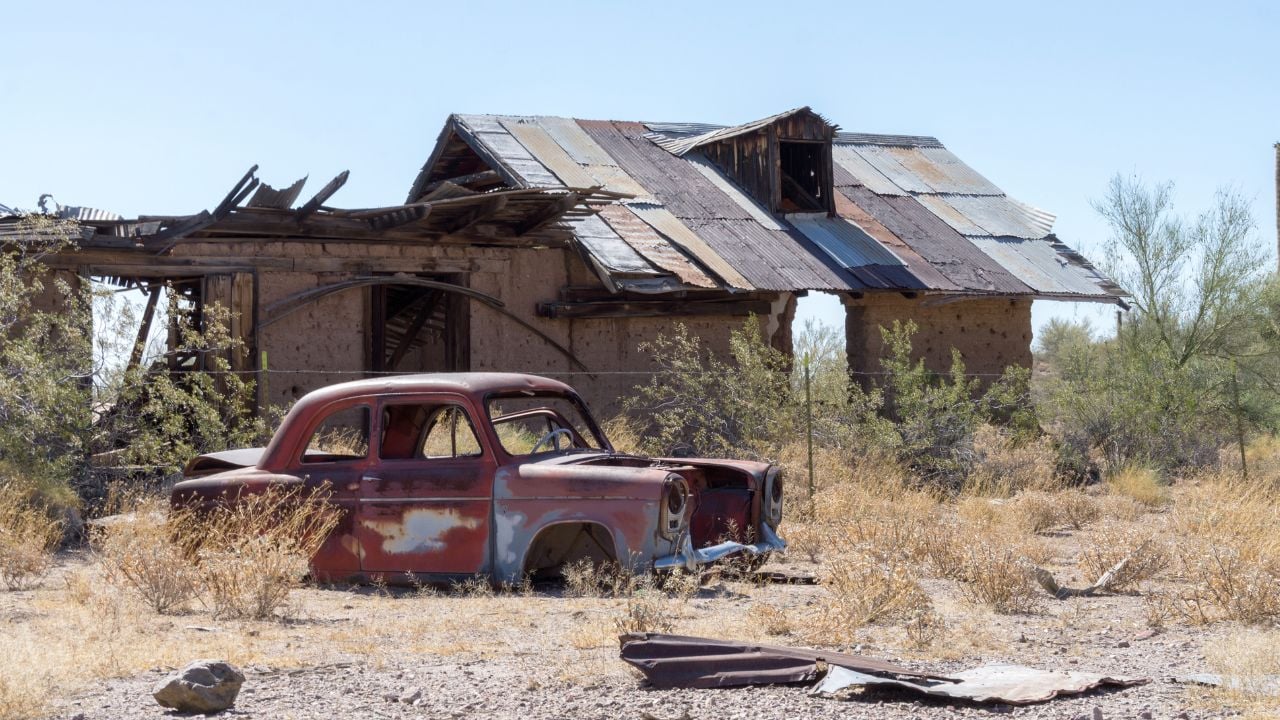
6 Arizona Ghost Towns Arizonans Still Drive Out to See

Some of Arizona’s best road trips end at a town with no one left in it.
Locals still make the drive to walk dusty streets, peek into old buildings and picture who lived there.
Here are the ghost towns worth the trip.
1. Vulture City
Vulture City is the ghost town that grew up around a gold mine Henry Wickenburg discovered in 1863.
The mine stayed active until 1942.
New owners bought the mine in 1970 and ran it as a tourist attraction.
You can walk through more than 18 restored buildings and structures now, including the assay office and Wickenburg’s cabin.
You can try hands-on gold panning and blacksmithing, too.
Many locals treat it as a cool-weather outing.
The Arizona Office of Tourism lists the hours as 9 a.m. to 4 p.m., October through May, with Wednesdays closed.
The Wickenburg Chamber of Commerce lists different days, Thursday through Sunday, with guided tours in the winter months.
Because the listings differ, check the town’s website before you drive out.
The mine is about 12 miles southwest of Wickenburg, so you can stop in town before you head out.
2. Fairbank
A railroad built in 1881 is how Fairbank, now a ghost town on the San Pedro River, got its start.
That line made Fairbank the closest railroad stop to Tombstone.
The Bureau of Land Management (BLM) says you don’t need a four-wheel-drive or high-clearance vehicle to get there.
Its mercantile building operated until the early 1970s.
The agency acquired the land in 1986.
Some visitors make it a day trip along the river.
You can walk Railroad Avenue past that building, then follow a 1.25-mile gravel trail north to the old Grand Central Mill.
The Fairbank cemetery is part of the site, too.
The schoolhouse museum is open Friday through Sunday, plus Monday holidays, from 9:30 a.m. to 4:30 p.m.
Entry is free, and the parking area is open from sunrise to sunset.
3. Castle Dome
The Castle Dome ghost town is 10 miles up a side road that starts at mile marker 55 on Highway 95.
Only the first 3 miles are paved, then the road turns to dirt.
That road crosses Yuma Proving Ground land and Kofa National Wildlife Refuge land before it reaches the museum’s private property.
The refuge lists Castle Dome as one of its major entrances from Highway 95 and asks you to call for current road conditions.
Arizona Highways says the Castle Dome Museum has buildings and artifacts from the area’s mining history, some of them moved when the mountains became part of the refuge.
Once there, you can walk a 1.8-mile tour for $20, with lower prices for children ages 7 to 11 and free entry for kids 6 and under.
The museum bills the place as a glimpse into everyday life in an old mining town.
Visitors often combine it with a trip to Yuma.
The grounds are open daily from October 15 to April 15, 10 a.m. to 5 p.m., except Thanksgiving and Christmas.
Call for summer hours.
4. Swansea
By 1909, the ghost town of Swansea had 500 residents, according to the BLM.
Adobe and brick buildings, the railroad grade, foundations and mine shafts remain.
Those open shafts and tunnels are dangerous, so keep your distance.
Mining in the area began around 1862, and the mines ran until 1937, when the Great Depression closed them for good.
The trip is about 25 miles from either Parker or Bouse, and the graded gravel road gets rough for the last few miles.
A high-clearance vehicle is recommended, but you don’t need four-wheel drive.
It costs nothing to visit.
For current conditions, you can call the BLM’s Lake Havasu Field Office at (928) 505-1200 before you go.
Psst! How much do you know about ghost towns? Take our quiz and see how many you can get right.
Quiz
Ghost Town IQ
Answer these questions about old mining towns and the roads that lead to them. We bet you can’t get them all right. Prove us wrong?
Charleston and Millville grew up around Tombstone’s silver boom. How can you reach what’s left of them today?
5. Courtland
About 2,000 people lived in Courtland, a ghost town on Cochise County's Ghost Town Trail, at its peak.
In its day, Courtland was larger than the other ghost towns on the trail.
Its post office closed in 1942.
Tucson news station KGUN's 2024 guide to the trail called Courtland the most barren of the ghost towns on it.
The old jail is the structure you'll want to find, though it had fallen into disrepair.
The way in is paved roads and a dirt trail.
The Courtland Ghost Town website says the town is closed to the public without prior arrangement and that visits are by advance appointment only.
Guided tours must be booked and paid for at least 24 hours in advance, so book through that site before you drive out.
6. Gleeson
Gleeson is a ghost town about 16 miles east of Tombstone with a 1910 jail that is a museum today.
You can go inside on the first Saturday of each month, from 9 a.m. to 4 p.m.
The jail is at Gleeson Road and High Lonesome Road.
You can call (520) 609-3549 to confirm the hours before you go.
Admission is free, though donations are welcome.
Only five people can be inside at one time.
The Arizona Office of Tourism says what remains of Gleeson is some private ranches, a nearly collapsed general store and an old jail.
Those ranches are private, so respect posted boundaries while you look around.
The jail's listing also points to the old Gleeson School and the Jail Tree, behind the old Bono Store across the road.
Kentucky Camp, a Historic Mining Headquarters
Kentucky Camp, a historic mining site in the Santa Rita Mountains, is a stop some visitors add after seeing the ghost towns.
It was built in 1904 as the headquarters of the Santa Rita Water and Mining Company.
The venture was abandoned after its chief engineer died in 1905.
The property then became a working cattle ranch for the next 50 years.
The Coronado National Forest acquired the site in 1989.
You can still see five century-old adobe buildings there, including a ten-room headquarters.
The Arizona Trail runs through the camp, so hikers, mountain bikers and horseback riders pass through.
You can even rent a three-room adobe building overnight through the Forest Service.
From Tucson, you take Interstate 10 east to State Route 83, then drive south about 21 miles to Gardner Canyon Road.
Turn west onto Gardner Canyon Road, drive about 0.75 mile, then follow Forest Road 163 for about 5 miles to the gate.
Arizona Highways says passenger vehicles can make the drive, though the last 5 miles may be muddy in wet weather.
From the gate, you walk about a quarter mile to the camp.
9 Doorbell Camera Settings Arizonans Should Change Today

The doorbell camera on your front door runs on factory settings until you change them.
The strongest protections sit a few menus deep, and many of them take only a minute to switch on.
9 Doorbell Camera Settings Arizonans Should Change Today
3 Bashas' Deals Arizonans Miss by Shopping the Wrong Day

Some days at Bashas' pay off more than others, and knowing them can save you cash.
A few of those deals come with a catch that's easy to miss.
